

226
M. Kauranen et al.
A drawback of BEM is that the scheme results in a dense and, in general, nonHermitian system matrix, which then leads to quadratic scaling in memory requirements and in the large electrical size limit to cubic scaling in solution time if direct
solvers are used. These scalability issues can be well mitigated by the use of the fast
multipole method [127] or the adaptive cross-approximation method [128], which
can lead to nlog(n) or even linear scaling with respect to the number of unknowns.
A practical difficulty of BEM is that the singular integral kernels require special
treatment, such as singularity subtraction or some regularization such as the Duffy
transform, before the matrix elements can be evaluated accurately by numerical integration.
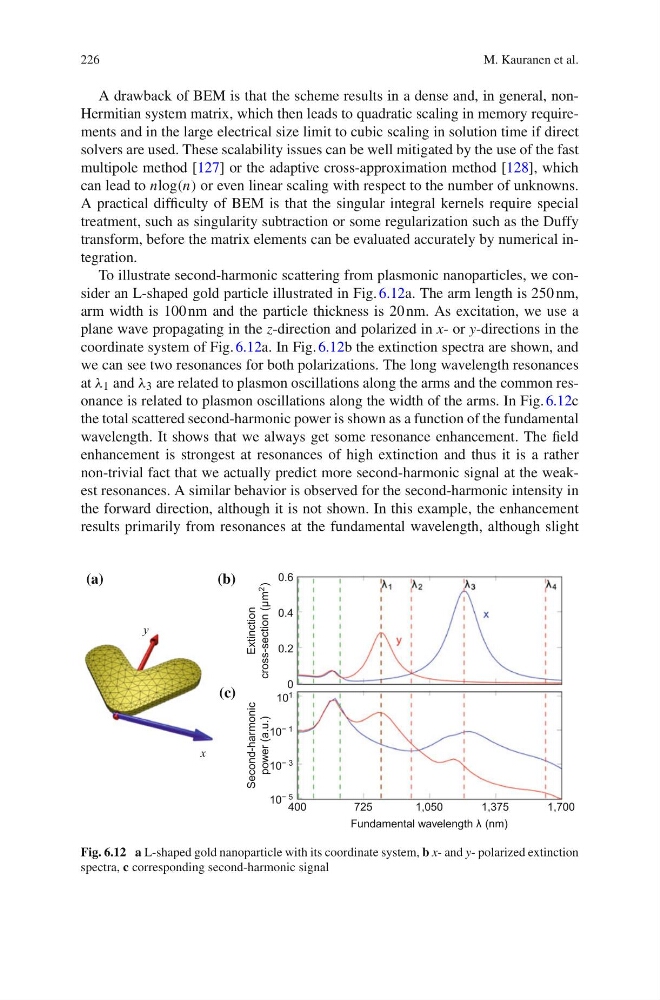
To illustrate second-harmonic scattering from plasmonic nanoparticles, we consider an L-shaped gold particle illustrated in Fig. 6.12a. The arm length is 250 nm,
arm width is 100 nm and the particle thickness is 20 nm. As excitation, we use a
plane wave propagating in the z-direction and polarized in x- or y-directions in the
coordinate system of Fig. 6.12a. In Fig. 6.12b the extinction spectra are shown, and
we can see two resonances for both polarizations. The long wavelength resonances
at λ 1 and λ 3 are related to plasmon oscillations along the arms and the common resonance is related to plasmon oscillations along the width of the arms. In Fig. 6.12c
the total scattered second-harmonic power is shown as a function of the fundamental
wavelength. It shows that we always get some resonance enhancement. The field
enhancement is strongest at resonances of high extinction and thus it is a rather
non-trivial fact that we actually predict more second-harmonic signal at the weakest resonances. A similar behavior is observed for the second-harmonic intensity in
the forward direction, although it is not shown. In this example, the enhancement
results primarily from resonances at the fundamental wavelength, although slight
(a)
(b)
(c)
Fig. 6.12 a L-shaped gold nanoparticle with its coordinate system, b x- and y- polarized extinction
spectra, c corresponding second-harmonic signal
M. Kauranen et al.
A drawback of BEM is that the scheme results in a dense and, in general, nonHermitian system matrix, which then leads to quadratic scaling in memory requirements and in the large electrical size limit to cubic scaling in solution time if direct
solvers are used. These scalability issues can be well mitigated by the use of the fast
multipole method [127] or the adaptive cross-approximation method [128], which
can lead to nlog(n) or even linear scaling with respect to the number of unknowns.
A practical difficulty of BEM is that the singular integral kernels require special
treatment, such as singularity subtraction or some regularization such as the Duffy
transform, before the matrix elements can be evaluated accurately by numerical integration.
To illustrate second-harmonic scattering from plasmonic nanoparticles, we consider an L-shaped gold particle illustrated in Fig. 6.12a. The arm length is 250 nm,
arm width is 100 nm and the particle thickness is 20 nm. As excitation, we use a
plane wave propagating in the z-direction and polarized in x- or y-directions in the
coordinate system of Fig. 6.12a. In Fig. 6.12b the extinction spectra are shown, and
we can see two resonances for both polarizations. The long wavelength resonances
at λ 1 and λ 3 are related to plasmon oscillations along the arms and the common resonance is related to plasmon oscillations along the width of the arms. In Fig. 6.12c
the total scattered second-harmonic power is shown as a function of the fundamental
wavelength. It shows that we always get some resonance enhancement. The field
enhancement is strongest at resonances of high extinction and thus it is a rather
non-trivial fact that we actually predict more second-harmonic signal at the weakest resonances. A similar behavior is observed for the second-harmonic intensity in
the forward direction, although it is not shown. In this example, the enhancement
results primarily from resonances at the fundamental wavelength, although slight
(a)
(b)
(c)
Fig. 6.12 a L-shaped gold nanoparticle with its coordinate system, b x- and y- polarized extinction
spectra, c corresponding second-harmonic signal