

6 Second-Order Nonlinear Optical Properties of Plasmonic Nanostructures
227
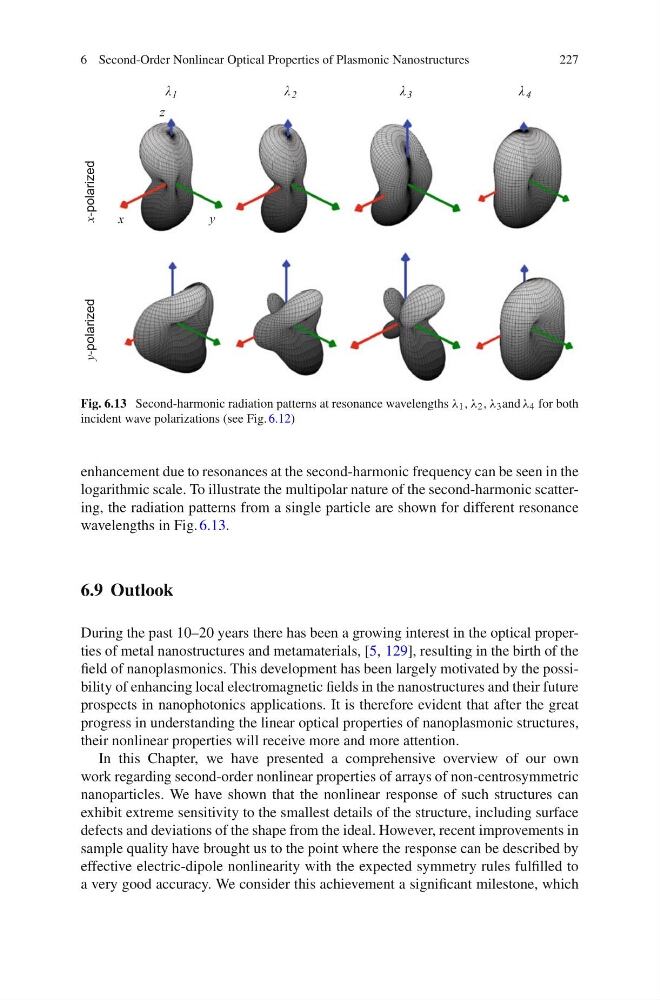
Fig. 6.13 Second-harmonic radiation patterns at resonance wavelengths λ 1 , λ 2 , λ 3 and λ 4 for both
incident wave polarizations (see Fig. 6.12)
enhancement due to resonances at the second-harmonic frequency can be seen in the
logarithmic scale. To illustrate the multipolar nature of the second-harmonic scattering, the radiation patterns from a single particle are shown for different resonance
wavelengths in Fig. 6.13.
6.9 Outlook
During the past 10–20 years there has been a growing interest in the optical properties of metal nanostructures and metamaterials, [5, 129], resulting in the birth of the
field of nanoplasmonics. This development has been largely motivated by the possibility of enhancing local electromagnetic fields in the nanostructures and their future
prospects in nanophotonics applications. It is therefore evident that after the great
progress in understanding the linear optical properties of nanoplasmonic structures,
their nonlinear properties will receive more and more attention.
In this Chapter, we have presented a comprehensive overview of our own
work regarding second-order nonlinear properties of arrays of non-centrosymmetric
nanoparticles. We have shown that the nonlinear response of such structures can
exhibit extreme sensitivity to the smallest details of the structure, including surface
defects and deviations of the shape from the ideal. However, recent improvements in
sample quality have brought us to the point where the response can be described by
effective electric-dipole nonlinearity with the expected symmetry rules fulfilled to
a very good accuracy. We consider this achievement a significant milestone, which
227
Fig. 6.13 Second-harmonic radiation patterns at resonance wavelengths λ 1 , λ 2 , λ 3 and λ 4 for both
incident wave polarizations (see Fig. 6.12)
enhancement due to resonances at the second-harmonic frequency can be seen in the
logarithmic scale. To illustrate the multipolar nature of the second-harmonic scattering, the radiation patterns from a single particle are shown for different resonance
wavelengths in Fig. 6.13.
6.9 Outlook
During the past 10–20 years there has been a growing interest in the optical properties of metal nanostructures and metamaterials, [5, 129], resulting in the birth of the
field of nanoplasmonics. This development has been largely motivated by the possibility of enhancing local electromagnetic fields in the nanostructures and their future
prospects in nanophotonics applications. It is therefore evident that after the great
progress in understanding the linear optical properties of nanoplasmonic structures,
their nonlinear properties will receive more and more attention.
In this Chapter, we have presented a comprehensive overview of our own
work regarding second-order nonlinear properties of arrays of non-centrosymmetric
nanoparticles. We have shown that the nonlinear response of such structures can
exhibit extreme sensitivity to the smallest details of the structure, including surface
defects and deviations of the shape from the ideal. However, recent improvements in
sample quality have brought us to the point where the response can be described by
effective electric-dipole nonlinearity with the expected symmetry rules fulfilled to
a very good accuracy. We consider this achievement a significant milestone, which