

6 Second-Order Nonlinear Optical Properties of Plasmonic Nanostructures
225
popularity in modeling the linear response of plasmonic structures [79, 119–122]. In
our use, BEM has proven to be excellent in terms of accuracy, efficiency and versatility. For our present implementation, we assume that the local nonlinear response
of the metal can be described by the surface susceptibility.
If a bounded domain consists of a homogeneous electromagnetic medium, it turns
out that the electric and magnetic fields are uniquely determined by their tangential
components on the domain boundary surface. Further, a linear mapping from these
surface fields to fields in the whole domain exists. This is facilitated by the StrattonChu equations [123]. The mapping is given by integro-differential operators, which
involve weakly and strongly singular kernels. The result holds even for unbounded
domains, if the fields are required to satisfy the Silver-Müller radiation conditions.
This motivates the use of these integral operators as a base for a numerical method
for obtaining approximate solutions to the scattering problem. The operators are
then used for each domain separately to formulate the problem entirely on compact
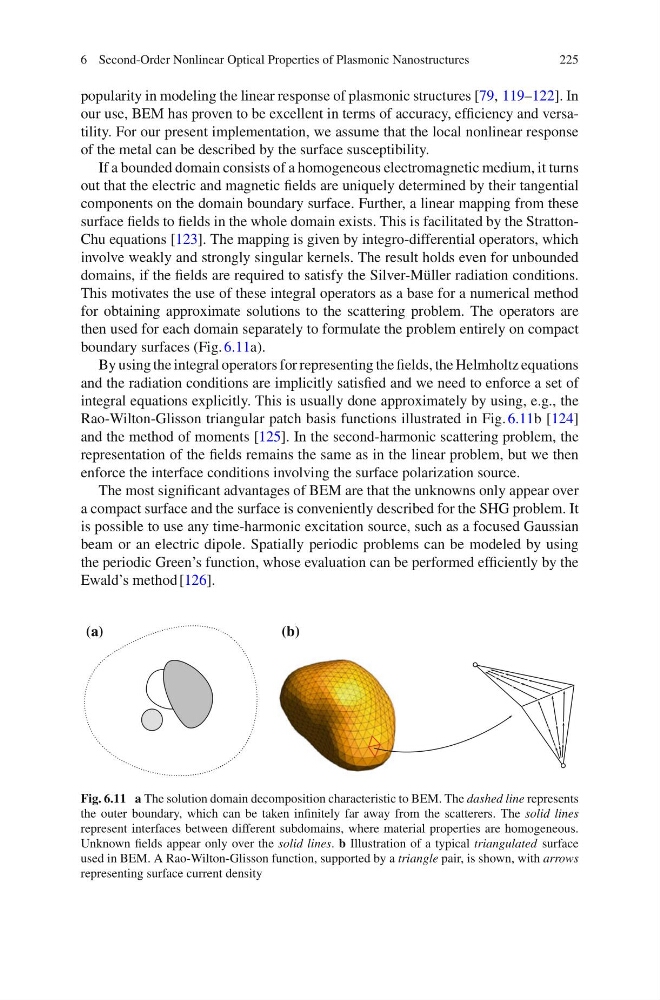
boundary surfaces (Fig. 6.11a).
By using the integral operators for representing the fields, the Helmholtz equations
and the radiation conditions are implicitly satisfied and we need to enforce a set of
integral equations explicitly. This is usually done approximately by using, e.g., the
Rao-Wilton-Glisson triangular patch basis functions illustrated in Fig. 6.11b [124]
and the method of moments [125]. In the second-harmonic scattering problem, the
representation of the fields remains the same as in the linear problem, but we then
enforce the interface conditions involving the surface polarization source.
The most significant advantages of BEM are that the unknowns only appear over
a compact surface and the surface is conveniently described for the SHG problem. It
is possible to use any time-harmonic excitation source, such as a focused Gaussian
beam or an electric dipole. Spatially periodic problems can be modeled by using
the periodic Green’s function, whose evaluation can be performed efficiently by the
Ewald’s method [126].
(a)
(b)
Fig. 6.11 a The solution domain decomposition characteristic to BEM. The dashed line represents
the outer boundary, which can be taken infinitely far away from the scatterers. The solid lines
represent interfaces between different subdomains, where material properties are homogeneous.
Unknown fields appear only over the solid lines. b Illustration of a typical triangulated surface
used in BEM. A Rao-Wilton-Glisson function, supported by a triangle pair, is shown, with arrows
representing surface current density
225
popularity in modeling the linear response of plasmonic structures [79, 119–122]. In
our use, BEM has proven to be excellent in terms of accuracy, efficiency and versatility. For our present implementation, we assume that the local nonlinear response
of the metal can be described by the surface susceptibility.
If a bounded domain consists of a homogeneous electromagnetic medium, it turns
out that the electric and magnetic fields are uniquely determined by their tangential
components on the domain boundary surface. Further, a linear mapping from these
surface fields to fields in the whole domain exists. This is facilitated by the StrattonChu equations [123]. The mapping is given by integro-differential operators, which
involve weakly and strongly singular kernels. The result holds even for unbounded
domains, if the fields are required to satisfy the Silver-Müller radiation conditions.
This motivates the use of these integral operators as a base for a numerical method
for obtaining approximate solutions to the scattering problem. The operators are
then used for each domain separately to formulate the problem entirely on compact
boundary surfaces (Fig. 6.11a).
By using the integral operators for representing the fields, the Helmholtz equations
and the radiation conditions are implicitly satisfied and we need to enforce a set of
integral equations explicitly. This is usually done approximately by using, e.g., the
Rao-Wilton-Glisson triangular patch basis functions illustrated in Fig. 6.11b [124]
and the method of moments [125]. In the second-harmonic scattering problem, the
representation of the fields remains the same as in the linear problem, but we then
enforce the interface conditions involving the surface polarization source.
The most significant advantages of BEM are that the unknowns only appear over
a compact surface and the surface is conveniently described for the SHG problem. It
is possible to use any time-harmonic excitation source, such as a focused Gaussian
beam or an electric dipole. Spatially periodic problems can be modeled by using
the periodic Green’s function, whose evaluation can be performed efficiently by the
Ewald’s method [126].
(a)
(b)
Fig. 6.11 a The solution domain decomposition characteristic to BEM. The dashed line represents
the outer boundary, which can be taken infinitely far away from the scatterers. The solid lines
represent interfaces between different subdomains, where material properties are homogeneous.
Unknown fields appear only over the solid lines. b Illustration of a typical triangulated surface
used in BEM. A Rao-Wilton-Glisson function, supported by a triangle pair, is shown, with arrows
representing surface current density