

6 Second-Order Nonlinear Optical Properties of Plasmonic Nanostructures
221
the future. As a first demonstration of this possibility, we have utilized arrays of
high-quality L-shaped gold nanoparticles and introduced a new concept for tuning
the optical properties of plasmonic samples.
Our approach is based on so-called resonance-domain effects, where the period of
the structure is of the order of wavelength. In contrast to effective medium samples,
where the period must be much smaller than wavelength, the resonance-domain effects allow diffractive coupling between the individual units even when no diffraction
orders propagate in free space. By proper design, such effects can be very useful as
an additional parameter for tailoring the optical properties of plasmonic arrays. They
can lead to spectral narrowing and enhancement of the plasmonic resonances [6–12].
Similar effect has been observed also for purely dielectric structures [89, 90].
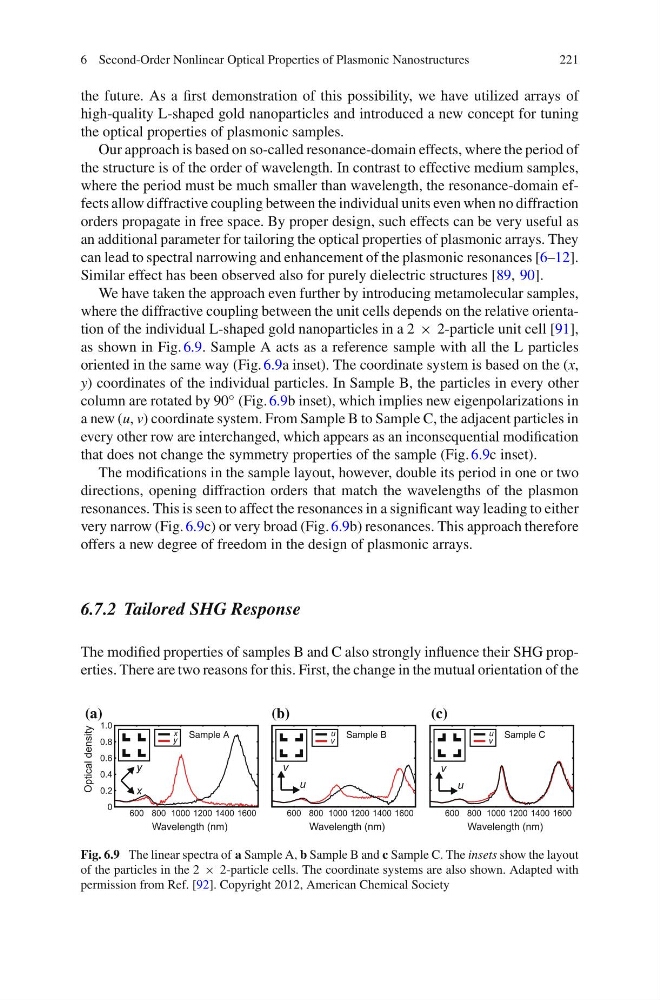
We have taken the approach even further by introducing metamolecular samples,
where the diffractive coupling between the unit cells depends on the relative orientation of the individual L-shaped gold nanoparticles in a 2 × 2-particle unit cell [91],
as shown in Fig. 6.9. Sample A acts as a reference sample with all the L particles
oriented in the same way (Fig. 6.9a inset). The coordinate system is based on the (x,
y) coordinates of the individual particles. In Sample B, the particles in every other
column are rotated by 90 ◦ (Fig. 6.9b inset), which implies new eigenpolarizations in
a new (u, v) coordinate system. From Sample B to Sample C, the adjacent particles in
every other row are interchanged, which appears as an inconsequential modification
that does not change the symmetry properties of the sample (Fig. 6.9c inset).
The modifications in the sample layout, however, double its period in one or two
directions, opening diffraction orders that match the wavelengths of the plasmon
resonances. This is seen to affect the resonances in a significant way leading to either
very narrow (Fig. 6.9c) or very broad (Fig. 6.9b) resonances. This approach therefore
offers a new degree of freedom in the design of plasmonic arrays.
6.7.2 Tailored SHG Response
The modified properties of samples B and C also strongly influence their SHG properties. There are two reasons for this. First, the change in the mutual orientation of the
Sample A
Sample B
Sample C
(a)
(b)
(c)
Fig. 6.9 The linear spectra of a Sample A, b Sample B and c Sample C. The insets show the layout
of the particles in the 2 × 2-particle cells. The coordinate systems are also shown. Adapted with
permission from Ref. [92]. Copyright 2012, American Chemical Society
221
the future. As a first demonstration of this possibility, we have utilized arrays of
high-quality L-shaped gold nanoparticles and introduced a new concept for tuning
the optical properties of plasmonic samples.
Our approach is based on so-called resonance-domain effects, where the period of
the structure is of the order of wavelength. In contrast to effective medium samples,
where the period must be much smaller than wavelength, the resonance-domain effects allow diffractive coupling between the individual units even when no diffraction
orders propagate in free space. By proper design, such effects can be very useful as
an additional parameter for tailoring the optical properties of plasmonic arrays. They
can lead to spectral narrowing and enhancement of the plasmonic resonances [6–12].
Similar effect has been observed also for purely dielectric structures [89, 90].
We have taken the approach even further by introducing metamolecular samples,
where the diffractive coupling between the unit cells depends on the relative orientation of the individual L-shaped gold nanoparticles in a 2 × 2-particle unit cell [91],
as shown in Fig. 6.9. Sample A acts as a reference sample with all the L particles
oriented in the same way (Fig. 6.9a inset). The coordinate system is based on the (x,
y) coordinates of the individual particles. In Sample B, the particles in every other
column are rotated by 90 ◦ (Fig. 6.9b inset), which implies new eigenpolarizations in
a new (u, v) coordinate system. From Sample B to Sample C, the adjacent particles in
every other row are interchanged, which appears as an inconsequential modification
that does not change the symmetry properties of the sample (Fig. 6.9c inset).
The modifications in the sample layout, however, double its period in one or two
directions, opening diffraction orders that match the wavelengths of the plasmon
resonances. This is seen to affect the resonances in a significant way leading to either
very narrow (Fig. 6.9c) or very broad (Fig. 6.9b) resonances. This approach therefore
offers a new degree of freedom in the design of plasmonic arrays.
6.7.2 Tailored SHG Response
The modified properties of samples B and C also strongly influence their SHG properties. There are two reasons for this. First, the change in the mutual orientation of the
Sample A
Sample B
Sample C
(a)
(b)
(c)
Fig. 6.9 The linear spectra of a Sample A, b Sample B and c Sample C. The insets show the layout
of the particles in the 2 × 2-particle cells. The coordinate systems are also shown. Adapted with
permission from Ref. [92]. Copyright 2012, American Chemical Society