

220
M. Kauranen et al.
6.6.2 Dipole Limit
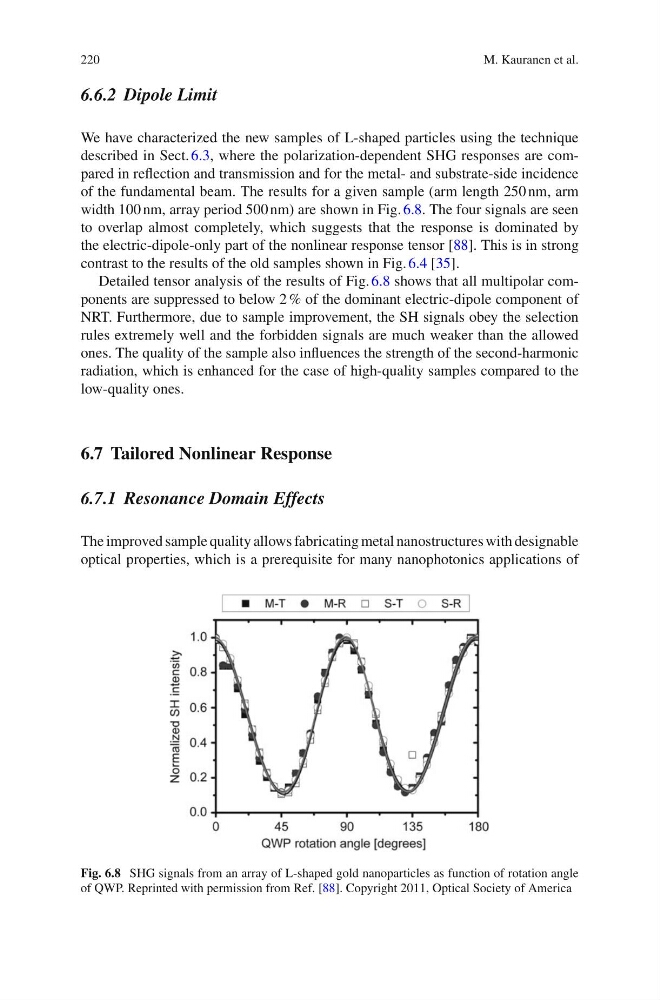
We have characterized the new samples of L-shaped particles using the technique
described in Sect. 6.3, where the polarization-dependent SHG responses are compared in reflection and transmission and for the metal- and substrate-side incidence
of the fundamental beam. The results for a given sample (arm length 250 nm, arm
width 100 nm, array period 500 nm) are shown in Fig. 6.8. The four signals are seen
to overlap almost completely, which suggests that the response is dominated by
the electric-dipole-only part of the nonlinear response tensor [88]. This is in strong
contrast to the results of the old samples shown in Fig. 6.4 [35].
Detailed tensor analysis of the results of Fig. 6.8 shows that all multipolar components are suppressed to below 2 % of the dominant electric-dipole component of
NRT. Furthermore, due to sample improvement, the SH signals obey the selection
rules extremely well and the forbidden signals are much weaker than the allowed
ones. The quality of the sample also influences the strength of the second-harmonic
radiation, which is enhanced for the case of high-quality samples compared to the
low-quality ones.
6.7 Tailored Nonlinear Response
6.7.1 Resonance Domain Effects
The improved sample quality allows fabricating metal nanostructures with designable
optical properties, which is a prerequisite for many nanophotonics applications of
Fig. 6.8 SHG signals from an array of L-shaped gold nanoparticles as function of rotation angle
of QWP. Reprinted with permission from Ref. [88]. Copyright 2011, Optical Society of America
M. Kauranen et al.
6.6.2 Dipole Limit
We have characterized the new samples of L-shaped particles using the technique
described in Sect. 6.3, where the polarization-dependent SHG responses are compared in reflection and transmission and for the metal- and substrate-side incidence
of the fundamental beam. The results for a given sample (arm length 250 nm, arm
width 100 nm, array period 500 nm) are shown in Fig. 6.8. The four signals are seen
to overlap almost completely, which suggests that the response is dominated by
the electric-dipole-only part of the nonlinear response tensor [88]. This is in strong
contrast to the results of the old samples shown in Fig. 6.4 [35].
Detailed tensor analysis of the results of Fig. 6.8 shows that all multipolar components are suppressed to below 2 % of the dominant electric-dipole component of
NRT. Furthermore, due to sample improvement, the SH signals obey the selection
rules extremely well and the forbidden signals are much weaker than the allowed
ones. The quality of the sample also influences the strength of the second-harmonic
radiation, which is enhanced for the case of high-quality samples compared to the
low-quality ones.
6.7 Tailored Nonlinear Response
6.7.1 Resonance Domain Effects
The improved sample quality allows fabricating metal nanostructures with designable
optical properties, which is a prerequisite for many nanophotonics applications of
Fig. 6.8 SHG signals from an array of L-shaped gold nanoparticles as function of rotation angle
of QWP. Reprinted with permission from Ref. [88]. Copyright 2011, Optical Society of America