

212
M. Kauranen et al.
Independent of which multipole effects play a role, the tensor components forbidden by symmetry vanish for a perfectly ideal particle. The real samples, however,
always have imperfections, which leads to nonvanishing of these ideally forbidden
components. For high-quality samples, those components are expected to remain
weak. The magnitude of the forbidden components can thus be used as a measure of
sample quality.
6.3 Experimental Techniques
6.3.1 Samples and Fabrication
The samples studied in our work consist of square arrays of T- and L-shaped gold
nanoparticles or nanodimers fabricated on a fused silica substrate by the common
electron-beam lithography and lift-off techniques. The thickness of the nanoparticles
is 20 nm and there is a thin (typically 5 nm) adhesion layer of chromium between the
substrate and gold. In addition, the samples are covered by a 20 nm thick protective
layer of silica. The other sample dimensions, such as the length and width of different
parts of the particles, are varied between different samples, and the array period is
either 400 or 500 nm.
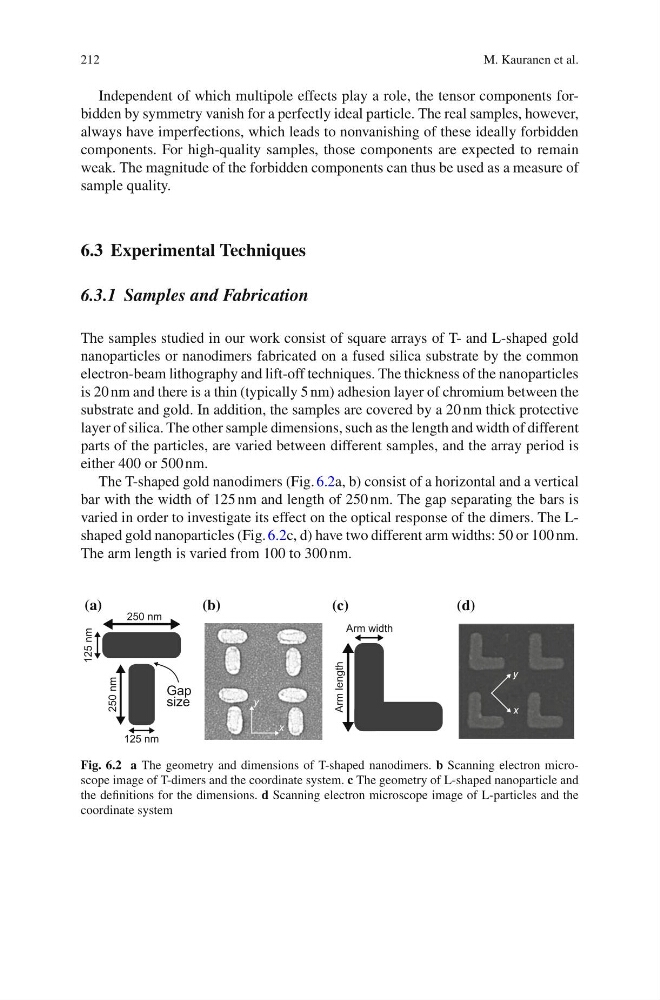
The T-shaped gold nanodimers (Fig. 6.2a, b) consist of a horizontal and a vertical
bar with the width of 125 nm and length of 250 nm. The gap separating the bars is
varied in order to investigate its effect on the optical response of the dimers. The Lshaped gold nanoparticles (Fig. 6.2c, d) have two different arm widths: 50 or 100 nm.
The arm length is varied from 100 to 300 nm.
(a)
(b)
(c)
(d)
Fig. 6.2 a The geometry and dimensions of T-shaped nanodimers. b Scanning electron microscope image of T-dimers and the coordinate system. c The geometry of L-shaped nanoparticle and
the definitions for the dimensions. d Scanning electron microscope image of L-particles and the
coordinate system
M. Kauranen et al.
Independent of which multipole effects play a role, the tensor components forbidden by symmetry vanish for a perfectly ideal particle. The real samples, however,
always have imperfections, which leads to nonvanishing of these ideally forbidden
components. For high-quality samples, those components are expected to remain
weak. The magnitude of the forbidden components can thus be used as a measure of
sample quality.
6.3 Experimental Techniques
6.3.1 Samples and Fabrication
The samples studied in our work consist of square arrays of T- and L-shaped gold
nanoparticles or nanodimers fabricated on a fused silica substrate by the common
electron-beam lithography and lift-off techniques. The thickness of the nanoparticles
is 20 nm and there is a thin (typically 5 nm) adhesion layer of chromium between the
substrate and gold. In addition, the samples are covered by a 20 nm thick protective
layer of silica. The other sample dimensions, such as the length and width of different
parts of the particles, are varied between different samples, and the array period is
either 400 or 500 nm.
The T-shaped gold nanodimers (Fig. 6.2a, b) consist of a horizontal and a vertical
bar with the width of 125 nm and length of 250 nm. The gap separating the bars is
varied in order to investigate its effect on the optical response of the dimers. The Lshaped gold nanoparticles (Fig. 6.2c, d) have two different arm widths: 50 or 100 nm.
The arm length is varied from 100 to 300 nm.
(a)
(b)
(c)
(d)
Fig. 6.2 a The geometry and dimensions of T-shaped nanodimers. b Scanning electron microscope image of T-dimers and the coordinate system. c The geometry of L-shaped nanoparticle and
the definitions for the dimensions. d Scanning electron microscope image of L-particles and the
coordinate system