

198
F. Vallée and N. Del Fatti
similar features as that for a spheroid Fig. 5.9c, showing in particular the same timedependent spectral features due to change with time of the dominant nonlinearity
around its longitudinal SPR.
The spectral shape, temporal behavior, and amplitude of the nonlinearity are in
excellent agreement with measurements performed in individual gold nanorod using
time-resolved spectroscopy [38]. In these experiments, the investigated nanorod
extinction cross-section and orientation on a substrate is first quantitatively determined monitoring the loss of energy of a tightly focused light beam while modulating the nanoparticle position (Spatial Modulation Spectroscopy, SMS) [131, 136].
The amount of energy absorbed by the particle, or equivalently the peak electron
temperature rise ωT me
e , can thus be precisely determined, permitting quantitative
comparison of the experimental and theoretical results using Eq. 5.50 [38].
5.5.3 Plasmonic Material: Ensemble of Metal Nanoparticles
Many plasmonic materials are formed by metal nanoparticles dispersed in a solid or
liquid dielectric matrix. Assuming homogeneous properties over a size smaller than
the optical wavelength, the linear optical response of the composite material can be
described defining an effective linear dielectric function ˜
ε L (ω) taking into account
the polarizability of the nanoparticles and host material. The main difficulty is to
properly define this connection, i.e., to link ˜
ε L to ε, ε d , V np and to the density of
nanoparticle N np . This can be easily done if N np is sufficiently small to neglect particle interactions. For small nanoparticles whose individual response can be described
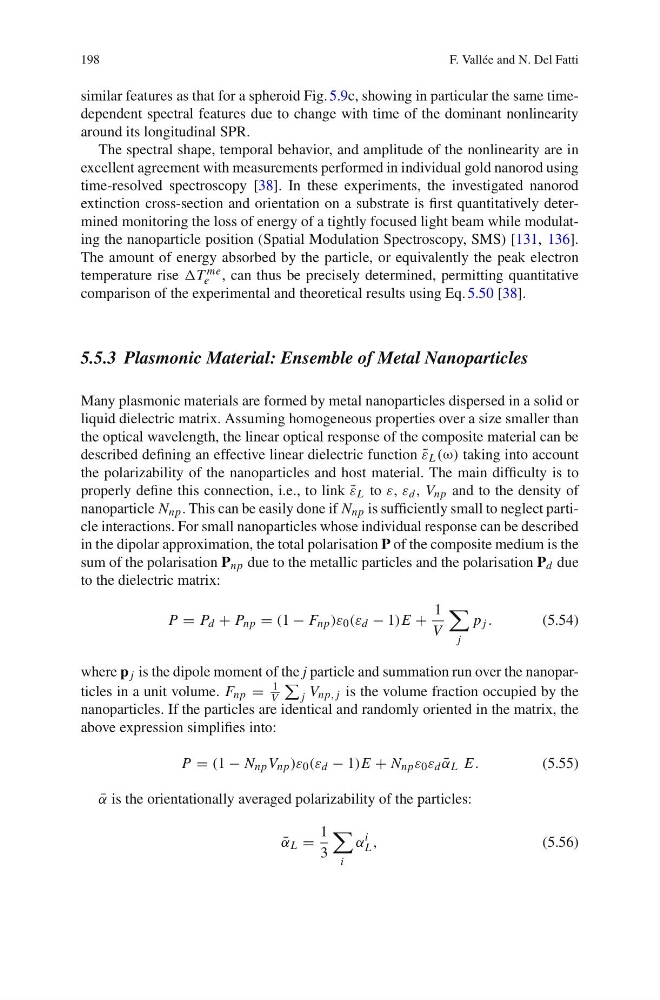
in the dipolar approximation, the total polarisation P of the composite medium is the
sum of the polarisation P np due to the metallic particles and the polarisation P d due
to the dielectric matrix:
P = P d + P np = (1 − F np )ε 0 (ε d − 1)E +
1
V
j
p j .
(5.54)
where p j is the dipole moment of the j particle and summation run over the nanoparticles in a unit volume. F np =
1
V
j V np, j is the volume fraction occupied by the
nanoparticles. If the particles are identical and randomly oriented in the matrix, the
above expression simplifies into:
P = (1 − N np V np )ε 0 (ε d − 1)E + N np ε 0 ε d ¯
β L E.
(5.55)
¯
β is the orientationally averaged polarizability of the particles:
¯
β L =
1
3
i
β
i
L ,
(5.56)
F. Vallée and N. Del Fatti
similar features as that for a spheroid Fig. 5.9c, showing in particular the same timedependent spectral features due to change with time of the dominant nonlinearity
around its longitudinal SPR.
The spectral shape, temporal behavior, and amplitude of the nonlinearity are in
excellent agreement with measurements performed in individual gold nanorod using
time-resolved spectroscopy [38]. In these experiments, the investigated nanorod
extinction cross-section and orientation on a substrate is first quantitatively determined monitoring the loss of energy of a tightly focused light beam while modulating the nanoparticle position (Spatial Modulation Spectroscopy, SMS) [131, 136].
The amount of energy absorbed by the particle, or equivalently the peak electron
temperature rise ωT me
e , can thus be precisely determined, permitting quantitative
comparison of the experimental and theoretical results using Eq. 5.50 [38].
5.5.3 Plasmonic Material: Ensemble of Metal Nanoparticles
Many plasmonic materials are formed by metal nanoparticles dispersed in a solid or
liquid dielectric matrix. Assuming homogeneous properties over a size smaller than
the optical wavelength, the linear optical response of the composite material can be
described defining an effective linear dielectric function ˜
ε L (ω) taking into account
the polarizability of the nanoparticles and host material. The main difficulty is to
properly define this connection, i.e., to link ˜
ε L to ε, ε d , V np and to the density of
nanoparticle N np . This can be easily done if N np is sufficiently small to neglect particle interactions. For small nanoparticles whose individual response can be described
in the dipolar approximation, the total polarisation P of the composite medium is the
sum of the polarisation P np due to the metallic particles and the polarisation P d due
to the dielectric matrix:
P = P d + P np = (1 − F np )ε 0 (ε d − 1)E +
1
V
j
p j .
(5.54)
where p j is the dipole moment of the j particle and summation run over the nanoparticles in a unit volume. F np =
1
V
j V np, j is the volume fraction occupied by the
nanoparticles. If the particles are identical and randomly oriented in the matrix, the
above expression simplifies into:
P = (1 − N np V np )ε 0 (ε d − 1)E + N np ε 0 ε d ¯
β L E.
(5.55)
¯
β is the orientationally averaged polarizability of the particles:
¯
β L =
1
3
i
β
i
L ,
(5.56)