

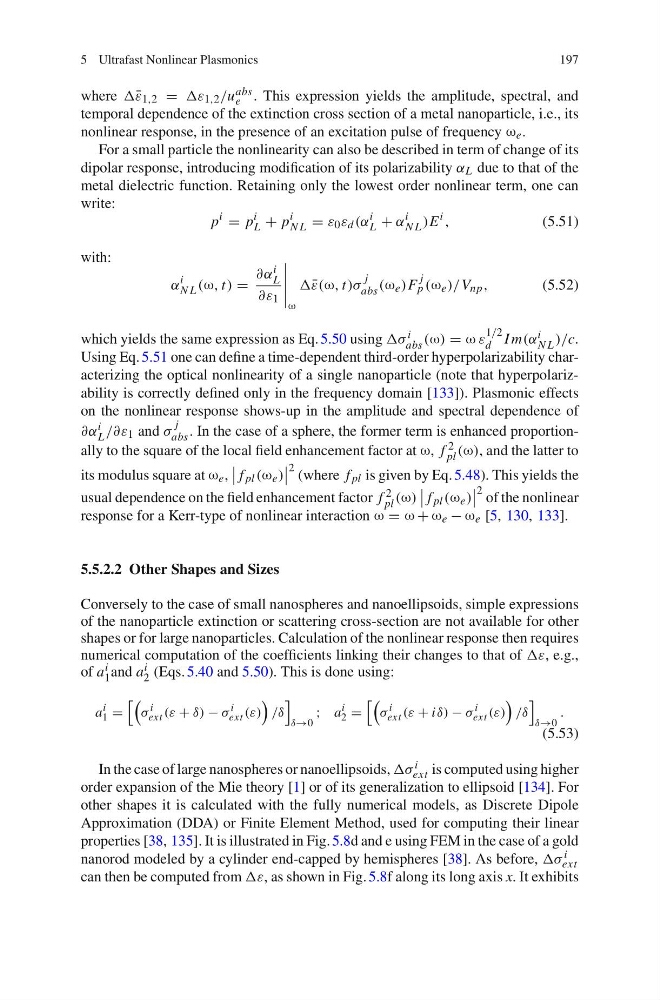
5 Ultrafast Nonlinear Plasmonics
197
where ω¯ ε 1,2 = ωε 1,2 /u abs
e . This expression yields the amplitude, spectral, and
temporal dependence of the extinction cross section of a metal nanoparticle, i.e., its
nonlinear response, in the presence of an excitation pulse of frequency ω e .
For a small particle the nonlinearity can also be described in term of change of its
dipolar response, introducing modification of its polarizability β L due to that of the
metal dielectric function. Retaining only the lowest order nonlinear term, one can
write:
p
i
= p
i
L + p
i
N L = ε 0 ε d (β
i
L + β
i
N L )E
i
,
(5.51)
with:
β
i
N L (ω, t) =
γβ i
L
γε 1
ω
ω¯ ε(ω, t)η
j
abs (ω e )F
j
p (ω e )/V np ,
(5.52)
which yields the same expression as Eq. 5.50 using ωη i
abs (ω) = ω ε
1/2
d I m(β i
N L )/c.
Using Eq. 5.51 one can define a time-dependent third-order hyperpolarizability characterizing the optical nonlinearity of a single nanoparticle (note that hyperpolarizability is correctly defined only in the frequency domain [133]). Plasmonic effects
on the nonlinear response shows-up in the amplitude and spectral dependence of
γβ i
L /γε 1 and η
j
abs . In the case of a sphere, the former term is enhanced proportionally to the square of the local field enhancement factor at ω, f 2
pl (ω), and the latter to
its modulus square at ω e ,
f pl (ω e )
2 (where f pl is given by Eq. 5.48). This yields the
usual dependence on the field enhancement factor f 2
pl (ω)
f pl (ω e )
2 of the nonlinear
response for a Kerr-type of nonlinear interaction ω = ω + ω e − ω e [5, 130, 133].
5.5.2.2 Other Shapes and Sizes
Conversely to the case of small nanospheres and nanoellipsoids, simple expressions
of the nanoparticle extinction or scattering cross-section are not available for other
shapes or for large nanoparticles. Calculation of the nonlinear response then requires
numerical computation of the coefficients linking their changes to that of ωε, e.g.,
of a i
1 and a i
2 (Eqs. 5.40 and 5.50). This is done using:
a
i
1 =
η
i
ext (ε + ∂) − η
i
ext (ε)
/∂
∂→0
; a
i
2 =
η
i
ext (ε + i∂) − η
i
ext (ε)
/∂
∂→0
.
(5.53)
In the case of large nanospheres or nanoellipsoids, ωη i
ext is computed using higher
order expansion of the Mie theory [1] or of its generalization to ellipsoid [134]. For
other shapes it is calculated with the fully numerical models, as Discrete Dipole
Approximation (DDA) or Finite Element Method, used for computing their linear
properties [38, 135]. It is illustrated in Fig. 5.8d and e using FEM in the case of a gold
nanorod modeled by a cylinder end-capped by hemispheres [38]. As before, ωη i
ext
can then be computed from ωε, as shown in Fig. 5.8f along its long axis x. It exhibits
197
where ω¯ ε 1,2 = ωε 1,2 /u abs
e . This expression yields the amplitude, spectral, and
temporal dependence of the extinction cross section of a metal nanoparticle, i.e., its
nonlinear response, in the presence of an excitation pulse of frequency ω e .
For a small particle the nonlinearity can also be described in term of change of its
dipolar response, introducing modification of its polarizability β L due to that of the
metal dielectric function. Retaining only the lowest order nonlinear term, one can
write:
p
i
= p
i
L + p
i
N L = ε 0 ε d (β
i
L + β
i
N L )E
i
,
(5.51)
with:
β
i
N L (ω, t) =
γβ i
L
γε 1
ω
ω¯ ε(ω, t)η
j
abs (ω e )F
j
p (ω e )/V np ,
(5.52)
which yields the same expression as Eq. 5.50 using ωη i
abs (ω) = ω ε
1/2
d I m(β i
N L )/c.
Using Eq. 5.51 one can define a time-dependent third-order hyperpolarizability characterizing the optical nonlinearity of a single nanoparticle (note that hyperpolarizability is correctly defined only in the frequency domain [133]). Plasmonic effects
on the nonlinear response shows-up in the amplitude and spectral dependence of
γβ i
L /γε 1 and η
j
abs . In the case of a sphere, the former term is enhanced proportionally to the square of the local field enhancement factor at ω, f 2
pl (ω), and the latter to
its modulus square at ω e ,
f pl (ω e )
2 (where f pl is given by Eq. 5.48). This yields the
usual dependence on the field enhancement factor f 2
pl (ω)
f pl (ω e )
2 of the nonlinear
response for a Kerr-type of nonlinear interaction ω = ω + ω e − ω e [5, 130, 133].
5.5.2.2 Other Shapes and Sizes
Conversely to the case of small nanospheres and nanoellipsoids, simple expressions
of the nanoparticle extinction or scattering cross-section are not available for other
shapes or for large nanoparticles. Calculation of the nonlinear response then requires
numerical computation of the coefficients linking their changes to that of ωε, e.g.,
of a i
1 and a i
2 (Eqs. 5.40 and 5.50). This is done using:
a
i
1 =
η
i
ext (ε + ∂) − η
i
ext (ε)
/∂
∂→0
; a
i
2 =
η
i
ext (ε + i∂) − η
i
ext (ε)
/∂
∂→0
.
(5.53)
In the case of large nanospheres or nanoellipsoids, ωη i
ext is computed using higher
order expansion of the Mie theory [1] or of its generalization to ellipsoid [134]. For
other shapes it is calculated with the fully numerical models, as Discrete Dipole
Approximation (DDA) or Finite Element Method, used for computing their linear
properties [38, 135]. It is illustrated in Fig. 5.8d and e using FEM in the case of a gold
nanorod modeled by a cylinder end-capped by hemispheres [38]. As before, ωη i
ext
can then be computed from ωε, as shown in Fig. 5.8f along its long axis x. It exhibits