

5 Ultrafast Nonlinear Plasmonics
199
where β i
L is the linear polarizability of one particle along its main axis i (Eq. 5.51).
The effective dielectric constant ˜
ε is then obtained using ˜
ε L ε 0 E = ε 0 E + P yielding
for small metal volume fraction [5]:
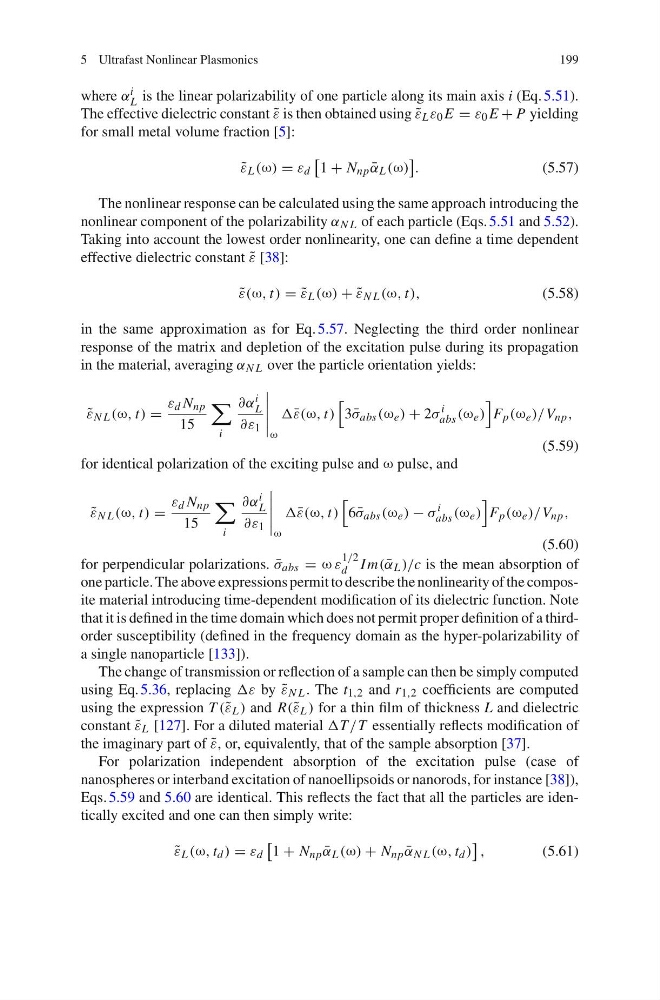
˜
ε L (ω) = ε d
1 + N np ¯
β L (ω)
.
(5.57)
The nonlinear response can be calculated using the same approach introducing the
nonlinear component of the polarizability β N L of each particle (Eqs. 5.51 and 5.52).
Taking into account the lowest order nonlinearity, one can define a time dependent
effective dielectric constant ˜
ε [38]:
˜
ε(ω, t) = ˜
ε L (ω) + ˜
ε N L (ω, t),
(5.58)
in the same approximation as for Eq. 5.57. Neglecting the third order nonlinear
response of the matrix and depletion of the excitation pulse during its propagation
in the material, averaging β N L over the particle orientation yields:
˜
ε N L (ω, t) =
ε d N np
15
i
γβ i
L
γε 1
ω
ω¯ ε(ω, t)
3 ¯
η abs (ω e ) + 2η
i
abs (ω e )
F p (ω e )/V np ,
(5.59)
for identical polarization of the exciting pulse and ω pulse, and
˜
ε N L (ω, t) =
ε d N np
15
i
γβ i
L
γε 1
ω
ω¯ ε(ω, t)
6 ¯
η abs (ω e ) − η
i
abs (ω e )
F p (ω e )/V np ,
(5.60)
for perpendicular polarizations. ¯
η abs = ω ε
1/2
d I m( ¯
β L )/c is the mean absorption of
one particle. The above expressions permit to describe the nonlinearity of the composite material introducing time-dependent modification of its dielectric function. Note
that it is defined in the time domain which does not permit proper definition of a thirdorder susceptibility (defined in the frequency domain as the hyper-polarizability of
a single nanoparticle [133]).
The change of transmission or reflection of a sample can then be simply computed
using Eq. 5.36, replacing ωε by ˜
ε N L . The t 1,2 and r 1,2 coefficients are computed
using the expression T (˜ ε L ) and R(˜ ε L ) for a thin film of thickness L and dielectric
constant ˜
ε L [127]. For a diluted material ωT /T essentially reflects modification of
the imaginary part of ˜
ε, or, equivalently, that of the sample absorption [37].
For polarization independent absorption of the excitation pulse (case of
nanospheres or interband excitation of nanoellipsoids or nanorods, for instance [38]),
Eqs. 5.59 and 5.60 are identical. This reflects the fact that all the particles are identically excited and one can then simply write:
˜
ε L (ω, t d ) = ε d
1 + N np ¯
β L (ω) + N np ¯
β N L (ω, t d )
,
(5.61)
199
where β i
L is the linear polarizability of one particle along its main axis i (Eq. 5.51).
The effective dielectric constant ˜
ε is then obtained using ˜
ε L ε 0 E = ε 0 E + P yielding
for small metal volume fraction [5]:
˜
ε L (ω) = ε d
1 + N np ¯
β L (ω)
.
(5.57)
The nonlinear response can be calculated using the same approach introducing the
nonlinear component of the polarizability β N L of each particle (Eqs. 5.51 and 5.52).
Taking into account the lowest order nonlinearity, one can define a time dependent
effective dielectric constant ˜
ε [38]:
˜
ε(ω, t) = ˜
ε L (ω) + ˜
ε N L (ω, t),
(5.58)
in the same approximation as for Eq. 5.57. Neglecting the third order nonlinear
response of the matrix and depletion of the excitation pulse during its propagation
in the material, averaging β N L over the particle orientation yields:
˜
ε N L (ω, t) =
ε d N np
15
i
γβ i
L
γε 1
ω
ω¯ ε(ω, t)
3 ¯
η abs (ω e ) + 2η
i
abs (ω e )
F p (ω e )/V np ,
(5.59)
for identical polarization of the exciting pulse and ω pulse, and
˜
ε N L (ω, t) =
ε d N np
15
i
γβ i
L
γε 1
ω
ω¯ ε(ω, t)
6 ¯
η abs (ω e ) − η
i
abs (ω e )
F p (ω e )/V np ,
(5.60)
for perpendicular polarizations. ¯
η abs = ω ε
1/2
d I m( ¯
β L )/c is the mean absorption of
one particle. The above expressions permit to describe the nonlinearity of the composite material introducing time-dependent modification of its dielectric function. Note
that it is defined in the time domain which does not permit proper definition of a thirdorder susceptibility (defined in the frequency domain as the hyper-polarizability of
a single nanoparticle [133]).
The change of transmission or reflection of a sample can then be simply computed
using Eq. 5.36, replacing ωε by ˜
ε N L . The t 1,2 and r 1,2 coefficients are computed
using the expression T (˜ ε L ) and R(˜ ε L ) for a thin film of thickness L and dielectric
constant ˜
ε L [127]. For a diluted material ωT /T essentially reflects modification of
the imaginary part of ˜
ε, or, equivalently, that of the sample absorption [37].
For polarization independent absorption of the excitation pulse (case of
nanospheres or interband excitation of nanoellipsoids or nanorods, for instance [38]),
Eqs. 5.59 and 5.60 are identical. This reflects the fact that all the particles are identically excited and one can then simply write:
˜
ε L (ω, t d ) = ε d
1 + N np ¯
β L (ω) + N np ¯
β N L (ω, t d )
,
(5.61)