

5 Ultrafast Nonlinear Plasmonics
181
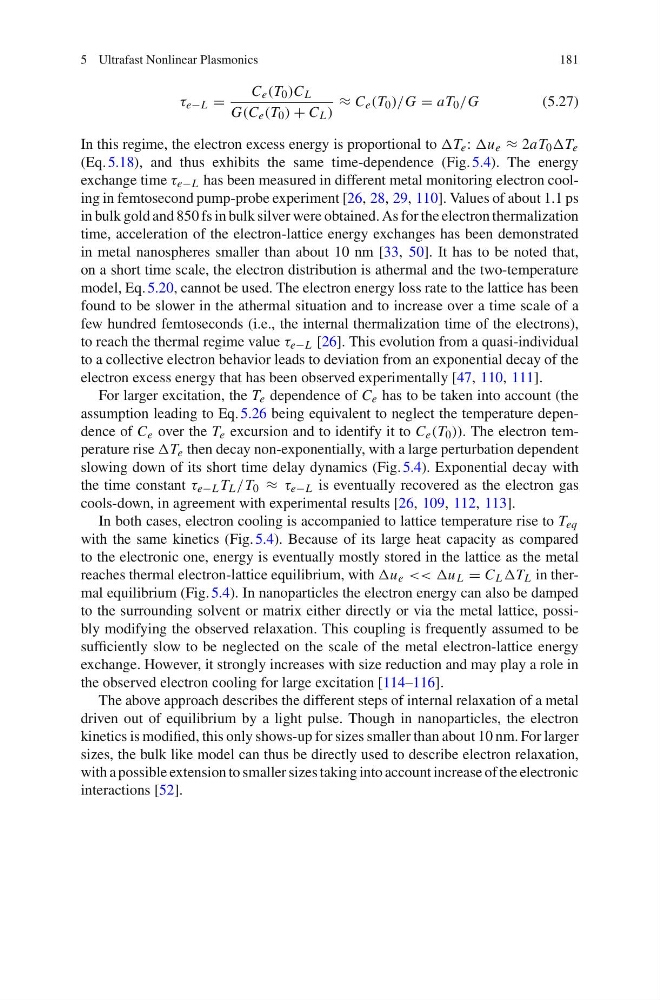
α e−L =
C e (T 0 )C L
G(C e (T 0 ) + C L )
≈ C e (T 0 )/G = aT 0 /G
(5.27)
In this regime, the electron excess energy is proportional to ωT e : ωu e ≈ 2aT 0 ωT e
(Eq. 5.18), and thus exhibits the same time-dependence (Fig. 5.4). The energy
exchange time α e−L has been measured in different metal monitoring electron cooling in femtosecond pump-probe experiment [26, 28, 29, 110]. Values of about 1.1 ps
in bulk gold and 850 fs in bulk silver were obtained. As for the electron thermalization
time, acceleration of the electron-lattice energy exchanges has been demonstrated
in metal nanospheres smaller than about 10 nm [33, 50]. It has to be noted that,
on a short time scale, the electron distribution is athermal and the two-temperature
model, Eq. 5.20, cannot be used. The electron energy loss rate to the lattice has been
found to be slower in the athermal situation and to increase over a time scale of a
few hundred femtoseconds (i.e., the internal thermalization time of the electrons),
to reach the thermal regime value α e−L [26]. This evolution from a quasi-individual
to a collective electron behavior leads to deviation from an exponential decay of the
electron excess energy that has been observed experimentally [47, 110, 111].
For larger excitation, the T e dependence of C e has to be taken into account (the
assumption leading to Eq. 5.26 being equivalent to neglect the temperature dependence of C e over the T e excursion and to identify it to C e (T 0 )). The electron temperature rise ωT e then decay non-exponentially, with a large perturbation dependent
slowing down of its short time delay dynamics (Fig. 5.4). Exponential decay with
the time constant α e−L T L /T 0 ≈ α e−L is eventually recovered as the electron gas
cools-down, in agreement with experimental results [26, 109, 112, 113].
In both cases, electron cooling is accompanied to lattice temperature rise to T eq
with the same kinetics (Fig. 5.4). Because of its large heat capacity as compared
to the electronic one, energy is eventually mostly stored in the lattice as the metal
reaches thermal electron-lattice equilibrium, with ωu e << ωu L = C L ωT L in thermal equilibrium (Fig. 5.4). In nanoparticles the electron energy can also be damped
to the surrounding solvent or matrix either directly or via the metal lattice, possibly modifying the observed relaxation. This coupling is frequently assumed to be
sufficiently slow to be neglected on the scale of the metal electron-lattice energy
exchange. However, it strongly increases with size reduction and may play a role in
the observed electron cooling for large excitation [114–116].
The above approach describes the different steps of internal relaxation of a metal
driven out of equilibrium by a light pulse. Though in nanoparticles, the electron
kinetics is modified, this only shows-up for sizes smaller than about 10 nm. For larger
sizes, the bulk like model can thus be directly used to describe electron relaxation,
with a possible extension to smaller sizes taking into account increase of the electronic
interactions [52].
181
α e−L =
C e (T 0 )C L
G(C e (T 0 ) + C L )
≈ C e (T 0 )/G = aT 0 /G
(5.27)
In this regime, the electron excess energy is proportional to ωT e : ωu e ≈ 2aT 0 ωT e
(Eq. 5.18), and thus exhibits the same time-dependence (Fig. 5.4). The energy
exchange time α e−L has been measured in different metal monitoring electron cooling in femtosecond pump-probe experiment [26, 28, 29, 110]. Values of about 1.1 ps
in bulk gold and 850 fs in bulk silver were obtained. As for the electron thermalization
time, acceleration of the electron-lattice energy exchanges has been demonstrated
in metal nanospheres smaller than about 10 nm [33, 50]. It has to be noted that,
on a short time scale, the electron distribution is athermal and the two-temperature
model, Eq. 5.20, cannot be used. The electron energy loss rate to the lattice has been
found to be slower in the athermal situation and to increase over a time scale of a
few hundred femtoseconds (i.e., the internal thermalization time of the electrons),
to reach the thermal regime value α e−L [26]. This evolution from a quasi-individual
to a collective electron behavior leads to deviation from an exponential decay of the
electron excess energy that has been observed experimentally [47, 110, 111].
For larger excitation, the T e dependence of C e has to be taken into account (the
assumption leading to Eq. 5.26 being equivalent to neglect the temperature dependence of C e over the T e excursion and to identify it to C e (T 0 )). The electron temperature rise ωT e then decay non-exponentially, with a large perturbation dependent
slowing down of its short time delay dynamics (Fig. 5.4). Exponential decay with
the time constant α e−L T L /T 0 ≈ α e−L is eventually recovered as the electron gas
cools-down, in agreement with experimental results [26, 109, 112, 113].
In both cases, electron cooling is accompanied to lattice temperature rise to T eq
with the same kinetics (Fig. 5.4). Because of its large heat capacity as compared
to the electronic one, energy is eventually mostly stored in the lattice as the metal
reaches thermal electron-lattice equilibrium, with ωu e << ωu L = C L ωT L in thermal equilibrium (Fig. 5.4). In nanoparticles the electron energy can also be damped
to the surrounding solvent or matrix either directly or via the metal lattice, possibly modifying the observed relaxation. This coupling is frequently assumed to be
sufficiently slow to be neglected on the scale of the metal electron-lattice energy
exchange. However, it strongly increases with size reduction and may play a role in
the observed electron cooling for large excitation [114–116].
The above approach describes the different steps of internal relaxation of a metal
driven out of equilibrium by a light pulse. Though in nanoparticles, the electron
kinetics is modified, this only shows-up for sizes smaller than about 10 nm. For larger
sizes, the bulk like model can thus be directly used to describe electron relaxation,
with a possible extension to smaller sizes taking into account increase of the electronic
interactions [52].