

180
F. Vallée and N. Del Fatti
where ˜
T = T eq + 2T s ≈ 2T s , and T s = C L /a is a metal dependent constant.
The lattice heat capacity C L being much larger than the electronic one, T s is large
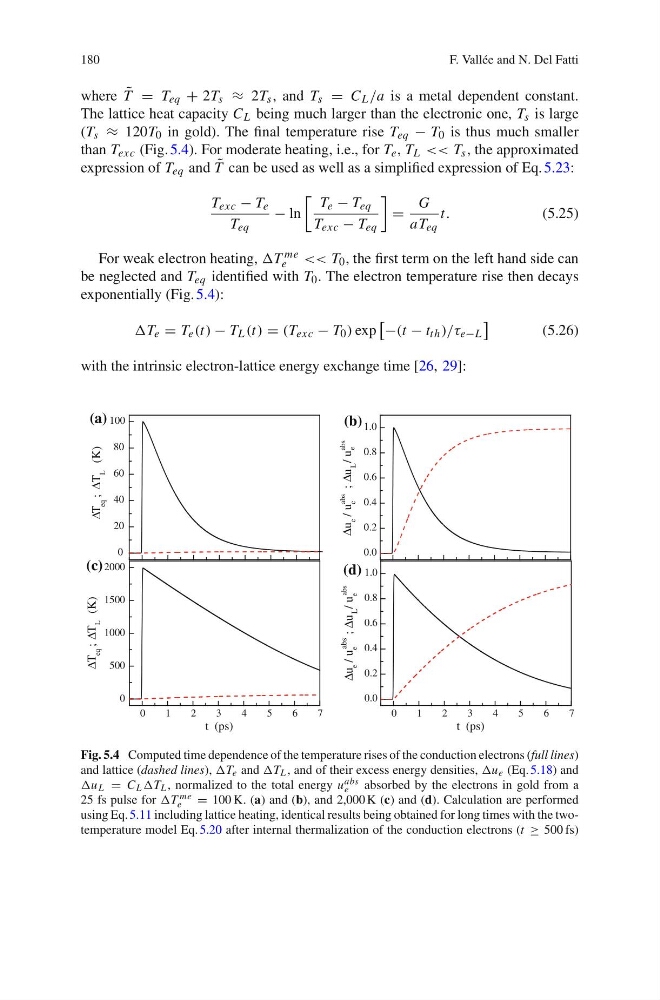
(T s ≈ 120T 0 in gold). The final temperature rise T eq − T 0 is thus much smaller
than T exc (Fig. 5.4). For moderate heating, i.e., for T e , T L << T s , the approximated
expression of T eq and ˜
T can be used as well as a simplified expression of Eq. 5.23:
T exc − T e
T eq
− ln
T e − T eq
T exc − T eq
=
G
aT eq
t.
(5.25)
For weak electron heating, ωT me
e << T 0 , the first term on the left hand side can
be neglected and T eq identified with T 0 . The electron temperature rise then decays
exponentially (Fig. 5.4):
ωT e = T e (t) − T L (t) = (T exc − T 0 ) exp
−(t − t th )/α e−L
(5.26)
with the intrinsic electron-lattice energy exchange time [26, 29]:
0
1
2
3
4
5
6
7
0
500
1000
1500
2000
(c)
ΔT
eq
;
ΔT
L
(K)
t (ps)
0
1
2
3
4
5
6
7
0.0
0.2
0.4
0.6
0.8
1.0
(d)
Δu
e
/ u
e
abs
;
Δu
L
/ u
e
abs
t (ps)
0
20
40
60
80
100
(a)
ΔT
eq
;
ΔT
L
(K)
0.0
0.2
0.4
0.6
0.8
1.0
(b)
Δu
e
/ u
e
abs
;
Δu
L
/ u
e
abs
Fig. 5.4 Computed time dependence of the temperature rises of the conduction electrons (full lines)
and lattice (dashed lines), ωT e and ωT L , and of their excess energy densities, ωu e (Eq. 5.18) and
ωu L = C L ωT L , normalized to the total energy u abs
e
absorbed by the electrons in gold from a
25 fs pulse for ωT me
e
= 100 K. (a) and (b), and 2,000 K (c) and (d). Calculation are performed
using Eq. 5.11 including lattice heating, identical results being obtained for long times with the twotemperature model Eq. 5.20 after internal thermalization of the conduction electrons (t ≥ 500 fs)
F. Vallée and N. Del Fatti
where ˜
T = T eq + 2T s ≈ 2T s , and T s = C L /a is a metal dependent constant.
The lattice heat capacity C L being much larger than the electronic one, T s is large
(T s ≈ 120T 0 in gold). The final temperature rise T eq − T 0 is thus much smaller
than T exc (Fig. 5.4). For moderate heating, i.e., for T e , T L << T s , the approximated
expression of T eq and ˜
T can be used as well as a simplified expression of Eq. 5.23:
T exc − T e
T eq
− ln
T e − T eq
T exc − T eq
=
G
aT eq
t.
(5.25)
For weak electron heating, ωT me
e << T 0 , the first term on the left hand side can
be neglected and T eq identified with T 0 . The electron temperature rise then decays
exponentially (Fig. 5.4):
ωT e = T e (t) − T L (t) = (T exc − T 0 ) exp
−(t − t th )/α e−L
(5.26)
with the intrinsic electron-lattice energy exchange time [26, 29]:
0
1
2
3
4
5
6
7
0
500
1000
1500
2000
(c)
ΔT
eq
;
ΔT
L
(K)
t (ps)
0
1
2
3
4
5
6
7
0.0
0.2
0.4
0.6
0.8
1.0
(d)
Δu
e
/ u
e
abs
;
Δu
L
/ u
e
abs
t (ps)
0
20
40
60
80
100
(a)
ΔT
eq
;
ΔT
L
(K)
0.0
0.2
0.4
0.6
0.8
1.0
(b)
Δu
e
/ u
e
abs
;
Δu
L
/ u
e
abs
Fig. 5.4 Computed time dependence of the temperature rises of the conduction electrons (full lines)
and lattice (dashed lines), ωT e and ωT L , and of their excess energy densities, ωu e (Eq. 5.18) and
ωu L = C L ωT L , normalized to the total energy u abs
e
absorbed by the electrons in gold from a
25 fs pulse for ωT me
e
= 100 K. (a) and (b), and 2,000 K (c) and (d). Calculation are performed
using Eq. 5.11 including lattice heating, identical results being obtained for long times with the twotemperature model Eq. 5.20 after internal thermalization of the conduction electrons (t ≥ 500 fs)