

182
F. Vallée and N. Del Fatti
5.3.2.3 Nanoparticle Cooling
After electron-lattice thermalization, the metal temperature T eq is larger than the
initial one. It subsequently cools-down by damping its energy to its environment via
its interface, making T eq time dependent on this time-scale. This effect is particularly
important for small size nanoparticles which exhibit a large surface over volume ratio,
increasing their interaction with their environment. The rate at which heat dissipates
from a nanoparticle depends both on the thermal interface resistance which governs
energy transfer at the interface between the nanoparticle and its surrounding, and on
heat diffusion in the surrounding medium [58, 59, 117, 118]. Nanoparticle cooling
can be described introducing the time and space dependent temperature T m of its
surrounding matrix, whose evolution is described adding a third rate equation to the
two-temperature model, Eq. 5.20 [114]. Assuming electron-lattice thermalization in a
nanoparticle is much faster than its cooling to its environment, T e and T L can be taken
as identical (to T eq , an assumption valid only after particle thermalization, i.e., after
a few picoseconds). T eq is also assumed to be uniform over the nanoparticle, which
is justified by the high thermal conductivity of metals. In the case of nanospheres, T m
depends only on the distance from the particle centre r, assuming sufficient dilution
to neglect matrix heating by other particles. Heat dissipation from a nanosphere of
diameter D is then governed by a set of two equations describing heat flux at the
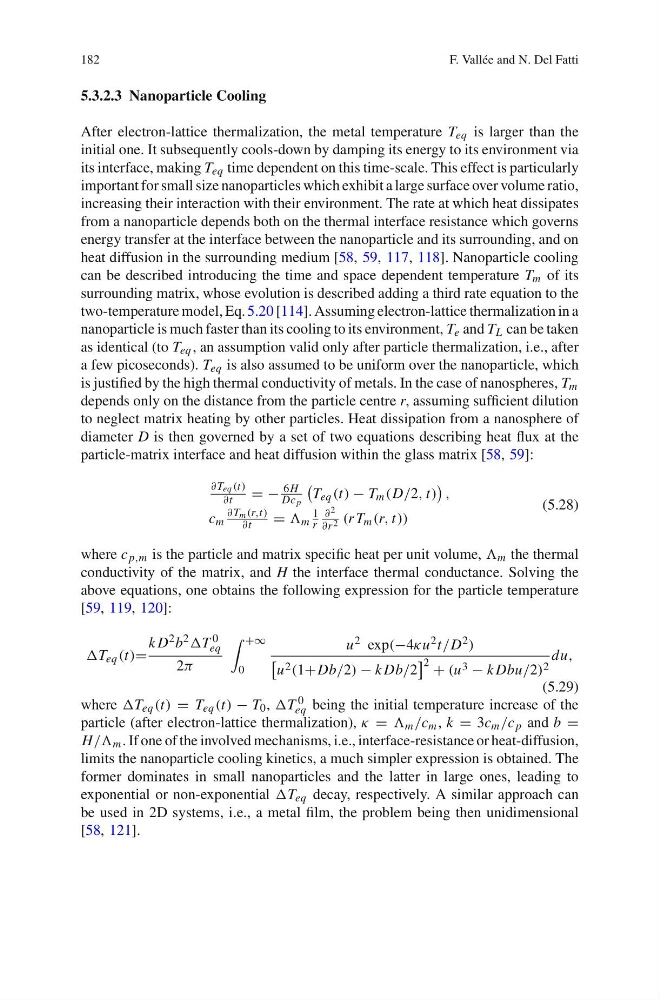
particle-matrix interface and heat diffusion within the glass matrix [58, 59]:
γ T eq (t)
γt
= −
6H
Dc p
T eq (t) − T m (D/2, t)
,
c m
γ T m (r,t)
γt
= ψ m
1
r
γ 2
γr 2 (r T m (r, t))
(5.28)
where c p,m is the particle and matrix specific heat per unit volume, ψ m the thermal
conductivity of the matrix, and H the interface thermal conductance. Solving the
above equations, one obtains the following expression for the particle temperature
[59, 119, 120]:
ωT eq (t)=
k D 2 b 2 ωT 0
eq
2π
+∞
0
u 2 exp(−4δu 2 t/D 2 )
u 2 (1+Db/2) − k Db/2
2 + (u 3 − k Dbu/2) 2
du,
(5.29)
where ωT eq (t) = T eq (t) − T 0 , ωT 0
eq being the initial temperature increase of the
particle (after electron-lattice thermalization), δ = ψ m /c m , k = 3c m /c p and b =
H/ψ m . If one of the involved mechanisms, i.e., interface-resistance or heat-diffusion,
limits the nanoparticle cooling kinetics, a much simpler expression is obtained. The
former dominates in small nanoparticles and the latter in large ones, leading to
exponential or non-exponential ωT eq decay, respectively. A similar approach can
be used in 2D systems, i.e., a metal film, the problem being then unidimensional
[58, 121].
F. Vallée and N. Del Fatti
5.3.2.3 Nanoparticle Cooling
After electron-lattice thermalization, the metal temperature T eq is larger than the
initial one. It subsequently cools-down by damping its energy to its environment via
its interface, making T eq time dependent on this time-scale. This effect is particularly
important for small size nanoparticles which exhibit a large surface over volume ratio,
increasing their interaction with their environment. The rate at which heat dissipates
from a nanoparticle depends both on the thermal interface resistance which governs
energy transfer at the interface between the nanoparticle and its surrounding, and on
heat diffusion in the surrounding medium [58, 59, 117, 118]. Nanoparticle cooling
can be described introducing the time and space dependent temperature T m of its
surrounding matrix, whose evolution is described adding a third rate equation to the
two-temperature model, Eq. 5.20 [114]. Assuming electron-lattice thermalization in a
nanoparticle is much faster than its cooling to its environment, T e and T L can be taken
as identical (to T eq , an assumption valid only after particle thermalization, i.e., after
a few picoseconds). T eq is also assumed to be uniform over the nanoparticle, which
is justified by the high thermal conductivity of metals. In the case of nanospheres, T m
depends only on the distance from the particle centre r, assuming sufficient dilution
to neglect matrix heating by other particles. Heat dissipation from a nanosphere of
diameter D is then governed by a set of two equations describing heat flux at the
particle-matrix interface and heat diffusion within the glass matrix [58, 59]:
γ T eq (t)
γt
= −
6H
Dc p
T eq (t) − T m (D/2, t)
,
c m
γ T m (r,t)
γt
= ψ m
1
r
γ 2
γr 2 (r T m (r, t))
(5.28)
where c p,m is the particle and matrix specific heat per unit volume, ψ m the thermal
conductivity of the matrix, and H the interface thermal conductance. Solving the
above equations, one obtains the following expression for the particle temperature
[59, 119, 120]:
ωT eq (t)=
k D 2 b 2 ωT 0
eq
2π
+∞
0
u 2 exp(−4δu 2 t/D 2 )
u 2 (1+Db/2) − k Db/2
2 + (u 3 − k Dbu/2) 2
du,
(5.29)
where ωT eq (t) = T eq (t) − T 0 , ωT 0
eq being the initial temperature increase of the
particle (after electron-lattice thermalization), δ = ψ m /c m , k = 3c m /c p and b =
H/ψ m . If one of the involved mechanisms, i.e., interface-resistance or heat-diffusion,
limits the nanoparticle cooling kinetics, a much simpler expression is obtained. The
former dominates in small nanoparticles and the latter in large ones, leading to
exponential or non-exponential ωT eq decay, respectively. A similar approach can
be used in 2D systems, i.e., a metal film, the problem being then unidimensional
[58, 121].