

176
F. Vallée and N. Del Fatti
d f (E, t)
dt
=
γ f (E, t)
γt
e−e
+
γ f (E, t)
γt
e− ph
+
γ f (E, t)
γt
exc
.
(5.11)
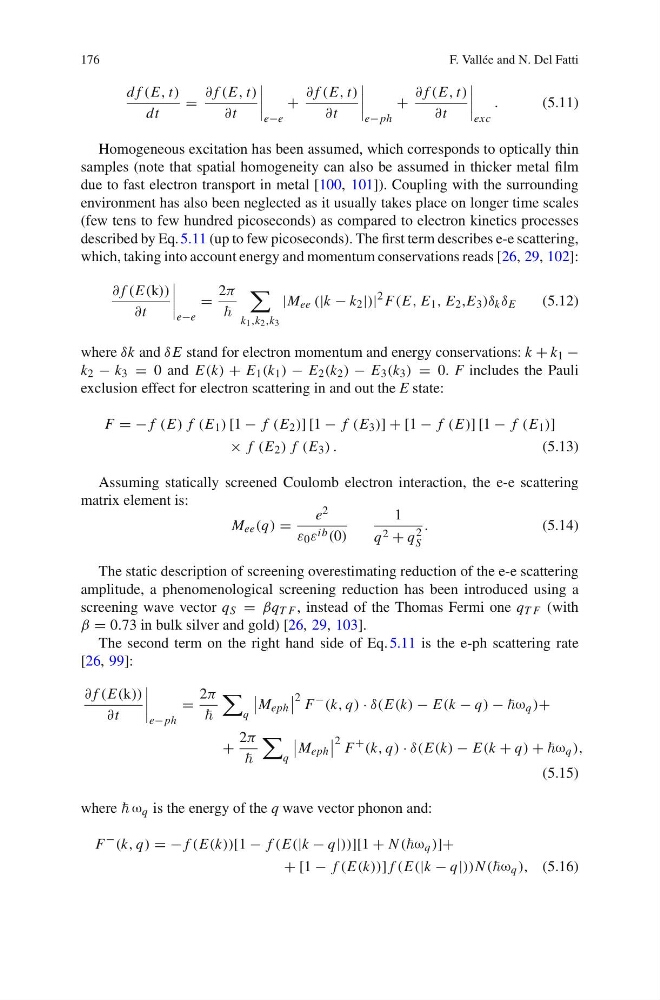
Homogeneous excitation has been assumed, which corresponds to optically thin
samples (note that spatial homogeneity can also be assumed in thicker metal film
due to fast electron transport in metal [100, 101]). Coupling with the surrounding
environment has also been neglected as it usually takes place on longer time scales
(few tens to few hundred picoseconds) as compared to electron kinetics processes
described by Eq. 5.11 (up to few picoseconds). The first term describes e-e scattering,
which, taking into account energy and momentum conservations reads [26, 29, 102]:
γ f (E(k))
γt
e−e
=
2π
k 1 ,k 2 ,k 3
|M ee (|k − k 2 |)|
2 F(E, E 1 , E 2 ,E 3 )∂ k ∂ E
(5.12)
where ∂k and ∂ E stand for electron momentum and energy conservations: k + k 1 −
k 2 − k 3 = 0 and E(k) + E 1 (k 1 ) − E 2 (k 2 ) − E 3 (k 3 ) = 0. F includes the Pauli
exclusion effect for electron scattering in and out the E state:
F = − f (E) f (E 1 ) [1 − f (E 2 )] [1 − f (E 3 )] + [1 − f (E)] [1 − f (E 1 )]
× f (E 2 ) f (E 3 ) .
(5.13)
Assuming statically screened Coulomb electron interaction, the e-e scattering
matrix element is:
M ee (q) =
e 2
ε 0 ε ib (0)
1
q 2 + q 2
S
.
(5.14)
The static description of screening overestimating reduction of the e-e scattering
amplitude, a phenomenological screening reduction has been introduced using a
screening wave vector q S = Δq T F , instead of the Thomas Fermi one q T F (with
Δ = 0.73 in bulk silver and gold) [26, 29, 103].
The second term on the right hand side of Eq. 5.11 is the e-ph scattering rate
[26, 99]:
γ f (E(k))
γt
e− ph
=
2π
q
M eph
2 F
−
(k, q) · ∂(E(k) − E(k − q) − ω q )+
+
2π
q
M eph
2 F
+
(k, q) · ∂(E(k) − E(k + q) + ω q ),
(5.15)
where ω q is the energy of the q wave vector phonon and:
F
−
(k, q) = − f (E(k))[1 − f (E(|k − q|))][1 + N (ω q )]+
+ [1 − f (E(k))] f (E(|k − q|))N (ω q ), (5.16)
F. Vallée and N. Del Fatti
d f (E, t)
dt
=
γ f (E, t)
γt
e−e
+
γ f (E, t)
γt
e− ph
+
γ f (E, t)
γt
exc
.
(5.11)
Homogeneous excitation has been assumed, which corresponds to optically thin
samples (note that spatial homogeneity can also be assumed in thicker metal film
due to fast electron transport in metal [100, 101]). Coupling with the surrounding
environment has also been neglected as it usually takes place on longer time scales
(few tens to few hundred picoseconds) as compared to electron kinetics processes
described by Eq. 5.11 (up to few picoseconds). The first term describes e-e scattering,
which, taking into account energy and momentum conservations reads [26, 29, 102]:
γ f (E(k))
γt
e−e
=
2π
k 1 ,k 2 ,k 3
|M ee (|k − k 2 |)|
2 F(E, E 1 , E 2 ,E 3 )∂ k ∂ E
(5.12)
where ∂k and ∂ E stand for electron momentum and energy conservations: k + k 1 −
k 2 − k 3 = 0 and E(k) + E 1 (k 1 ) − E 2 (k 2 ) − E 3 (k 3 ) = 0. F includes the Pauli
exclusion effect for electron scattering in and out the E state:
F = − f (E) f (E 1 ) [1 − f (E 2 )] [1 − f (E 3 )] + [1 − f (E)] [1 − f (E 1 )]
× f (E 2 ) f (E 3 ) .
(5.13)
Assuming statically screened Coulomb electron interaction, the e-e scattering
matrix element is:
M ee (q) =
e 2
ε 0 ε ib (0)
1
q 2 + q 2
S
.
(5.14)
The static description of screening overestimating reduction of the e-e scattering
amplitude, a phenomenological screening reduction has been introduced using a
screening wave vector q S = Δq T F , instead of the Thomas Fermi one q T F (with
Δ = 0.73 in bulk silver and gold) [26, 29, 103].
The second term on the right hand side of Eq. 5.11 is the e-ph scattering rate
[26, 99]:
γ f (E(k))
γt
e− ph
=
2π
q
M eph
2 F
−
(k, q) · ∂(E(k) − E(k − q) − ω q )+
+
2π
q
M eph
2 F
+
(k, q) · ∂(E(k) − E(k + q) + ω q ),
(5.15)
where ω q is the energy of the q wave vector phonon and:
F
−
(k, q) = − f (E(k))[1 − f (E(|k − q|))][1 + N (ω q )]+
+ [1 − f (E(k))] f (E(|k − q|))N (ω q ), (5.16)