

5 Ultrafast Nonlinear Plasmonics
177
and F + (k, q) = −F − (k +q, q). N ( ω q ) is the occupation number of the q phonon.
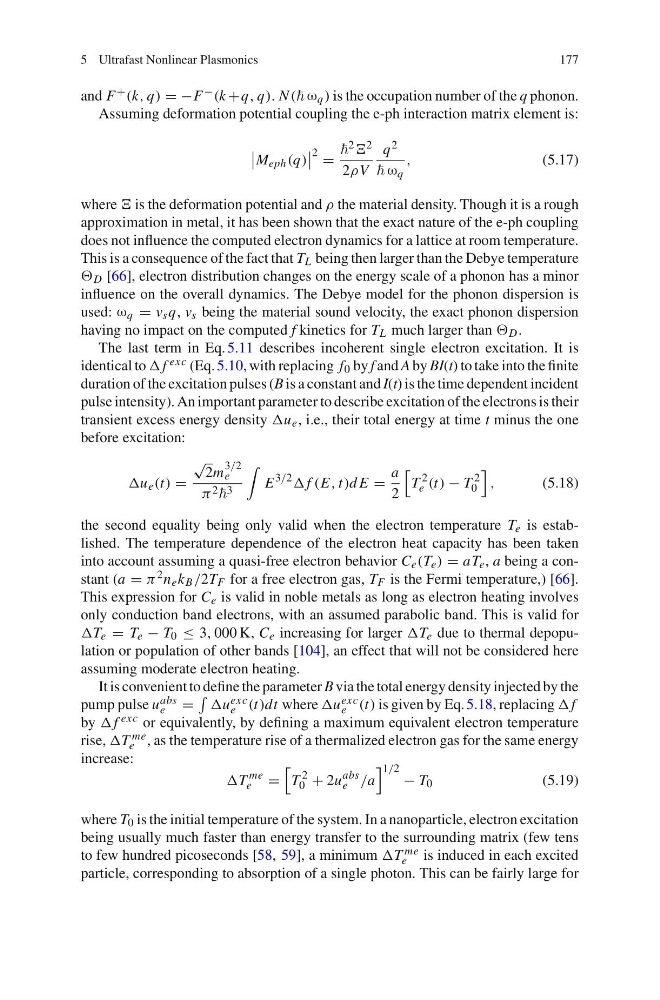
Assuming deformation potential coupling the e-ph interaction matrix element is:
M eph (q)
2 =
2 ϕ 2
2τV
q 2
ω q
,
(5.17)
where ϕ is the deformation potential and τ the material density. Though it is a rough
approximation in metal, it has been shown that the exact nature of the e-ph coupling
does not influence the computed electron dynamics for a lattice at room temperature.
This is a consequence of the fact that T L being then larger than the Debye temperature
Θ D [66], electron distribution changes on the energy scale of a phonon has a minor
influence on the overall dynamics. The Debye model for the phonon dispersion is
used: ω q = v s q, v s being the material sound velocity, the exact phonon dispersion
having no impact on the computed f kinetics for T L much larger than Θ D .
The last term in Eq. 5.11 describes incoherent single electron excitation. It is
identical to ω f exc (Eq. 5.10, with replacing f 0 by f and A by BI(t) to take into the finite
duration of the excitation pulses (B is a constant and I(t) is the time dependent incident
pulse intensity). An important parameter to describe excitation of the electrons is their
transient excess energy density ωu e , i.e., their total energy at time t minus the one
before excitation:
ωu e (t) =
√
2m
3/2
e
π 2 3
E
3/2
ω f (E, t)d E =
a
2
T
2
e (t) − T
2
0
,
(5.18)
the second equality being only valid when the electron temperature T e is established. The temperature dependence of the electron heat capacity has been taken
into account assuming a quasi-free electron behavior C e (T e ) = aT e , a being a constant (a = π 2 n e k B /2T F for a free electron gas, T F is the Fermi temperature,) [66].
This expression for C e is valid in noble metals as long as electron heating involves
only conduction band electrons, with an assumed parabolic band. This is valid for
ωT e = T e − T 0 ≤ 3, 000 K, C e increasing for larger ωT e due to thermal depopulation or population of other bands [104], an effect that will not be considered here
assuming moderate electron heating.
It is convenient to define the parameter B via the total energy density injected by the
pump pulse u abs
e
=
ωu exc
e (t)dt where ωu exc
e (t) is given by Eq. 5.18, replacing ω f
by ω f exc or equivalently, by defining a maximum equivalent electron temperature
rise, ωT me
e , as the temperature rise of a thermalized electron gas for the same energy
increase:
ωT
me
e =
T
2
0 + 2u
abs
e /a
1/2 − T 0
(5.19)
where T 0 is the initial temperature of the system. In a nanoparticle, electron excitation
being usually much faster than energy transfer to the surrounding matrix (few tens
to few hundred picoseconds [58, 59], a minimum ωT me
e is induced in each excited
particle, corresponding to absorption of a single photon. This can be fairly large for
177
and F + (k, q) = −F − (k +q, q). N ( ω q ) is the occupation number of the q phonon.
Assuming deformation potential coupling the e-ph interaction matrix element is:
M eph (q)
2 =
2 ϕ 2
2τV
q 2
ω q
,
(5.17)
where ϕ is the deformation potential and τ the material density. Though it is a rough
approximation in metal, it has been shown that the exact nature of the e-ph coupling
does not influence the computed electron dynamics for a lattice at room temperature.
This is a consequence of the fact that T L being then larger than the Debye temperature
Θ D [66], electron distribution changes on the energy scale of a phonon has a minor
influence on the overall dynamics. The Debye model for the phonon dispersion is
used: ω q = v s q, v s being the material sound velocity, the exact phonon dispersion
having no impact on the computed f kinetics for T L much larger than Θ D .
The last term in Eq. 5.11 describes incoherent single electron excitation. It is
identical to ω f exc (Eq. 5.10, with replacing f 0 by f and A by BI(t) to take into the finite
duration of the excitation pulses (B is a constant and I(t) is the time dependent incident
pulse intensity). An important parameter to describe excitation of the electrons is their
transient excess energy density ωu e , i.e., their total energy at time t minus the one
before excitation:
ωu e (t) =
√
2m
3/2
e
π 2 3
E
3/2
ω f (E, t)d E =
a
2
T
2
e (t) − T
2
0
,
(5.18)
the second equality being only valid when the electron temperature T e is established. The temperature dependence of the electron heat capacity has been taken
into account assuming a quasi-free electron behavior C e (T e ) = aT e , a being a constant (a = π 2 n e k B /2T F for a free electron gas, T F is the Fermi temperature,) [66].
This expression for C e is valid in noble metals as long as electron heating involves
only conduction band electrons, with an assumed parabolic band. This is valid for
ωT e = T e − T 0 ≤ 3, 000 K, C e increasing for larger ωT e due to thermal depopulation or population of other bands [104], an effect that will not be considered here
assuming moderate electron heating.
It is convenient to define the parameter B via the total energy density injected by the
pump pulse u abs
e
=
ωu exc
e (t)dt where ωu exc
e (t) is given by Eq. 5.18, replacing ω f
by ω f exc or equivalently, by defining a maximum equivalent electron temperature
rise, ωT me
e , as the temperature rise of a thermalized electron gas for the same energy
increase:
ωT
me
e =
T
2
0 + 2u
abs
e /a
1/2 − T 0
(5.19)
where T 0 is the initial temperature of the system. In a nanoparticle, electron excitation
being usually much faster than energy transfer to the surrounding matrix (few tens
to few hundred picoseconds [58, 59], a minimum ωT me
e is induced in each excited
particle, corresponding to absorption of a single photon. This can be fairly large for