

48
K. D. Dahm and D. J. Dahm
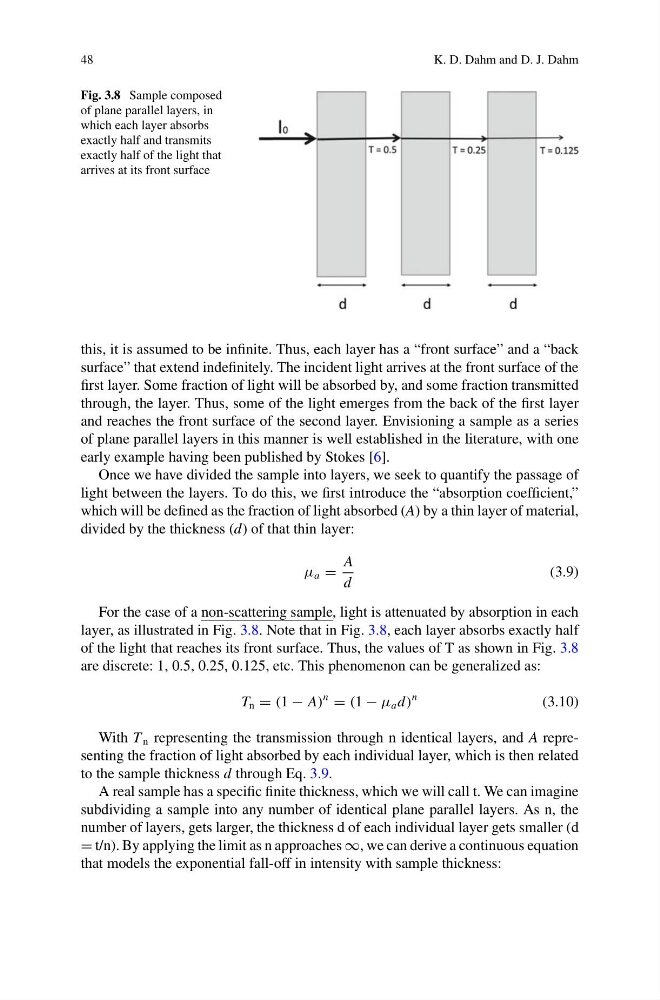
Fig. 3.8 Sample composed
of plane parallel layers, in
which each layer absorbs
exactly half and transmits
exactly half of the light that
arrives at its front surface
this, it is assumed to be infinite. Thus, each layer has a “front surface” and a “back
surface” that extend indefinitely. The incident light arrives at the front surface of the
first layer. Some fraction of light will be absorbed by, and some fraction transmitted
through, the layer. Thus, some of the light emerges from the back of the first layer
and reaches the front surface of the second layer. Envisioning a sample as a series
of plane parallel layers in this manner is well established in the literature, with one
early example having been published by Stokes [6].
Once we have divided the sample into layers, we seek to quantify the passage of
light between the layers. To do this, we first introduce the “absorption coefficient,”
which will be defined as the fraction of light absorbed (A) by a thin layer of material,
divided by the thickness (d) of that thin layer:
μ a =
A
d
(3.9)
For the case of a non-scattering sample, light is attenuated by absorption in each
layer, as illustrated in Fig. 3.8. Note that in Fig. 3.8, each layer absorbs exactly half
of the light that reaches its front surface. Thus, the values of T as shown in Fig. 3.8
are discrete: 1, 0.5, 0.25, 0.125, etc. This phenomenon can be generalized as:
T n = (1 − A)
n
= (1 − μ a d)
n
(3.10)
With T n representing the transmission through n identical layers, and A representing the fraction of light absorbed by each individual layer, which is then related
to the sample thickness d through Eq. 3.9.
A real sample has a specific finite thickness, which we will call t. We can imagine
subdividing a sample into any number of identical plane parallel layers. As n, the
number of layers, gets larger, the thickness d of each individual layer gets smaller (d
= t/n). By applying the limit as n approaches ∞, we can derive a continuous equation
that models the exponential fall-off in intensity with sample thickness:
K. D. Dahm and D. J. Dahm
Fig. 3.8 Sample composed
of plane parallel layers, in
which each layer absorbs
exactly half and transmits
exactly half of the light that
arrives at its front surface
this, it is assumed to be infinite. Thus, each layer has a “front surface” and a “back
surface” that extend indefinitely. The incident light arrives at the front surface of the
first layer. Some fraction of light will be absorbed by, and some fraction transmitted
through, the layer. Thus, some of the light emerges from the back of the first layer
and reaches the front surface of the second layer. Envisioning a sample as a series
of plane parallel layers in this manner is well established in the literature, with one
early example having been published by Stokes [6].
Once we have divided the sample into layers, we seek to quantify the passage of
light between the layers. To do this, we first introduce the “absorption coefficient,”
which will be defined as the fraction of light absorbed (A) by a thin layer of material,
divided by the thickness (d) of that thin layer:
μ a =
A
d
(3.9)
For the case of a non-scattering sample, light is attenuated by absorption in each
layer, as illustrated in Fig. 3.8. Note that in Fig. 3.8, each layer absorbs exactly half
of the light that reaches its front surface. Thus, the values of T as shown in Fig. 3.8
are discrete: 1, 0.5, 0.25, 0.125, etc. This phenomenon can be generalized as:
T n = (1 − A)
n
= (1 − μ a d)
n
(3.10)
With T n representing the transmission through n identical layers, and A representing the fraction of light absorbed by each individual layer, which is then related
to the sample thickness d through Eq. 3.9.
A real sample has a specific finite thickness, which we will call t. We can imagine
subdividing a sample into any number of identical plane parallel layers. As n, the
number of layers, gets larger, the thickness d of each individual layer gets smaller (d
= t/n). By applying the limit as n approaches ∞, we can derive a continuous equation
that models the exponential fall-off in intensity with sample thickness: