

3 Theoretical Models of Light Scattering and Absorption
47
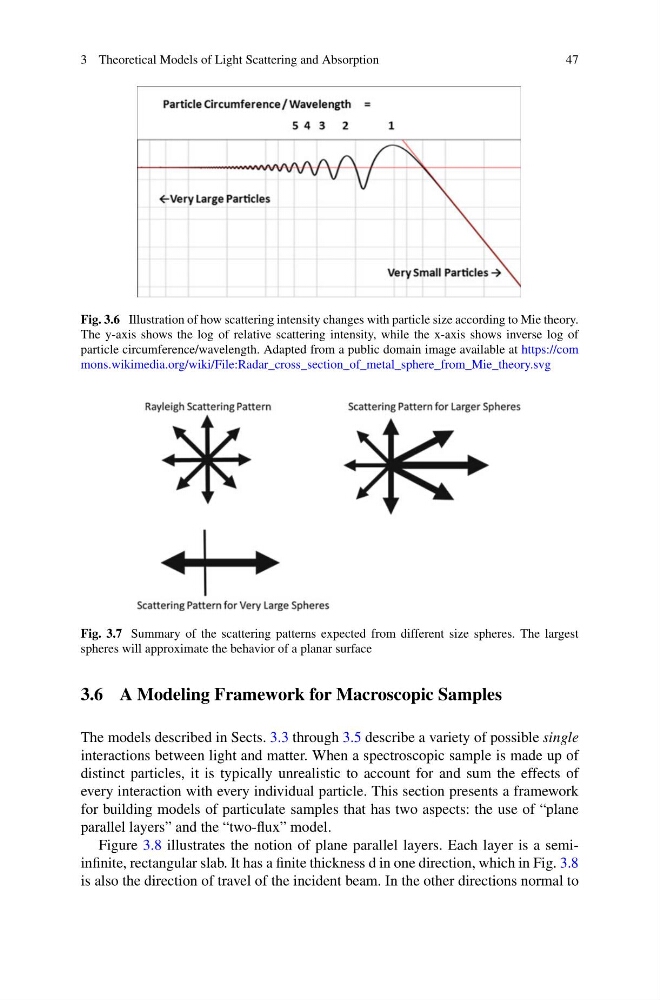
Fig. 3.6 Illustration of how scattering intensity changes with particle size according to Mie theory.
The y-axis shows the log of relative scattering intensity, while the x-axis shows inverse log of
particle circumference/wavelength. Adapted from a public domain image available at https://com
mons.wikimedia.org/wiki/File:Radar_cross_section_of_metal_sphere_from_Mie_theory.svg
Fig. 3.7 Summary of the scattering patterns expected from different size spheres. The largest
spheres will approximate the behavior of a planar surface
3.6 A Modeling Framework for Macroscopic Samples
The models described in Sects. 3.3 through 3.5 describe a variety of possible single
interactions between light and matter. When a spectroscopic sample is made up of
distinct particles, it is typically unrealistic to account for and sum the effects of
every interaction with every individual particle. This section presents a framework
for building models of particulate samples that has two aspects: the use of “plane
parallel layers” and the “two-flux” model.
Figure 3.8 illustrates the notion of plane parallel layers. Each layer is a semiinfinite, rectangular slab. It has a finite thickness d in one direction, which in Fig. 3.8
is also the direction of travel of the incident beam. In the other directions normal to
47
Fig. 3.6 Illustration of how scattering intensity changes with particle size according to Mie theory.
The y-axis shows the log of relative scattering intensity, while the x-axis shows inverse log of
particle circumference/wavelength. Adapted from a public domain image available at https://com
mons.wikimedia.org/wiki/File:Radar_cross_section_of_metal_sphere_from_Mie_theory.svg
Fig. 3.7 Summary of the scattering patterns expected from different size spheres. The largest
spheres will approximate the behavior of a planar surface
3.6 A Modeling Framework for Macroscopic Samples
The models described in Sects. 3.3 through 3.5 describe a variety of possible single
interactions between light and matter. When a spectroscopic sample is made up of
distinct particles, it is typically unrealistic to account for and sum the effects of
every interaction with every individual particle. This section presents a framework
for building models of particulate samples that has two aspects: the use of “plane
parallel layers” and the “two-flux” model.
Figure 3.8 illustrates the notion of plane parallel layers. Each layer is a semiinfinite, rectangular slab. It has a finite thickness d in one direction, which in Fig. 3.8
is also the direction of travel of the incident beam. In the other directions normal to