

500
T. Scherzer
0
2 0
4 0
6 0
8 0
0
20
40
60
80
100
83% UV
100% UV
66 % UV
50 % UV
Conversion predicted with NIR
Conversion determind by FTIR
Conversion [%]
Sheet Number
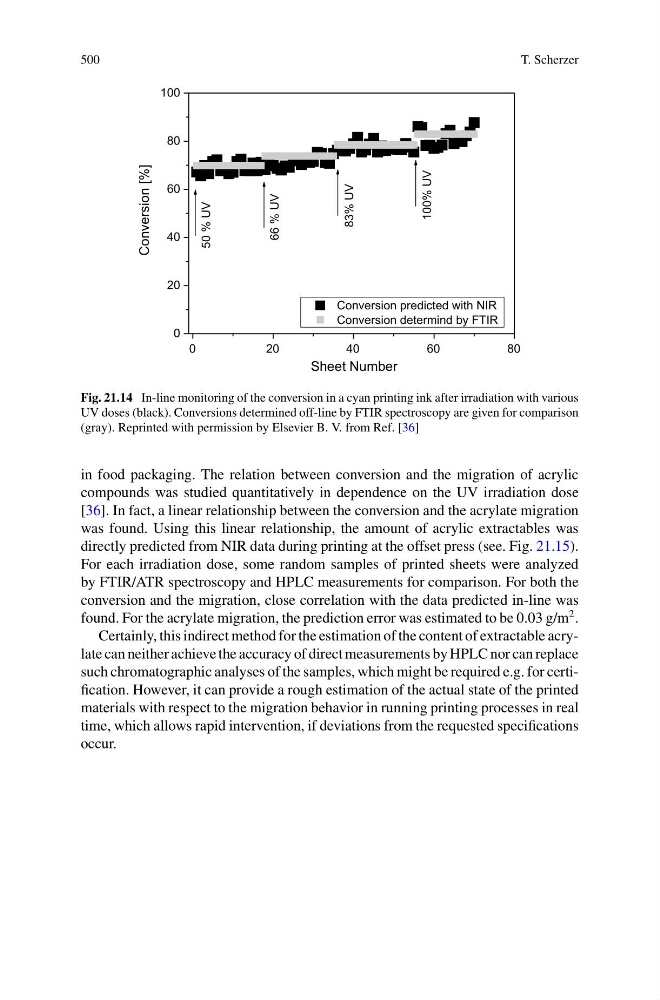
Fig. 21.14 In-line monitoring of the conversion in a cyan printing ink after irradiation with various
UV doses (black). Conversions determined off-line by FTIR spectroscopy are given for comparison
(gray). Reprinted with permission by Elsevier B. V. from Ref. [36]
in food packaging. The relation between conversion and the migration of acrylic
compounds was studied quantitatively in dependence on the UV irradiation dose
[36]. In fact, a linear relationship between the conversion and the acrylate migration
was found. Using this linear relationship, the amount of acrylic extractables was
directly predicted from NIR data during printing at the offset press (see. Fig. 21.15).
For each irradiation dose, some random samples of printed sheets were analyzed
by FTIR/ATR spectroscopy and HPLC measurements for comparison. For both the
conversion and the migration, close correlation with the data predicted in-line was
found. For the acrylate migration, the prediction error was estimated to be 0.03 g/m
2 .
Certainly, this indirect method for the estimation of the content of extractable acrylate can neither achieve the accuracy of direct measurements by HPLC nor can replace
such chromatographic analyses of the samples, which might be required e.g. for certification. However, it can provide a rough estimation of the actual state of the printed
materials with respect to the migration behavior in running printing processes in real
time, which allows rapid intervention, if deviations from the requested specifications
occur.
T. Scherzer
0
2 0
4 0
6 0
8 0
0
20
40
60
80
100
83% UV
100% UV
66 % UV
50 % UV
Conversion predicted with NIR
Conversion determind by FTIR
Conversion [%]
Sheet Number
Fig. 21.14 In-line monitoring of the conversion in a cyan printing ink after irradiation with various
UV doses (black). Conversions determined off-line by FTIR spectroscopy are given for comparison
(gray). Reprinted with permission by Elsevier B. V. from Ref. [36]
in food packaging. The relation between conversion and the migration of acrylic
compounds was studied quantitatively in dependence on the UV irradiation dose
[36]. In fact, a linear relationship between the conversion and the acrylate migration
was found. Using this linear relationship, the amount of acrylic extractables was
directly predicted from NIR data during printing at the offset press (see. Fig. 21.15).
For each irradiation dose, some random samples of printed sheets were analyzed
by FTIR/ATR spectroscopy and HPLC measurements for comparison. For both the
conversion and the migration, close correlation with the data predicted in-line was
found. For the acrylate migration, the prediction error was estimated to be 0.03 g/m
2 .
Certainly, this indirect method for the estimation of the content of extractable acrylate can neither achieve the accuracy of direct measurements by HPLC nor can replace
such chromatographic analyses of the samples, which might be required e.g. for certification. However, it can provide a rough estimation of the actual state of the printed
materials with respect to the migration behavior in running printing processes in real
time, which allows rapid intervention, if deviations from the requested specifications
occur.