

21 Applications of NIR Techniques in Polymer Coatings …
501
0
30
60
90
120
0
20
40
60
80
100
Conversion predicted with NIR
Conversion determined with FTIR
Sheet Number
Conversion [%]
0.0
0.1
0.2
0.3
0.4
0.5
0.6
Migration predicted from NIR
Migration determined with HPLC
Acrylate Migration [mg dm
-2
]
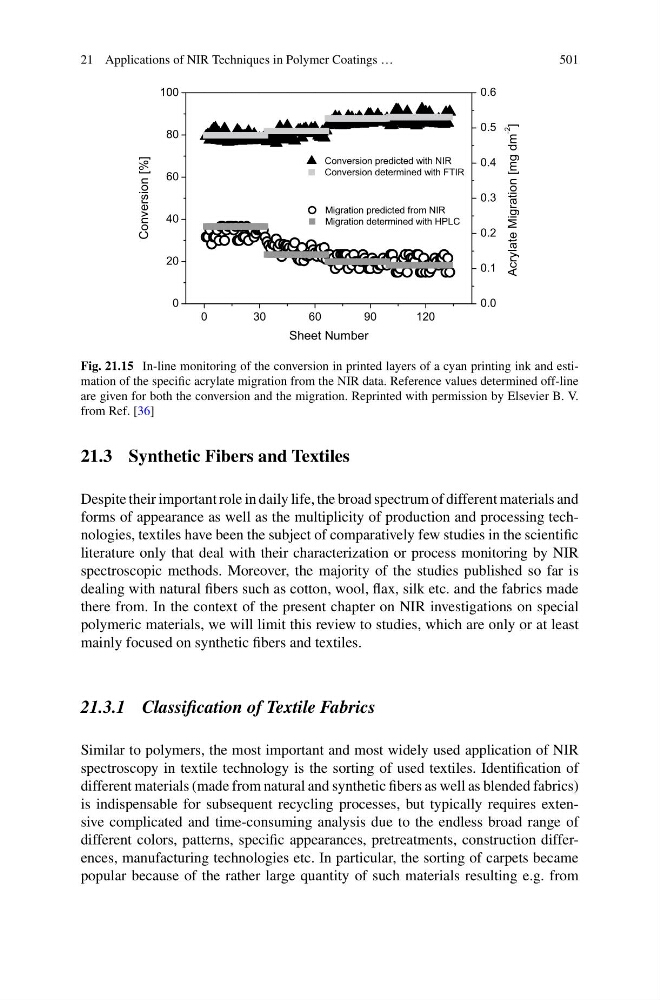
Fig. 21.15 In-line monitoring of the conversion in printed layers of a cyan printing ink and estimation of the specific acrylate migration from the NIR data. Reference values determined off-line
are given for both the conversion and the migration. Reprinted with permission by Elsevier B. V.
from Ref. [36]
21.3 Synthetic Fibers and Textiles
Despite their important role in daily life, the broad spectrum of different materials and
forms of appearance as well as the multiplicity of production and processing technologies, textiles have been the subject of comparatively few studies in the scientific
literature only that deal with their characterization or process monitoring by NIR
spectroscopic methods. Moreover, the majority of the studies published so far is
dealing with natural fibers such as cotton, wool, flax, silk etc. and the fabrics made
there from. In the context of the present chapter on NIR investigations on special
polymeric materials, we will limit this review to studies, which are only or at least
mainly focused on synthetic fibers and textiles.
21.3.1 Classification of Textile Fabrics
Similar to polymers, the most important and most widely used application of NIR
spectroscopy in textile technology is the sorting of used textiles. Identification of
different materials (made from natural and synthetic fibers as well as blended fabrics)
is indispensable for subsequent recycling processes, but typically requires extensive complicated and time-consuming analysis due to the endless broad range of
different colors, patterns, specific appearances, pretreatments, construction differences, manufacturing technologies etc. In particular, the sorting of carpets became
popular because of the rather large quantity of such materials resulting e.g. from
501
0
30
60
90
120
0
20
40
60
80
100
Conversion predicted with NIR
Conversion determined with FTIR
Sheet Number
Conversion [%]
0.0
0.1
0.2
0.3
0.4
0.5
0.6
Migration predicted from NIR
Migration determined with HPLC
Acrylate Migration [mg dm
-2
]
Fig. 21.15 In-line monitoring of the conversion in printed layers of a cyan printing ink and estimation of the specific acrylate migration from the NIR data. Reference values determined off-line
are given for both the conversion and the migration. Reprinted with permission by Elsevier B. V.
from Ref. [36]
21.3 Synthetic Fibers and Textiles
Despite their important role in daily life, the broad spectrum of different materials and
forms of appearance as well as the multiplicity of production and processing technologies, textiles have been the subject of comparatively few studies in the scientific
literature only that deal with their characterization or process monitoring by NIR
spectroscopic methods. Moreover, the majority of the studies published so far is
dealing with natural fibers such as cotton, wool, flax, silk etc. and the fabrics made
there from. In the context of the present chapter on NIR investigations on special
polymeric materials, we will limit this review to studies, which are only or at least
mainly focused on synthetic fibers and textiles.
21.3.1 Classification of Textile Fabrics
Similar to polymers, the most important and most widely used application of NIR
spectroscopy in textile technology is the sorting of used textiles. Identification of
different materials (made from natural and synthetic fibers as well as blended fabrics)
is indispensable for subsequent recycling processes, but typically requires extensive complicated and time-consuming analysis due to the endless broad range of
different colors, patterns, specific appearances, pretreatments, construction differences, manufacturing technologies etc. In particular, the sorting of carpets became
popular because of the rather large quantity of such materials resulting e.g. from