

21 Applications of NIR Techniques in Polymer Coatings …
499
60
70
80
90
100
60
70
80
90
100
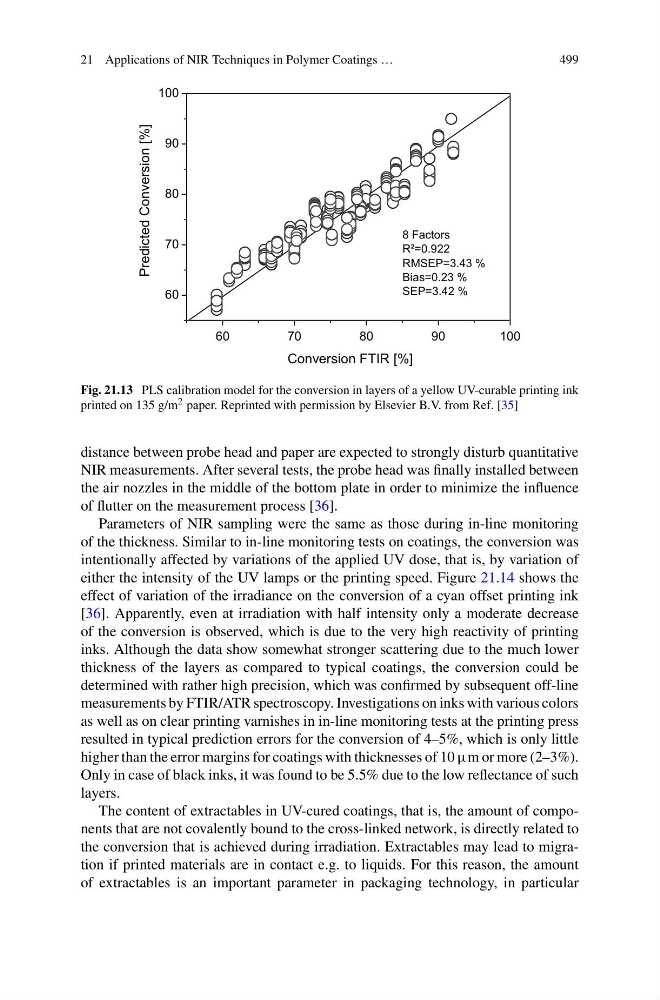
RMSEP=3.43 %
Bias=0.23 %
SEP=3.42 %
8 Factors
R²=0.922
Predicted Conversion [%]
Conversion FTIR [%]
Fig. 21.13 PLS calibration model for the conversion in layers of a yellow UV-curable printing ink
printed on 135 g/m 2 paper. Reprinted with permission by Elsevier B.V. from Ref. [35]
distance between probe head and paper are expected to strongly disturb quantitative
NIR measurements. After several tests, the probe head was finally installed between
the air nozzles in the middle of the bottom plate in order to minimize the influence
of flutter on the measurement process [36].
Parameters of NIR sampling were the same as those during in-line monitoring
of the thickness. Similar to in-line monitoring tests on coatings, the conversion was
intentionally affected by variations of the applied UV dose, that is, by variation of
either the intensity of the UV lamps or the printing speed. Figure 21.14 shows the
effect of variation of the irradiance on the conversion of a cyan offset printing ink
[36]. Apparently, even at irradiation with half intensity only a moderate decrease
of the conversion is observed, which is due to the very high reactivity of printing
inks. Although the data show somewhat stronger scattering due to the much lower
thickness of the layers as compared to typical coatings, the conversion could be
determined with rather high precision, which was confirmed by subsequent off-line
measurements by FTIR/ATR spectroscopy. Investigations on inks with various colors
as well as on clear printing varnishes in in-line monitoring tests at the printing press
resulted in typical prediction errors for the conversion of 4–5%, which is only little
higher than the error margins for coatings with thicknesses of 10 μm or more (2–3%).
Only in case of black inks, it was found to be 5.5% due to the low reflectance of such
layers.
The content of extractables in UV-cured coatings, that is, the amount of components that are not covalently bound to the cross-linked network, is directly related to
the conversion that is achieved during irradiation. Extractables may lead to migration if printed materials are in contact e.g. to liquids. For this reason, the amount
of extractables is an important parameter in packaging technology, in particular
499
60
70
80
90
100
60
70
80
90
100
RMSEP=3.43 %
Bias=0.23 %
SEP=3.42 %
8 Factors
R²=0.922
Predicted Conversion [%]
Conversion FTIR [%]
Fig. 21.13 PLS calibration model for the conversion in layers of a yellow UV-curable printing ink
printed on 135 g/m 2 paper. Reprinted with permission by Elsevier B.V. from Ref. [35]
distance between probe head and paper are expected to strongly disturb quantitative
NIR measurements. After several tests, the probe head was finally installed between
the air nozzles in the middle of the bottom plate in order to minimize the influence
of flutter on the measurement process [36].
Parameters of NIR sampling were the same as those during in-line monitoring
of the thickness. Similar to in-line monitoring tests on coatings, the conversion was
intentionally affected by variations of the applied UV dose, that is, by variation of
either the intensity of the UV lamps or the printing speed. Figure 21.14 shows the
effect of variation of the irradiance on the conversion of a cyan offset printing ink
[36]. Apparently, even at irradiation with half intensity only a moderate decrease
of the conversion is observed, which is due to the very high reactivity of printing
inks. Although the data show somewhat stronger scattering due to the much lower
thickness of the layers as compared to typical coatings, the conversion could be
determined with rather high precision, which was confirmed by subsequent off-line
measurements by FTIR/ATR spectroscopy. Investigations on inks with various colors
as well as on clear printing varnishes in in-line monitoring tests at the printing press
resulted in typical prediction errors for the conversion of 4–5%, which is only little
higher than the error margins for coatings with thicknesses of 10 μm or more (2–3%).
Only in case of black inks, it was found to be 5.5% due to the low reflectance of such
layers.
The content of extractables in UV-cured coatings, that is, the amount of components that are not covalently bound to the cross-linked network, is directly related to
the conversion that is achieved during irradiation. Extractables may lead to migration if printed materials are in contact e.g. to liquids. For this reason, the amount
of extractables is an important parameter in packaging technology, in particular