

21 Applications of NIR Techniques in Polymer Coatings …
489
Time [sec]
0
1
2
3
4
5
VE Conversion
0.0
0.2
0.4
0.6
0.8
1.0
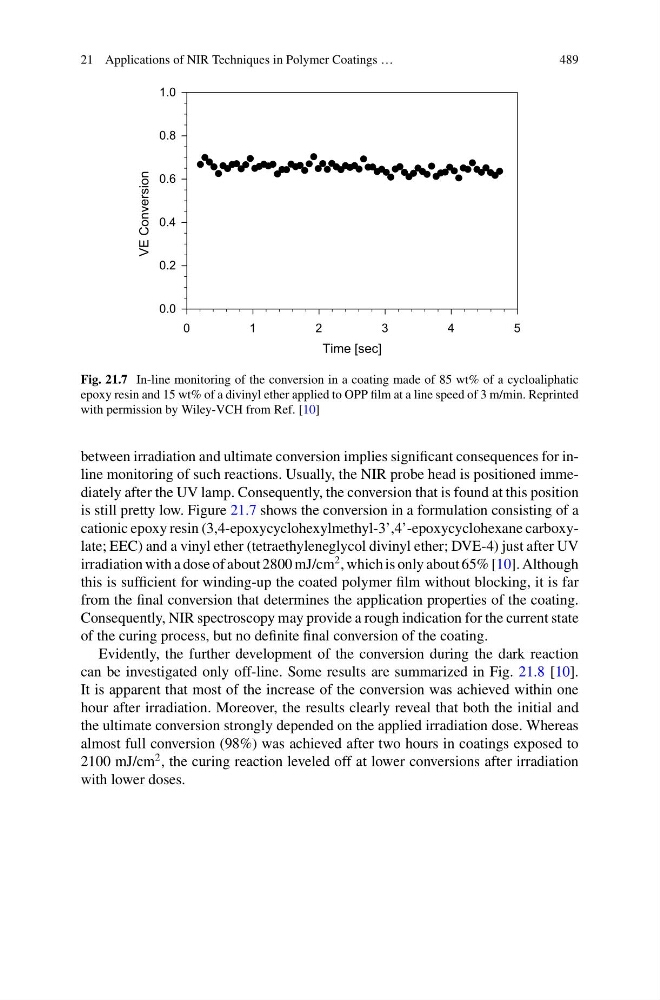
Fig. 21.7 In-line monitoring of the conversion in a coating made of 85 wt% of a cycloaliphatic
epoxy resin and 15 wt% of a divinyl ether applied to OPP film at a line speed of 3 m/min. Reprinted
with permission by Wiley-VCH from Ref. [10]
between irradiation and ultimate conversion implies significant consequences for inline monitoring of such reactions. Usually, the NIR probe head is positioned immediately after the UV lamp. Consequently, the conversion that is found at this position
is still pretty low. Figure 21.7 shows the conversion in a formulation consisting of a
cationic epoxy resin (3,4-epoxycyclohexylmethyl-3’,4’-epoxycyclohexane carboxylate; EEC) and a vinyl ether (tetraethyleneglycol divinyl ether; DVE-4) just after UV
irradiation with a dose of about 2800 mJ/cm
2 , which is only about 65% [10]. Although
this is sufficient for winding-up the coated polymer film without blocking, it is far
from the final conversion that determines the application properties of the coating.
Consequently, NIR spectroscopy may provide a rough indication for the current state
of the curing process, but no definite final conversion of the coating.
Evidently, the further development of the conversion during the dark reaction
can be investigated only off-line. Some results are summarized in Fig. 21.8 [10].
It is apparent that most of the increase of the conversion was achieved within one
hour after irradiation. Moreover, the results clearly reveal that both the initial and
the ultimate conversion strongly depended on the applied irradiation dose. Whereas
almost full conversion (98%) was achieved after two hours in coatings exposed to
2100 mJ/cm
2 , the curing reaction leveled off at lower conversions after irradiation
with lower doses.
489
Time [sec]
0
1
2
3
4
5
VE Conversion
0.0
0.2
0.4
0.6
0.8
1.0
Fig. 21.7 In-line monitoring of the conversion in a coating made of 85 wt% of a cycloaliphatic
epoxy resin and 15 wt% of a divinyl ether applied to OPP film at a line speed of 3 m/min. Reprinted
with permission by Wiley-VCH from Ref. [10]
between irradiation and ultimate conversion implies significant consequences for inline monitoring of such reactions. Usually, the NIR probe head is positioned immediately after the UV lamp. Consequently, the conversion that is found at this position
is still pretty low. Figure 21.7 shows the conversion in a formulation consisting of a
cationic epoxy resin (3,4-epoxycyclohexylmethyl-3’,4’-epoxycyclohexane carboxylate; EEC) and a vinyl ether (tetraethyleneglycol divinyl ether; DVE-4) just after UV
irradiation with a dose of about 2800 mJ/cm
2 , which is only about 65% [10]. Although
this is sufficient for winding-up the coated polymer film without blocking, it is far
from the final conversion that determines the application properties of the coating.
Consequently, NIR spectroscopy may provide a rough indication for the current state
of the curing process, but no definite final conversion of the coating.
Evidently, the further development of the conversion during the dark reaction
can be investigated only off-line. Some results are summarized in Fig. 21.8 [10].
It is apparent that most of the increase of the conversion was achieved within one
hour after irradiation. Moreover, the results clearly reveal that both the initial and
the ultimate conversion strongly depended on the applied irradiation dose. Whereas
almost full conversion (98%) was achieved after two hours in coatings exposed to
2100 mJ/cm
2 , the curing reaction leveled off at lower conversions after irradiation
with lower doses.