

488
T. Scherzer
Time [sec]
0
50
100
150
200
250
Conversion
0
20
40
60
80
100
4 m/min
2 m/min
3 m/min
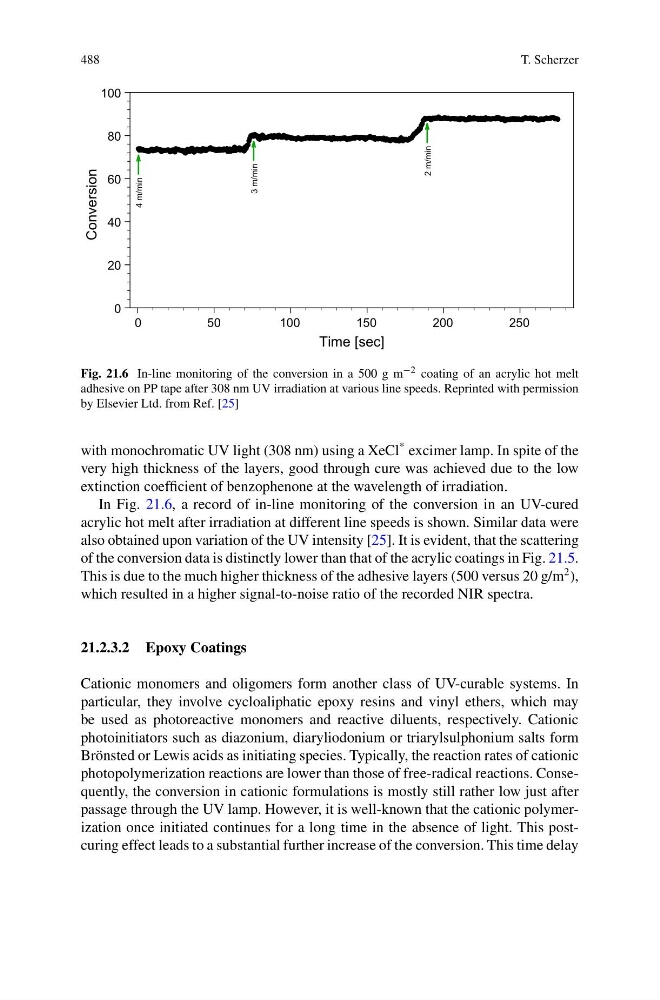
Fig. 21.6 In-line monitoring of the conversion in a 500 g m −2 coating of an acrylic hot melt
adhesive on PP tape after 308 nm UV irradiation at various line speeds. Reprinted with permission
by Elsevier Ltd. from Ref. [25]
with monochromatic UV light (308 nm) using a XeCl
* excimer lamp. In spite of the
very high thickness of the layers, good through cure was achieved due to the low
extinction coefficient of benzophenone at the wavelength of irradiation.
In Fig. 21.6, a record of in-line monitoring of the conversion in an UV-cured
acrylic hot melt after irradiation at different line speeds is shown. Similar data were
also obtained upon variation of the UV intensity [25]. It is evident, that the scattering
of the conversion data is distinctly lower than that of the acrylic coatings in Fig. 21.5.
This is due to the much higher thickness of the adhesive layers (500 versus 20 g/m
2 ),
which resulted in a higher signal-to-noise ratio of the recorded NIR spectra.
21.2.3.2 Epoxy Coatings
Cationic monomers and oligomers form another class of UV-curable systems. In
particular, they involve cycloaliphatic epoxy resins and vinyl ethers, which may
be used as photoreactive monomers and reactive diluents, respectively. Cationic
photoinitiators such as diazonium, diaryliodonium or triarylsulphonium salts form
Brönsted or Lewis acids as initiating species. Typically, the reaction rates of cationic
photopolymerization reactions are lower than those of free-radical reactions. Consequently, the conversion in cationic formulations is mostly still rather low just after
passage through the UV lamp. However, it is well-known that the cationic polymerization once initiated continues for a long time in the absence of light. This postcuring effect leads to a substantial further increase of the conversion. This time delay
T. Scherzer
Time [sec]
0
50
100
150
200
250
Conversion
0
20
40
60
80
100
4 m/min
2 m/min
3 m/min
Fig. 21.6 In-line monitoring of the conversion in a 500 g m −2 coating of an acrylic hot melt
adhesive on PP tape after 308 nm UV irradiation at various line speeds. Reprinted with permission
by Elsevier Ltd. from Ref. [25]
with monochromatic UV light (308 nm) using a XeCl
* excimer lamp. In spite of the
very high thickness of the layers, good through cure was achieved due to the low
extinction coefficient of benzophenone at the wavelength of irradiation.
In Fig. 21.6, a record of in-line monitoring of the conversion in an UV-cured
acrylic hot melt after irradiation at different line speeds is shown. Similar data were
also obtained upon variation of the UV intensity [25]. It is evident, that the scattering
of the conversion data is distinctly lower than that of the acrylic coatings in Fig. 21.5.
This is due to the much higher thickness of the adhesive layers (500 versus 20 g/m
2 ),
which resulted in a higher signal-to-noise ratio of the recorded NIR spectra.
21.2.3.2 Epoxy Coatings
Cationic monomers and oligomers form another class of UV-curable systems. In
particular, they involve cycloaliphatic epoxy resins and vinyl ethers, which may
be used as photoreactive monomers and reactive diluents, respectively. Cationic
photoinitiators such as diazonium, diaryliodonium or triarylsulphonium salts form
Brönsted or Lewis acids as initiating species. Typically, the reaction rates of cationic
photopolymerization reactions are lower than those of free-radical reactions. Consequently, the conversion in cationic formulations is mostly still rather low just after
passage through the UV lamp. However, it is well-known that the cationic polymerization once initiated continues for a long time in the absence of light. This postcuring effect leads to a substantial further increase of the conversion. This time delay