

21 Applications of NIR Techniques in Polymer Coatings …
487
Time [sec]
0
50
100
150
200
250
300
350
Conversion
0
20
40
60
80
100
25 % UV
10 m/min
6 m/min
20 m/min
30 m/min
40 m/min
40 %
40 m/min
60 % UV
80 m/min
60 m/min
40 m/min
100 %
100 m/min
80 % UV
80 m/min
100 m/min
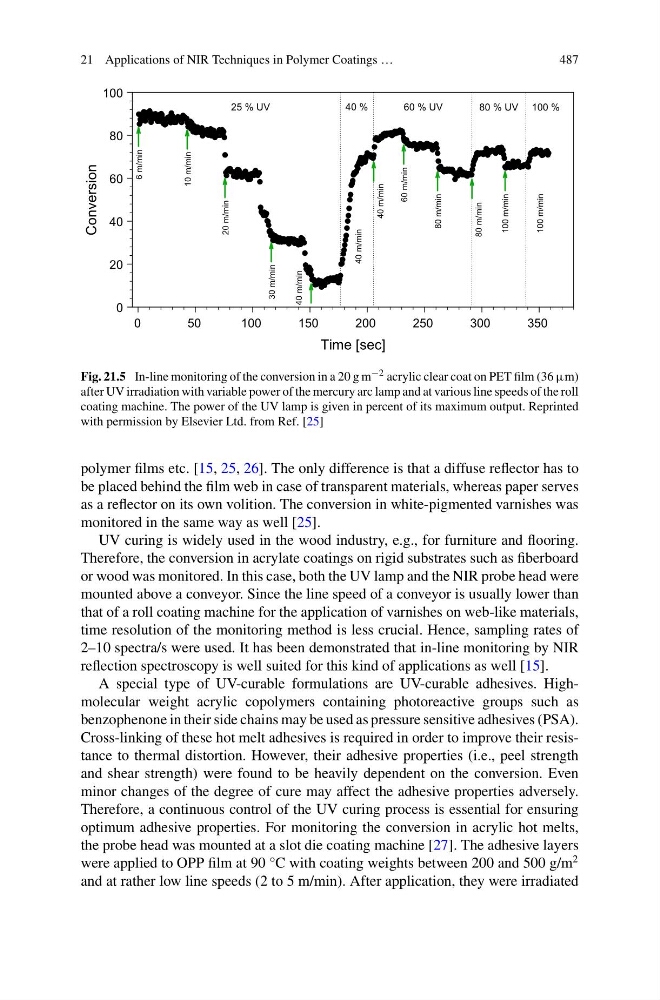
Fig. 21.5 In-line monitoring of the conversion in a 20 g m −2 acrylic clear coat on PET film (36 μm)
after UV irradiation with variable power of the mercury arc lamp and at various line speeds of the roll
coating machine. The power of the UV lamp is given in percent of its maximum output. Reprinted
with permission by Elsevier Ltd. from Ref. [25]
polymer films etc. [15, 25, 26]. The only difference is that a diffuse reflector has to
be placed behind the film web in case of transparent materials, whereas paper serves
as a reflector on its own volition. The conversion in white-pigmented varnishes was
monitored in the same way as well [25].
UV curing is widely used in the wood industry, e.g., for furniture and flooring.
Therefore, the conversion in acrylate coatings on rigid substrates such as fiberboard
or wood was monitored. In this case, both the UV lamp and the NIR probe head were
mounted above a conveyor. Since the line speed of a conveyor is usually lower than
that of a roll coating machine for the application of varnishes on web-like materials,
time resolution of the monitoring method is less crucial. Hence, sampling rates of
2–10 spectra/s were used. It has been demonstrated that in-line monitoring by NIR
reflection spectroscopy is well suited for this kind of applications as well [15].
A special type of UV-curable formulations are UV-curable adhesives. Highmolecular weight acrylic copolymers containing photoreactive groups such as
benzophenone in their side chains may be used as pressure sensitive adhesives (PSA).
Cross-linking of these hot melt adhesives is required in order to improve their resistance to thermal distortion. However, their adhesive properties (i.e., peel strength
and shear strength) were found to be heavily dependent on the conversion. Even
minor changes of the degree of cure may affect the adhesive properties adversely.
Therefore, a continuous control of the UV curing process is essential for ensuring
optimum adhesive properties. For monitoring the conversion in acrylic hot melts,
the probe head was mounted at a slot die coating machine [27]. The adhesive layers
were applied to OPP film at 90 °C with coating weights between 200 and 500 g/m
2
and at rather low line speeds (2 to 5 m/min). After application, they were irradiated
487
Time [sec]
0
50
100
150
200
250
300
350
Conversion
0
20
40
60
80
100
25 % UV
10 m/min
6 m/min
20 m/min
30 m/min
40 m/min
40 %
40 m/min
60 % UV
80 m/min
60 m/min
40 m/min
100 %
100 m/min
80 % UV
80 m/min
100 m/min
Fig. 21.5 In-line monitoring of the conversion in a 20 g m −2 acrylic clear coat on PET film (36 μm)
after UV irradiation with variable power of the mercury arc lamp and at various line speeds of the roll
coating machine. The power of the UV lamp is given in percent of its maximum output. Reprinted
with permission by Elsevier Ltd. from Ref. [25]
polymer films etc. [15, 25, 26]. The only difference is that a diffuse reflector has to
be placed behind the film web in case of transparent materials, whereas paper serves
as a reflector on its own volition. The conversion in white-pigmented varnishes was
monitored in the same way as well [25].
UV curing is widely used in the wood industry, e.g., for furniture and flooring.
Therefore, the conversion in acrylate coatings on rigid substrates such as fiberboard
or wood was monitored. In this case, both the UV lamp and the NIR probe head were
mounted above a conveyor. Since the line speed of a conveyor is usually lower than
that of a roll coating machine for the application of varnishes on web-like materials,
time resolution of the monitoring method is less crucial. Hence, sampling rates of
2–10 spectra/s were used. It has been demonstrated that in-line monitoring by NIR
reflection spectroscopy is well suited for this kind of applications as well [15].
A special type of UV-curable formulations are UV-curable adhesives. Highmolecular weight acrylic copolymers containing photoreactive groups such as
benzophenone in their side chains may be used as pressure sensitive adhesives (PSA).
Cross-linking of these hot melt adhesives is required in order to improve their resistance to thermal distortion. However, their adhesive properties (i.e., peel strength
and shear strength) were found to be heavily dependent on the conversion. Even
minor changes of the degree of cure may affect the adhesive properties adversely.
Therefore, a continuous control of the UV curing process is essential for ensuring
optimum adhesive properties. For monitoring the conversion in acrylic hot melts,
the probe head was mounted at a slot die coating machine [27]. The adhesive layers
were applied to OPP film at 90 °C with coating weights between 200 and 500 g/m
2
and at rather low line speeds (2 to 5 m/min). After application, they were irradiated