

486
T. Scherzer
40
50
60
70
80
90
100
40
50
60
70
80
90
100
RMSEP=3.1 %
R²=93.0
Predicted Conversion (NIR) [%]
Actual Conversion (FTIR) [%]
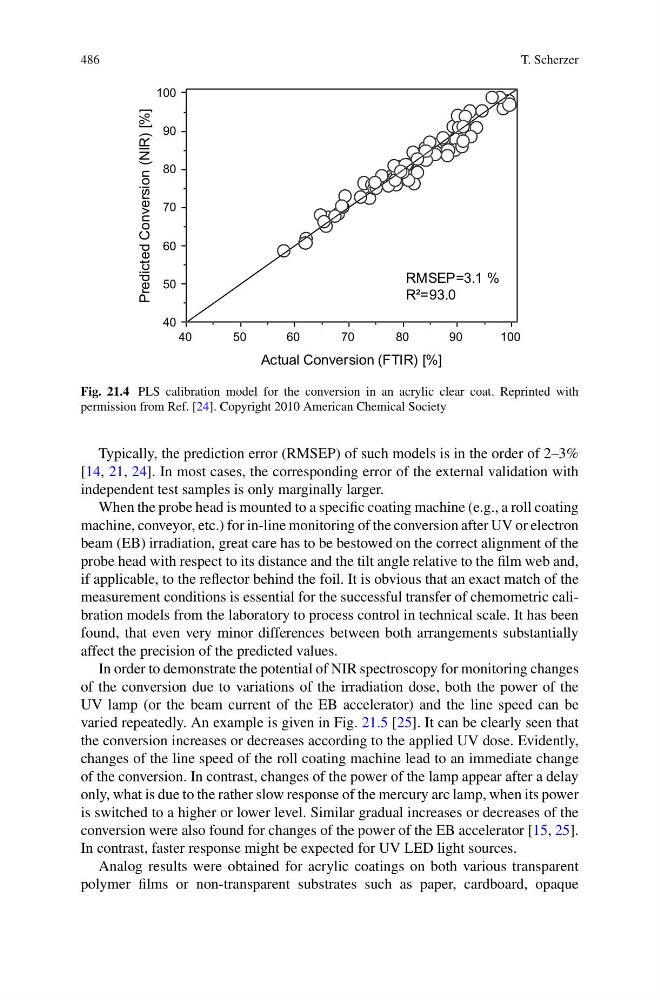
Fig. 21.4 PLS calibration model for the conversion in an acrylic clear coat. Reprinted with
permission from Ref. [24]. Copyright 2010 American Chemical Society
Typically, the prediction error (RMSEP) of such models is in the order of 2–3%
[14, 21, 24]. In most cases, the corresponding error of the external validation with
independent test samples is only marginally larger.
When the probe head is mounted to a specific coating machine (e.g., a roll coating
machine, conveyor, etc.) for in-line monitoring of the conversion after UV or electron
beam (EB) irradiation, great care has to be bestowed on the correct alignment of the
probe head with respect to its distance and the tilt angle relative to the film web and,
if applicable, to the reflector behind the foil. It is obvious that an exact match of the
measurement conditions is essential for the successful transfer of chemometric calibration models from the laboratory to process control in technical scale. It has been
found, that even very minor differences between both arrangements substantially
affect the precision of the predicted values.
In order to demonstrate the potential of NIR spectroscopy for monitoring changes
of the conversion due to variations of the irradiation dose, both the power of the
UV lamp (or the beam current of the EB accelerator) and the line speed can be
varied repeatedly. An example is given in Fig. 21.5 [25]. It can be clearly seen that
the conversion increases or decreases according to the applied UV dose. Evidently,
changes of the line speed of the roll coating machine lead to an immediate change
of the conversion. In contrast, changes of the power of the lamp appear after a delay
only, what is due to the rather slow response of the mercury arc lamp, when its power
is switched to a higher or lower level. Similar gradual increases or decreases of the
conversion were also found for changes of the power of the EB accelerator [15, 25].
In contrast, faster response might be expected for UV LED light sources.
Analog results were obtained for acrylic coatings on both various transparent
polymer films or non-transparent substrates such as paper, cardboard, opaque
T. Scherzer
40
50
60
70
80
90
100
40
50
60
70
80
90
100
RMSEP=3.1 %
R²=93.0
Predicted Conversion (NIR) [%]
Actual Conversion (FTIR) [%]
Fig. 21.4 PLS calibration model for the conversion in an acrylic clear coat. Reprinted with
permission from Ref. [24]. Copyright 2010 American Chemical Society
Typically, the prediction error (RMSEP) of such models is in the order of 2–3%
[14, 21, 24]. In most cases, the corresponding error of the external validation with
independent test samples is only marginally larger.
When the probe head is mounted to a specific coating machine (e.g., a roll coating
machine, conveyor, etc.) for in-line monitoring of the conversion after UV or electron
beam (EB) irradiation, great care has to be bestowed on the correct alignment of the
probe head with respect to its distance and the tilt angle relative to the film web and,
if applicable, to the reflector behind the foil. It is obvious that an exact match of the
measurement conditions is essential for the successful transfer of chemometric calibration models from the laboratory to process control in technical scale. It has been
found, that even very minor differences between both arrangements substantially
affect the precision of the predicted values.
In order to demonstrate the potential of NIR spectroscopy for monitoring changes
of the conversion due to variations of the irradiation dose, both the power of the
UV lamp (or the beam current of the EB accelerator) and the line speed can be
varied repeatedly. An example is given in Fig. 21.5 [25]. It can be clearly seen that
the conversion increases or decreases according to the applied UV dose. Evidently,
changes of the line speed of the roll coating machine lead to an immediate change
of the conversion. In contrast, changes of the power of the lamp appear after a delay
only, what is due to the rather slow response of the mercury arc lamp, when its power
is switched to a higher or lower level. Similar gradual increases or decreases of the
conversion were also found for changes of the power of the EB accelerator [15, 25].
In contrast, faster response might be expected for UV LED light sources.
Analog results were obtained for acrylic coatings on both various transparent
polymer films or non-transparent substrates such as paper, cardboard, opaque