

490
T. Scherzer
Time [min]
0
2 0
4 0
6 0
8 0
1 0 0
1 2 0
VE Conversion
30
40
50
60
70
80
90
100
2100 mJ/cm²
1400 mJ/cm²
700 mJ/cm²
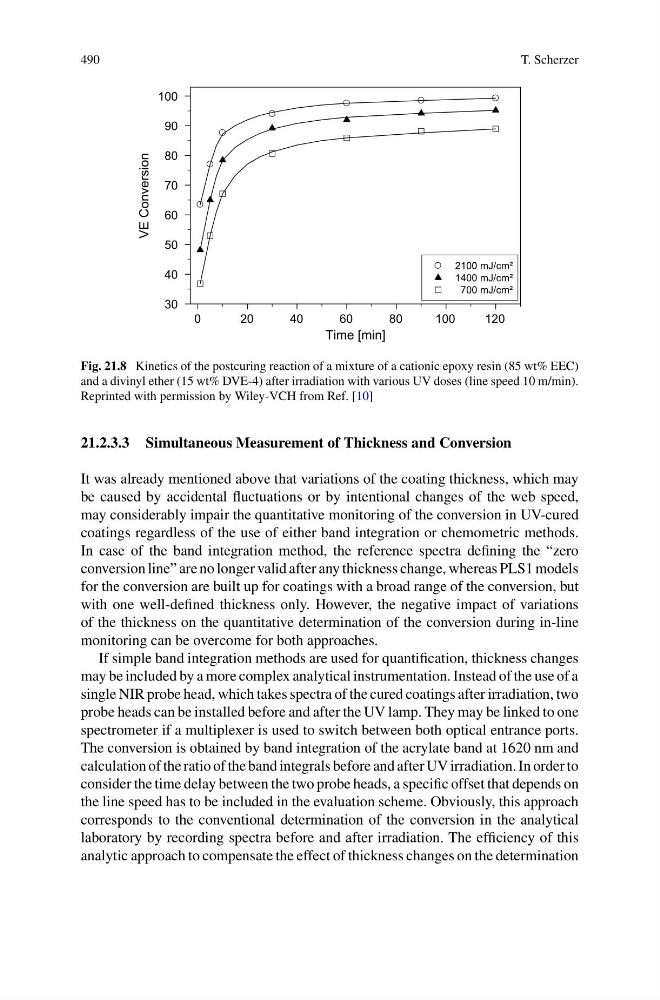
Fig. 21.8 Kinetics of the postcuring reaction of a mixture of a cationic epoxy resin (85 wt% EEC)
and a divinyl ether (15 wt% DVE-4) after irradiation with various UV doses (line speed 10 m/min).
Reprinted with permission by Wiley-VCH from Ref. [10]
21.2.3.3 Simultaneous Measurement of Thickness and Conversion
It was already mentioned above that variations of the coating thickness, which may
be caused by accidental fluctuations or by intentional changes of the web speed,
may considerably impair the quantitative monitoring of the conversion in UV-cured
coatings regardless of the use of either band integration or chemometric methods.
In case of the band integration method, the reference spectra defining the “zero
conversion line” are no longer valid after any thickness change, whereas PLS1 models
for the conversion are built up for coatings with a broad range of the conversion, but
with one well-defined thickness only. However, the negative impact of variations
of the thickness on the quantitative determination of the conversion during in-line
monitoring can be overcome for both approaches.
If simple band integration methods are used for quantification, thickness changes
may be included by a more complex analytical instrumentation. Instead of the use of a
single NIR probe head, which takes spectra of the cured coatings after irradiation, two
probe heads can be installed before and after the UV lamp. They may be linked to one
spectrometer if a multiplexer is used to switch between both optical entrance ports.
The conversion is obtained by band integration of the acrylate band at 1620 nm and
calculation of the ratio of the band integrals before and after UV irradiation. In order to
consider the time delay between the two probe heads, a specific offset that depends on
the line speed has to be included in the evaluation scheme. Obviously, this approach
corresponds to the conventional determination of the conversion in the analytical
laboratory by recording spectra before and after irradiation. The efficiency of this
analytic approach to compensate the effect of thickness changes on the determination
T. Scherzer
Time [min]
0
2 0
4 0
6 0
8 0
1 0 0
1 2 0
VE Conversion
30
40
50
60
70
80
90
100
2100 mJ/cm²
1400 mJ/cm²
700 mJ/cm²
Fig. 21.8 Kinetics of the postcuring reaction of a mixture of a cationic epoxy resin (85 wt% EEC)
and a divinyl ether (15 wt% DVE-4) after irradiation with various UV doses (line speed 10 m/min).
Reprinted with permission by Wiley-VCH from Ref. [10]
21.2.3.3 Simultaneous Measurement of Thickness and Conversion
It was already mentioned above that variations of the coating thickness, which may
be caused by accidental fluctuations or by intentional changes of the web speed,
may considerably impair the quantitative monitoring of the conversion in UV-cured
coatings regardless of the use of either band integration or chemometric methods.
In case of the band integration method, the reference spectra defining the “zero
conversion line” are no longer valid after any thickness change, whereas PLS1 models
for the conversion are built up for coatings with a broad range of the conversion, but
with one well-defined thickness only. However, the negative impact of variations
of the thickness on the quantitative determination of the conversion during in-line
monitoring can be overcome for both approaches.
If simple band integration methods are used for quantification, thickness changes
may be included by a more complex analytical instrumentation. Instead of the use of a
single NIR probe head, which takes spectra of the cured coatings after irradiation, two
probe heads can be installed before and after the UV lamp. They may be linked to one
spectrometer if a multiplexer is used to switch between both optical entrance ports.
The conversion is obtained by band integration of the acrylate band at 1620 nm and
calculation of the ratio of the band integrals before and after UV irradiation. In order to
consider the time delay between the two probe heads, a specific offset that depends on
the line speed has to be included in the evaluation scheme. Obviously, this approach
corresponds to the conventional determination of the conversion in the analytical
laboratory by recording spectra before and after irradiation. The efficiency of this
analytic approach to compensate the effect of thickness changes on the determination