

452
H. M. Heise
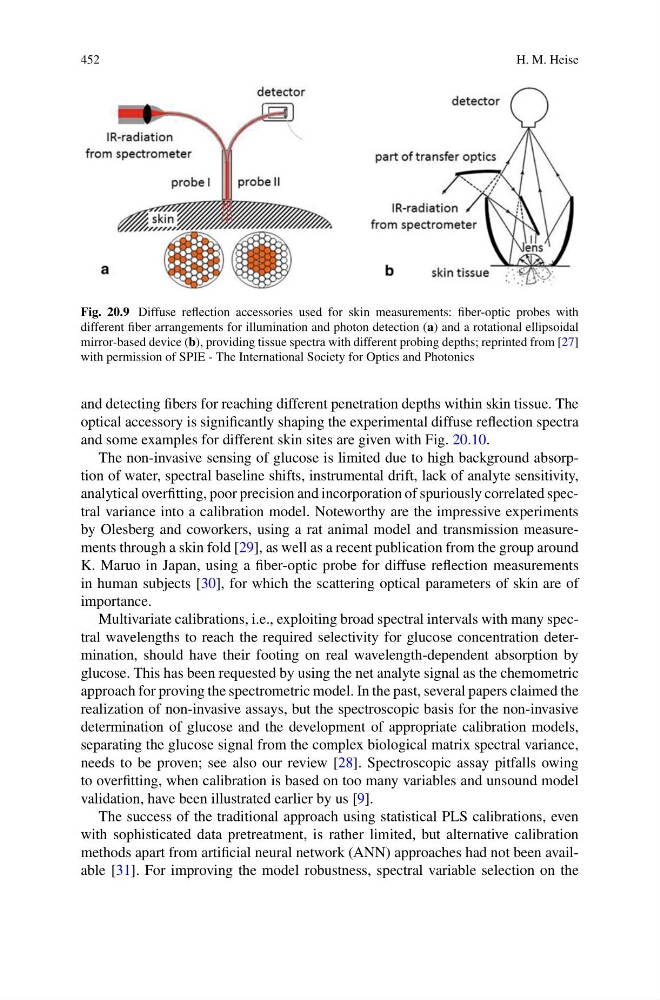
Fig. 20.9 Diffuse reflection accessories used for skin measurements: fiber-optic probes with
different fiber arrangements for illumination and photon detection (a) and a rotational ellipsoidal
mirror-based device (b), providing tissue spectra with different probing depths; reprinted from [27]
with permission of SPIE - The International Society for Optics and Photonics
and detecting fibers for reaching different penetration depths within skin tissue. The
optical accessory is significantly shaping the experimental diffuse reflection spectra
and some examples for different skin sites are given with Fig. 20.10.
The non-invasive sensing of glucose is limited due to high background absorption of water, spectral baseline shifts, instrumental drift, lack of analyte sensitivity,
analytical overfitting, poor precision and incorporation of spuriously correlated spectral variance into a calibration model. Noteworthy are the impressive experiments
by Olesberg and coworkers, using a rat animal model and transmission measurements through a skin fold [29], as well as a recent publication from the group around
K. Maruo in Japan, using a fiber-optic probe for diffuse reflection measurements
in human subjects [30], for which the scattering optical parameters of skin are of
importance.
Multivariate calibrations, i.e., exploiting broad spectral intervals with many spectral wavelengths to reach the required selectivity for glucose concentration determination, should have their footing on real wavelength-dependent absorption by
glucose. This has been requested by using the net analyte signal as the chemometric
approach for proving the spectrometric model. In the past, several papers claimed the
realization of non-invasive assays, but the spectroscopic basis for the non-invasive
determination of glucose and the development of appropriate calibration models,
separating the glucose signal from the complex biological matrix spectral variance,
needs to be proven; see also our review [28]. Spectroscopic assay pitfalls owing
to overfitting, when calibration is based on too many variables and unsound model
validation, have been illustrated earlier by us [9].
The success of the traditional approach using statistical PLS calibrations, even
with sophisticated data pretreatment, is rather limited, but alternative calibration
methods apart from artificial neural network (ANN) approaches had not been available [31]. For improving the model robustness, spectral variable selection on the
H. M. Heise
Fig. 20.9 Diffuse reflection accessories used for skin measurements: fiber-optic probes with
different fiber arrangements for illumination and photon detection (a) and a rotational ellipsoidal
mirror-based device (b), providing tissue spectra with different probing depths; reprinted from [27]
with permission of SPIE - The International Society for Optics and Photonics
and detecting fibers for reaching different penetration depths within skin tissue. The
optical accessory is significantly shaping the experimental diffuse reflection spectra
and some examples for different skin sites are given with Fig. 20.10.
The non-invasive sensing of glucose is limited due to high background absorption of water, spectral baseline shifts, instrumental drift, lack of analyte sensitivity,
analytical overfitting, poor precision and incorporation of spuriously correlated spectral variance into a calibration model. Noteworthy are the impressive experiments
by Olesberg and coworkers, using a rat animal model and transmission measurements through a skin fold [29], as well as a recent publication from the group around
K. Maruo in Japan, using a fiber-optic probe for diffuse reflection measurements
in human subjects [30], for which the scattering optical parameters of skin are of
importance.
Multivariate calibrations, i.e., exploiting broad spectral intervals with many spectral wavelengths to reach the required selectivity for glucose concentration determination, should have their footing on real wavelength-dependent absorption by
glucose. This has been requested by using the net analyte signal as the chemometric
approach for proving the spectrometric model. In the past, several papers claimed the
realization of non-invasive assays, but the spectroscopic basis for the non-invasive
determination of glucose and the development of appropriate calibration models,
separating the glucose signal from the complex biological matrix spectral variance,
needs to be proven; see also our review [28]. Spectroscopic assay pitfalls owing
to overfitting, when calibration is based on too many variables and unsound model
validation, have been illustrated earlier by us [9].
The success of the traditional approach using statistical PLS calibrations, even
with sophisticated data pretreatment, is rather limited, but alternative calibration
methods apart from artificial neural network (ANN) approaches had not been available [31]. For improving the model robustness, spectral variable selection on the