

20 Medical Applications of NIR Spectroscopy
451
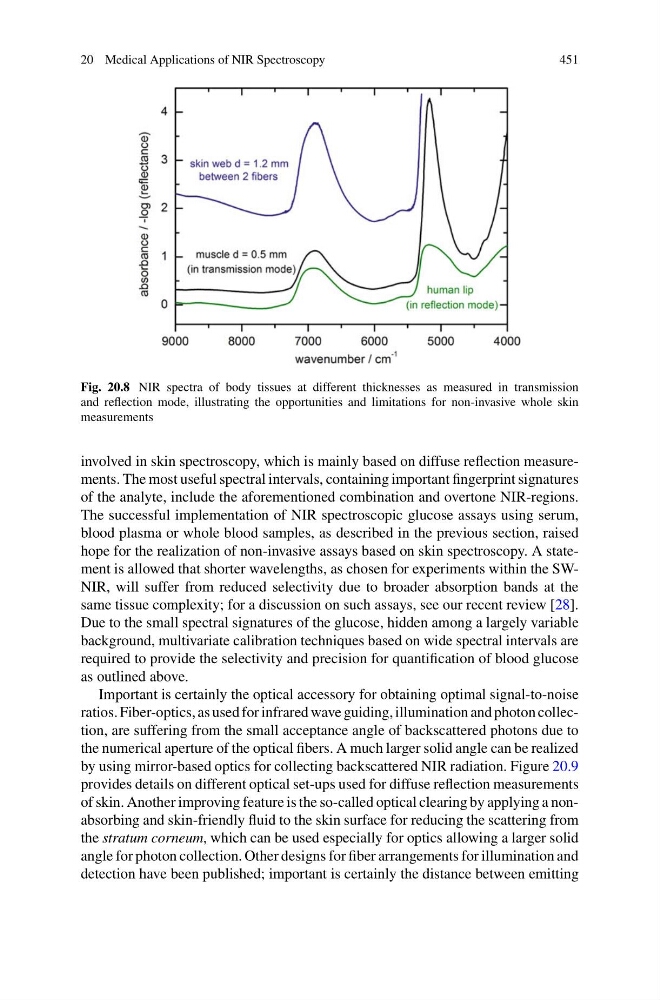
Fig. 20.8 NIR spectra of body tissues at different thicknesses as measured in transmission
and reflection mode, illustrating the opportunities and limitations for non-invasive whole skin
measurements
involved in skin spectroscopy, which is mainly based on diffuse reflection measurements. The most useful spectral intervals, containing important fingerprint signatures
of the analyte, include the aforementioned combination and overtone NIR-regions.
The successful implementation of NIR spectroscopic glucose assays using serum,
blood plasma or whole blood samples, as described in the previous section, raised
hope for the realization of non-invasive assays based on skin spectroscopy. A statement is allowed that shorter wavelengths, as chosen for experiments within the SWNIR, will suffer from reduced selectivity due to broader absorption bands at the
same tissue complexity; for a discussion on such assays, see our recent review [28].
Due to the small spectral signatures of the glucose, hidden among a largely variable
background, multivariate calibration techniques based on wide spectral intervals are
required to provide the selectivity and precision for quantification of blood glucose
as outlined above.
Important is certainly the optical accessory for obtaining optimal signal-to-noise
ratios. Fiber-optics, as used for infrared wave guiding, illumination and photon collection, are suffering from the small acceptance angle of backscattered photons due to
the numerical aperture of the optical fibers. A much larger solid angle can be realized
by using mirror-based optics for collecting backscattered NIR radiation. Figure 20.9
provides details on different optical set-ups used for diffuse reflection measurements
of skin. Another improving feature is the so-called optical clearing by applying a nonabsorbing and skin-friendly fluid to the skin surface for reducing the scattering from
the stratum corneum, which can be used especially for optics allowing a larger solid
angle for photon collection. Other designs for fiber arrangements for illumination and
detection have been published; important is certainly the distance between emitting
451
Fig. 20.8 NIR spectra of body tissues at different thicknesses as measured in transmission
and reflection mode, illustrating the opportunities and limitations for non-invasive whole skin
measurements
involved in skin spectroscopy, which is mainly based on diffuse reflection measurements. The most useful spectral intervals, containing important fingerprint signatures
of the analyte, include the aforementioned combination and overtone NIR-regions.
The successful implementation of NIR spectroscopic glucose assays using serum,
blood plasma or whole blood samples, as described in the previous section, raised
hope for the realization of non-invasive assays based on skin spectroscopy. A statement is allowed that shorter wavelengths, as chosen for experiments within the SWNIR, will suffer from reduced selectivity due to broader absorption bands at the
same tissue complexity; for a discussion on such assays, see our recent review [28].
Due to the small spectral signatures of the glucose, hidden among a largely variable
background, multivariate calibration techniques based on wide spectral intervals are
required to provide the selectivity and precision for quantification of blood glucose
as outlined above.
Important is certainly the optical accessory for obtaining optimal signal-to-noise
ratios. Fiber-optics, as used for infrared wave guiding, illumination and photon collection, are suffering from the small acceptance angle of backscattered photons due to
the numerical aperture of the optical fibers. A much larger solid angle can be realized
by using mirror-based optics for collecting backscattered NIR radiation. Figure 20.9
provides details on different optical set-ups used for diffuse reflection measurements
of skin. Another improving feature is the so-called optical clearing by applying a nonabsorbing and skin-friendly fluid to the skin surface for reducing the scattering from
the stratum corneum, which can be used especially for optics allowing a larger solid
angle for photon collection. Other designs for fiber arrangements for illumination and
detection have been published; important is certainly the distance between emitting