

450
H. M. Heise
20.3.1 Non-invasive Technology for Glucose Monitoring
The benefits of tight glycemic control in people with diabetes have been repeatedly well described in the past. Previous studies had indicated that intensive insulin
therapy in diabetic patients can dramatically delay the onset of serious micro- and
macrovascular complications affecting eye sight, kidney, perfusion of the extremities
and others. Most diabetic patients are using blood glucose self-monitoring (SMBG)
devices for monitoring their glucose levels and adjustments of their insulin dosage
to achieve normoglycemia. When undergoing intensive insulin therapy, current
glucose monitoring requires people with diabetes to prick their fingers for blood
sampling several times a day. Besides that also needle-type wearable sensors based
on enzyme-mediated electrochemistry are nowadays available for continuous monitoring of interstitial glucose within the subcutaneous skin tissue (see also our recent
review [28]), but suffer from systematic deviations from the capillary or arterial
blood glucose level as gold standard for treatment with insulin. A non-invasive
measurement device certainly eliminates the inconvenience and pain of frequent
finger pricking or, as in the case of continuously sensing systems, avoids the invasiveness of needle-type sensors, allowing also a much higher frequency of readings
than using SMBG invasive techniques.
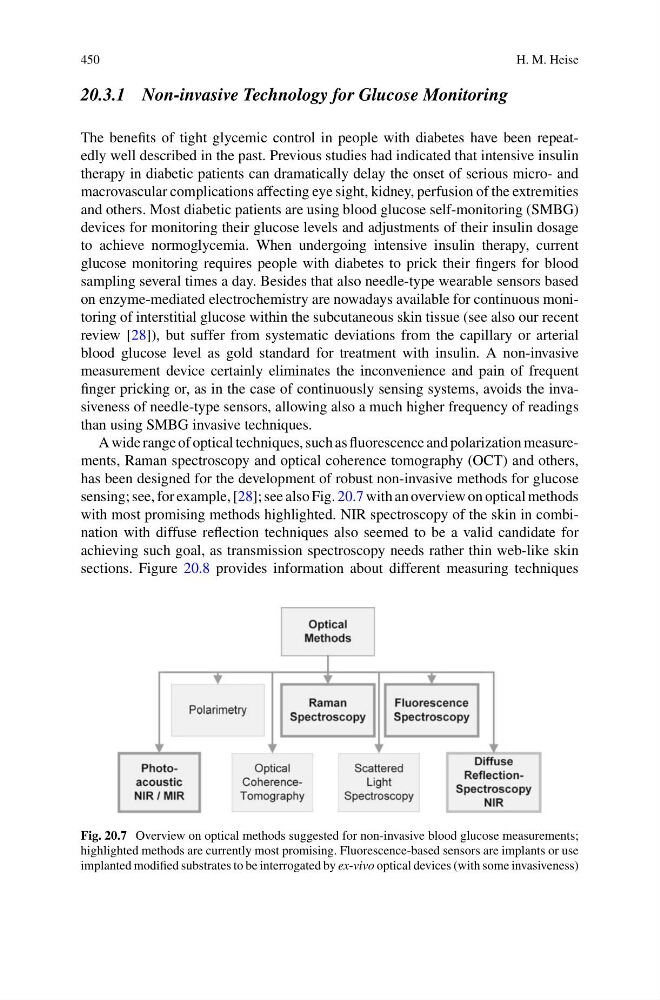
A wide range of optical techniques, such as fluorescence and polarization measurements, Raman spectroscopy and optical coherence tomography (OCT) and others,
has been designed for the development of robust non-invasive methods for glucose
sensing; see, for example, [28]; see also Fig. 20.7 with an overview on optical methods
with most promising methods highlighted. NIR spectroscopy of the skin in combination with diffuse reflection techniques also seemed to be a valid candidate for
achieving such goal, as transmission spectroscopy needs rather thin web-like skin
sections. Figure 20.8 provides information about different measuring techniques
Fig. 20.7 Overview on optical methods suggested for non-invasive blood glucose measurements;
highlighted methods are currently most promising. Fluorescence-based sensors are implants or use
implanted modified substrates to be interrogated by ex-vivo optical devices (with some invasiveness)
H. M. Heise
20.3.1 Non-invasive Technology for Glucose Monitoring
The benefits of tight glycemic control in people with diabetes have been repeatedly well described in the past. Previous studies had indicated that intensive insulin
therapy in diabetic patients can dramatically delay the onset of serious micro- and
macrovascular complications affecting eye sight, kidney, perfusion of the extremities
and others. Most diabetic patients are using blood glucose self-monitoring (SMBG)
devices for monitoring their glucose levels and adjustments of their insulin dosage
to achieve normoglycemia. When undergoing intensive insulin therapy, current
glucose monitoring requires people with diabetes to prick their fingers for blood
sampling several times a day. Besides that also needle-type wearable sensors based
on enzyme-mediated electrochemistry are nowadays available for continuous monitoring of interstitial glucose within the subcutaneous skin tissue (see also our recent
review [28]), but suffer from systematic deviations from the capillary or arterial
blood glucose level as gold standard for treatment with insulin. A non-invasive
measurement device certainly eliminates the inconvenience and pain of frequent
finger pricking or, as in the case of continuously sensing systems, avoids the invasiveness of needle-type sensors, allowing also a much higher frequency of readings
than using SMBG invasive techniques.
A wide range of optical techniques, such as fluorescence and polarization measurements, Raman spectroscopy and optical coherence tomography (OCT) and others,
has been designed for the development of robust non-invasive methods for glucose
sensing; see, for example, [28]; see also Fig. 20.7 with an overview on optical methods
with most promising methods highlighted. NIR spectroscopy of the skin in combination with diffuse reflection techniques also seemed to be a valid candidate for
achieving such goal, as transmission spectroscopy needs rather thin web-like skin
sections. Figure 20.8 provides information about different measuring techniques
Fig. 20.7 Overview on optical methods suggested for non-invasive blood glucose measurements;
highlighted methods are currently most promising. Fluorescence-based sensors are implants or use
implanted modified substrates to be interrogated by ex-vivo optical devices (with some invasiveness)