

418
C. W. Huck
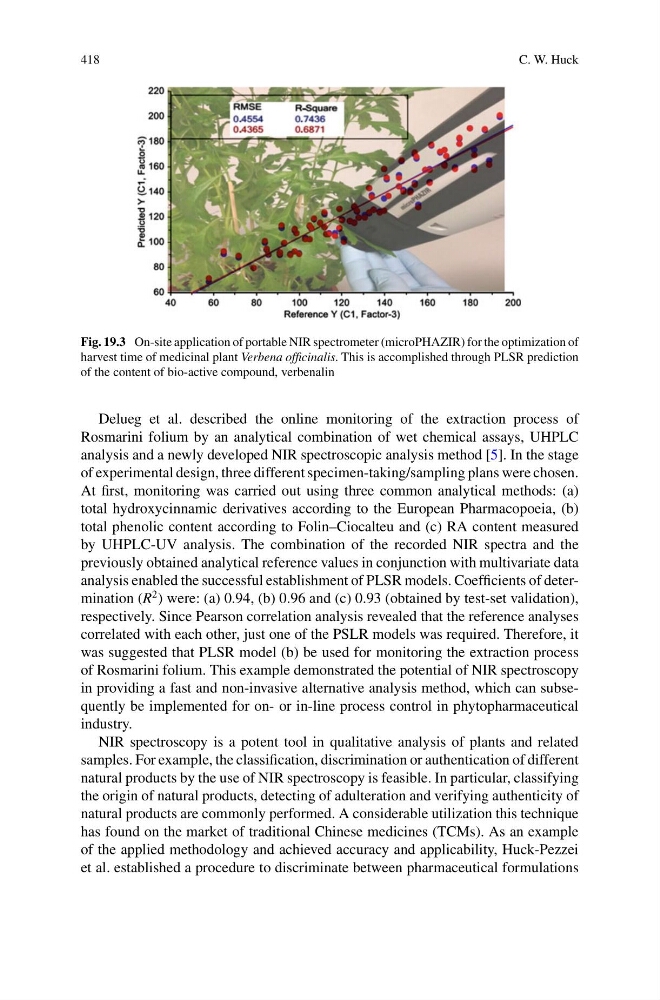
Fig. 19.3 On-site application of portable NIR spectrometer (microPHAZIR) for the optimization of
harvest time of medicinal plant Verbena officinalis. This is accomplished through PLSR prediction
of the content of bio-active compound, verbenalin
Delueg et al. described the online monitoring of the extraction process of
Rosmarini folium by an analytical combination of wet chemical assays, UHPLC
analysis and a newly developed NIR spectroscopic analysis method [5]. In the stage
of experimental design, three different specimen-taking/sampling plans were chosen.
At first, monitoring was carried out using three common analytical methods: (a)
total hydroxycinnamic derivatives according to the European Pharmacopoeia, (b)
total phenolic content according to Folin–Ciocalteu and (c) RA content measured
by UHPLC-UV analysis. The combination of the recorded NIR spectra and the
previously obtained analytical reference values in conjunction with multivariate data
analysis enabled the successful establishment of PLSR models. Coefficients of determination (R
2 ) were: (a) 0.94, (b) 0.96 and (c) 0.93 (obtained by test-set validation),
respectively. Since Pearson correlation analysis revealed that the reference analyses
correlated with each other, just one of the PSLR models was required. Therefore, it
was suggested that PLSR model (b) be used for monitoring the extraction process
of Rosmarini folium. This example demonstrated the potential of NIR spectroscopy
in providing a fast and non-invasive alternative analysis method, which can subsequently be implemented for on- or in-line process control in phytopharmaceutical
industry.
NIR spectroscopy is a potent tool in qualitative analysis of plants and related
samples. For example, the classification, discrimination or authentication of different
natural products by the use of NIR spectroscopy is feasible. In particular, classifying
the origin of natural products, detecting of adulteration and verifying authenticity of
natural products are commonly performed. A considerable utilization this technique
has found on the market of traditional Chinese medicines (TCMs). As an example
of the applied methodology and achieved accuracy and applicability, Huck-Pezzei
et al. established a procedure to discriminate between pharmaceutical formulations
C. W. Huck
Fig. 19.3 On-site application of portable NIR spectrometer (microPHAZIR) for the optimization of
harvest time of medicinal plant Verbena officinalis. This is accomplished through PLSR prediction
of the content of bio-active compound, verbenalin
Delueg et al. described the online monitoring of the extraction process of
Rosmarini folium by an analytical combination of wet chemical assays, UHPLC
analysis and a newly developed NIR spectroscopic analysis method [5]. In the stage
of experimental design, three different specimen-taking/sampling plans were chosen.
At first, monitoring was carried out using three common analytical methods: (a)
total hydroxycinnamic derivatives according to the European Pharmacopoeia, (b)
total phenolic content according to Folin–Ciocalteu and (c) RA content measured
by UHPLC-UV analysis. The combination of the recorded NIR spectra and the
previously obtained analytical reference values in conjunction with multivariate data
analysis enabled the successful establishment of PLSR models. Coefficients of determination (R
2 ) were: (a) 0.94, (b) 0.96 and (c) 0.93 (obtained by test-set validation),
respectively. Since Pearson correlation analysis revealed that the reference analyses
correlated with each other, just one of the PSLR models was required. Therefore, it
was suggested that PLSR model (b) be used for monitoring the extraction process
of Rosmarini folium. This example demonstrated the potential of NIR spectroscopy
in providing a fast and non-invasive alternative analysis method, which can subsequently be implemented for on- or in-line process control in phytopharmaceutical
industry.
NIR spectroscopy is a potent tool in qualitative analysis of plants and related
samples. For example, the classification, discrimination or authentication of different
natural products by the use of NIR spectroscopy is feasible. In particular, classifying
the origin of natural products, detecting of adulteration and verifying authenticity of
natural products are commonly performed. A considerable utilization this technique
has found on the market of traditional Chinese medicines (TCMs). As an example
of the applied methodology and achieved accuracy and applicability, Huck-Pezzei
et al. established a procedure to discriminate between pharmaceutical formulations