

32
Y. Ozaki and Y. Morisawa
A potential energy V is generally expressed as:
V = k 2 Q
2
+ k 3 Q
3
+ k 4 Q
4
+ · · · · · ·
(2.33)
The high-order terms such as Q
3 and Q
4 are called anharmonic terms.
Calculating an eigen value E
’ ν considering up to the Q
3 -term, we obtain,
E
ν =
v +
1
2
hν e −
v +
1
2
2
hν e χ e
(2.34)
where ν a = a/π
√
D e /2π. The symbol χ e is a constant called an anharmonic
constant. One can estimate the degree of anharmonicity from the value of this
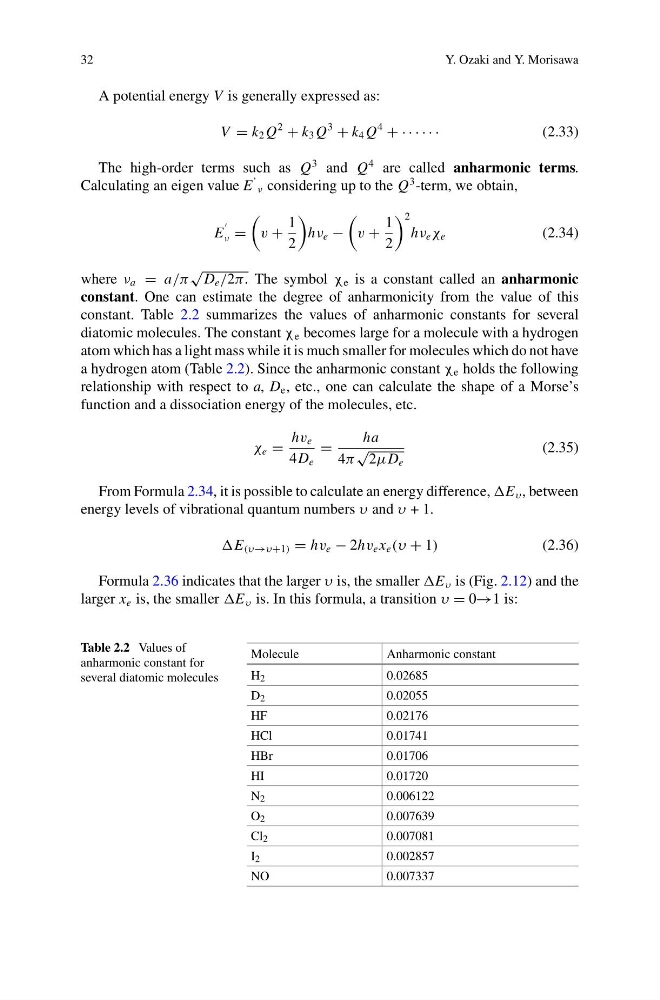
constant. Table 2.2 summarizes the values of anharmonic constants for several
diatomic molecules. The constant χ e becomes large for a molecule with a hydrogen
atom which has a light mass while it is much smaller for molecules which do not have
a hydrogen atom (Table 2.2). Since the anharmonic constant χ e holds the following
relationship with respect to a, D e , etc., one can calculate the shape of a Morse’s
function and a dissociation energy of the molecules, etc.
χ e =
hv e
4D e
=
ha
4π
√
2μD e
(2.35)
From Formula 2.34, it is possible to calculate an energy difference, E υ , between
energy levels of vibrational quantum numbers υ and υ + 1.
E (υ→υ+1) = hv e − 2hv e x e (υ + 1)
(2.36)
Formula 2.36 indicates that the larger υ is, the smaller E υ is (Fig. 2.12) and the
larger x e is, the smaller E υ is. In this formula, a transition υ = 0→1 is:
Table 2.2 Values of
anharmonic constant for
several diatomic molecules
Molecule
Anharmonic constant
H 2
0.02685
D 2
0.02055
HF
0.02176
HCl
0.01741
HBr
0.01706
HI
0.01720
N 2
0.006122
O 2
0.007639
Cl 2
0.007081
I 2
0.002857
NO
0.007337
Y. Ozaki and Y. Morisawa
A potential energy V is generally expressed as:
V = k 2 Q
2
+ k 3 Q
3
+ k 4 Q
4
+ · · · · · ·
(2.33)
The high-order terms such as Q
3 and Q
4 are called anharmonic terms.
Calculating an eigen value E
’ ν considering up to the Q
3 -term, we obtain,
E
ν =
v +
1
2
hν e −
v +
1
2
2
hν e χ e
(2.34)
where ν a = a/π
√
D e /2π. The symbol χ e is a constant called an anharmonic
constant. One can estimate the degree of anharmonicity from the value of this
constant. Table 2.2 summarizes the values of anharmonic constants for several
diatomic molecules. The constant χ e becomes large for a molecule with a hydrogen
atom which has a light mass while it is much smaller for molecules which do not have
a hydrogen atom (Table 2.2). Since the anharmonic constant χ e holds the following
relationship with respect to a, D e , etc., one can calculate the shape of a Morse’s
function and a dissociation energy of the molecules, etc.
χ e =
hv e
4D e
=
ha
4π
√
2μD e
(2.35)
From Formula 2.34, it is possible to calculate an energy difference, E υ , between
energy levels of vibrational quantum numbers υ and υ + 1.
E (υ→υ+1) = hv e − 2hv e x e (υ + 1)
(2.36)
Formula 2.36 indicates that the larger υ is, the smaller E υ is (Fig. 2.12) and the
larger x e is, the smaller E υ is. In this formula, a transition υ = 0→1 is:
Table 2.2 Values of
anharmonic constant for
several diatomic molecules
Molecule
Anharmonic constant
H 2
0.02685
D 2
0.02055
HF
0.02176
HCl
0.01741
HBr
0.01706
HI
0.01720
N 2
0.006122
O 2
0.007639
Cl 2
0.007081
I 2
0.002857
NO
0.007337