

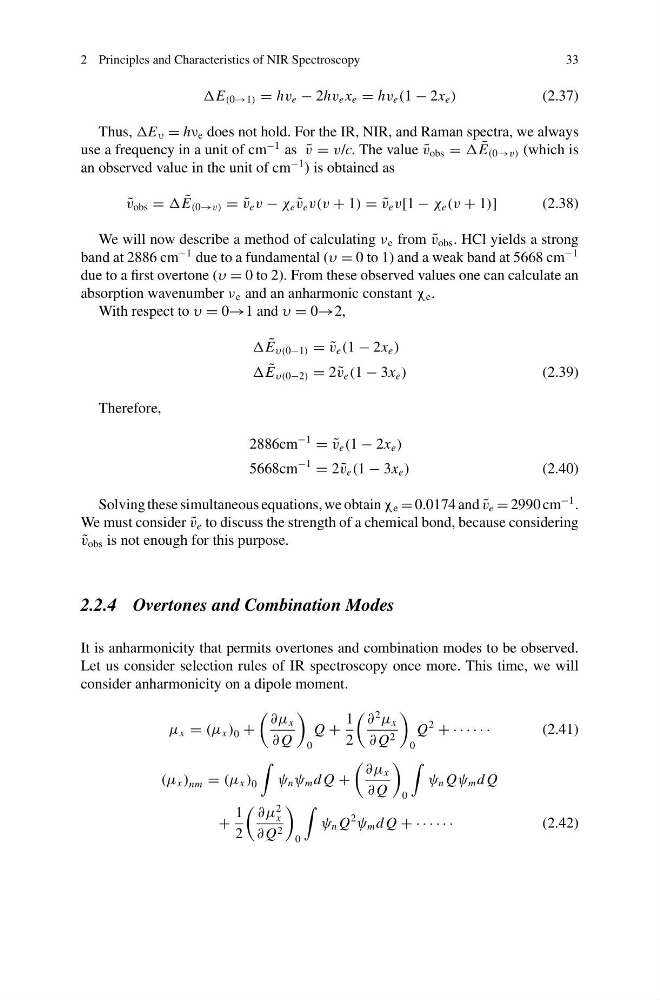
2 Principles and Characteristics of NIR Spectroscopy
33
E (0→1) = hv e − 2hv e x e = hv e (1 − 2x e )
(2.37)
Thus, E υ = hν e does not hold. For the IR, NIR, and Raman spectra, we always
use a frequency in a unit of cm
−1 as ˜
v = v/c. The value ˜
v obs = ˜
E (0→v) (which is
an observed value in the unit of cm
−1 ) is obtained as
˜
v obs = ˜
E (0→v) = ˜
v e v − χ e ˜
v e v(v + 1) = ˜
v e v[1 − χ e (v + 1)]
(2.38)
We will now describe a method of calculating ν e from ˜
v obs . HCl yields a strong
band at 2886 cm
−1 due to a fundamental (υ = 0 to 1) and a weak band at 5668 cm
−1
due to a first overtone (υ = 0 to 2). From these observed values one can calculate an
absorption wavenumber ν e and an anharmonic constant χ e .
With respect to υ = 0→1 and υ = 0→2,
˜
E υ(0−1) = ˜
v e (1 − 2x e )
˜
E υ(0−2) = 2 ˜
v e (1 − 3x e )
(2.39)
Therefore,
2886cm
−1
= ˜
v e (1 − 2x e )
5668cm
−1
= 2 ˜
v e (1 − 3x e )
(2.40)
Solving these simultaneous equations, we obtain χ e = 0.0174 and ˜
v e = 2990 cm
−1 .
We must consider ˜
v e to discuss the strength of a chemical bond, because considering
˜
v obs is not enough for this purpose.
2.2.4 Overtones and Combination Modes
It is anharmonicity that permits overtones and combination modes to be observed.
Let us consider selection rules of IR spectroscopy once more. This time, we will
consider anharmonicity on a dipole moment.
μ x = (μ x ) 0 +
∂μ x
∂ Q
0
Q +
1
2
∂
2
μ x
∂ Q 2
0
Q
2
+ · · · · · ·
(2.41)
(μ x ) nm = (μ x ) 0
ψ n ψ m d Q +
∂μ x
∂ Q
0
ψ n Qψ m d Q
+
1
2
∂μ
2
x
∂ Q 2
0
ψ n Q
2
ψ m d Q + · · · · · ·
(2.42)
33
E (0→1) = hv e − 2hv e x e = hv e (1 − 2x e )
(2.37)
Thus, E υ = hν e does not hold. For the IR, NIR, and Raman spectra, we always
use a frequency in a unit of cm
−1 as ˜
v = v/c. The value ˜
v obs = ˜
E (0→v) (which is
an observed value in the unit of cm
−1 ) is obtained as
˜
v obs = ˜
E (0→v) = ˜
v e v − χ e ˜
v e v(v + 1) = ˜
v e v[1 − χ e (v + 1)]
(2.38)
We will now describe a method of calculating ν e from ˜
v obs . HCl yields a strong
band at 2886 cm
−1 due to a fundamental (υ = 0 to 1) and a weak band at 5668 cm
−1
due to a first overtone (υ = 0 to 2). From these observed values one can calculate an
absorption wavenumber ν e and an anharmonic constant χ e .
With respect to υ = 0→1 and υ = 0→2,
˜
E υ(0−1) = ˜
v e (1 − 2x e )
˜
E υ(0−2) = 2 ˜
v e (1 − 3x e )
(2.39)
Therefore,
2886cm
−1
= ˜
v e (1 − 2x e )
5668cm
−1
= 2 ˜
v e (1 − 3x e )
(2.40)
Solving these simultaneous equations, we obtain χ e = 0.0174 and ˜
v e = 2990 cm
−1 .
We must consider ˜
v e to discuss the strength of a chemical bond, because considering
˜
v obs is not enough for this purpose.
2.2.4 Overtones and Combination Modes
It is anharmonicity that permits overtones and combination modes to be observed.
Let us consider selection rules of IR spectroscopy once more. This time, we will
consider anharmonicity on a dipole moment.
μ x = (μ x ) 0 +
∂μ x
∂ Q
0
Q +
1
2
∂
2
μ x
∂ Q 2
0
Q
2
+ · · · · · ·
(2.41)
(μ x ) nm = (μ x ) 0
ψ n ψ m d Q +
∂μ x
∂ Q
0
ψ n Qψ m d Q
+
1
2
∂μ
2
x
∂ Q 2
0
ψ n Q
2
ψ m d Q + · · · · · ·
(2.42)