

2 Principles and Characteristics of NIR Spectroscopy
31
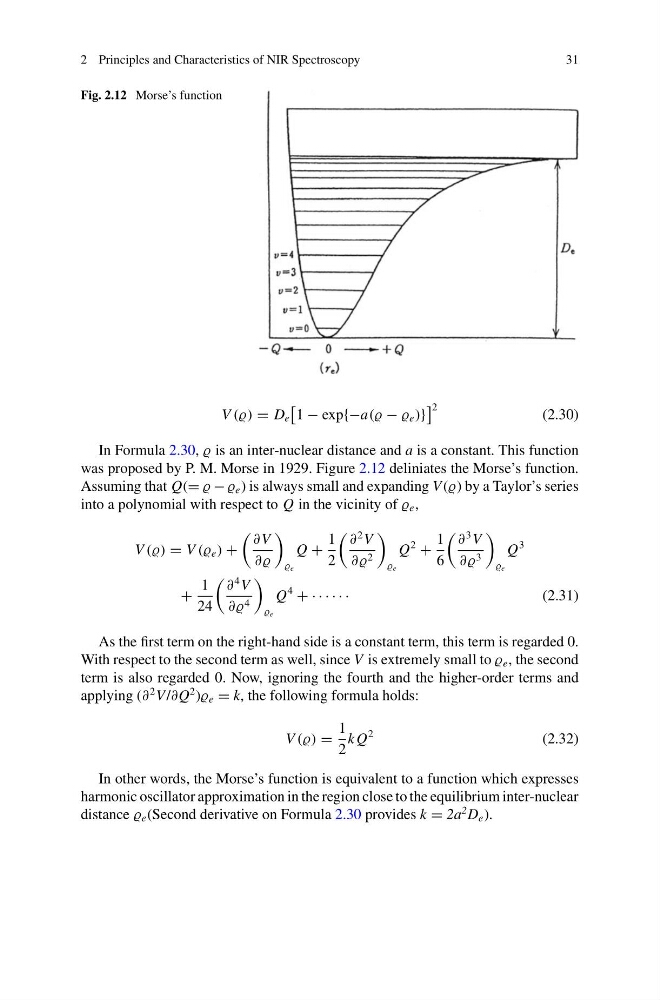
Fig. 2.12 Morse’s function
V () = D e
1 − exp{−a( − e )}
2
(2.30)
In Formula 2.30, is an inter-nuclear distance and a is a constant. This function
was proposed by P. M. Morse in 1929. Figure 2.12 deliniates the Morse’s function.
Assuming that Q(= − e ) is always small and expanding V () by a Taylor’s series
into a polynomial with respect to Q in the vicinity of e ,
V () = V ( e ) +
∂ V
∂∂
e
Q +
1
2
∂
2 V
∂∂ 2
e
Q
2
+
1
6
∂
3 V
∂∂ 3
e
Q
3
+
1
24
∂
4 V
∂∂ 4
e
Q
4
+ · · · · · ·
(2.31)
As the first term on the right-hand side is a constant term, this term is regarded 0.
With respect to the second term as well, since V is extremely small to e , the second
term is also regarded 0. Now, ignoring the fourth and the higher-order terms and
applying (∂
2 V /∂Q
2 ) e = k, the following formula holds:
V () =
1
2
k Q
2
(2.32)
In other words, the Morse’s function is equivalent to a function which expresses
harmonic oscillator approximation in the region close to the equilibrium inter-nuclear
distance e (Second derivative on Formula 2.30 provides k = 2a
2 D e ).
31
Fig. 2.12 Morse’s function
V () = D e
1 − exp{−a( − e )}
2
(2.30)
In Formula 2.30, is an inter-nuclear distance and a is a constant. This function
was proposed by P. M. Morse in 1929. Figure 2.12 deliniates the Morse’s function.
Assuming that Q(= − e ) is always small and expanding V () by a Taylor’s series
into a polynomial with respect to Q in the vicinity of e ,
V () = V ( e ) +
∂ V
∂∂
e
Q +
1
2
∂
2 V
∂∂ 2
e
Q
2
+
1
6
∂
3 V
∂∂ 3
e
Q
3
+
1
24
∂
4 V
∂∂ 4
e
Q
4
+ · · · · · ·
(2.31)
As the first term on the right-hand side is a constant term, this term is regarded 0.
With respect to the second term as well, since V is extremely small to e , the second
term is also regarded 0. Now, ignoring the fourth and the higher-order terms and
applying (∂
2 V /∂Q
2 ) e = k, the following formula holds:
V () =
1
2
k Q
2
(2.32)
In other words, the Morse’s function is equivalent to a function which expresses
harmonic oscillator approximation in the region close to the equilibrium inter-nuclear
distance e (Second derivative on Formula 2.30 provides k = 2a
2 D e ).