

30
Y. Ozaki and Y. Morisawa
As normal vibrations are independent of each other, the above formula can be
separated into n wave equations, respectively, corresponding to the respective normal
vibrations, an eigen value E υ is expressed as the sum of eigen values E i of the
respective normal vibrations, and an eigen function ψ υ is given as a product of eigen
functions ψ i representing the respective normal vibrations. Since Formula 2.27 has
the same style as Formula 2.20, the eigen value E i is also the same as Formula 2.21.
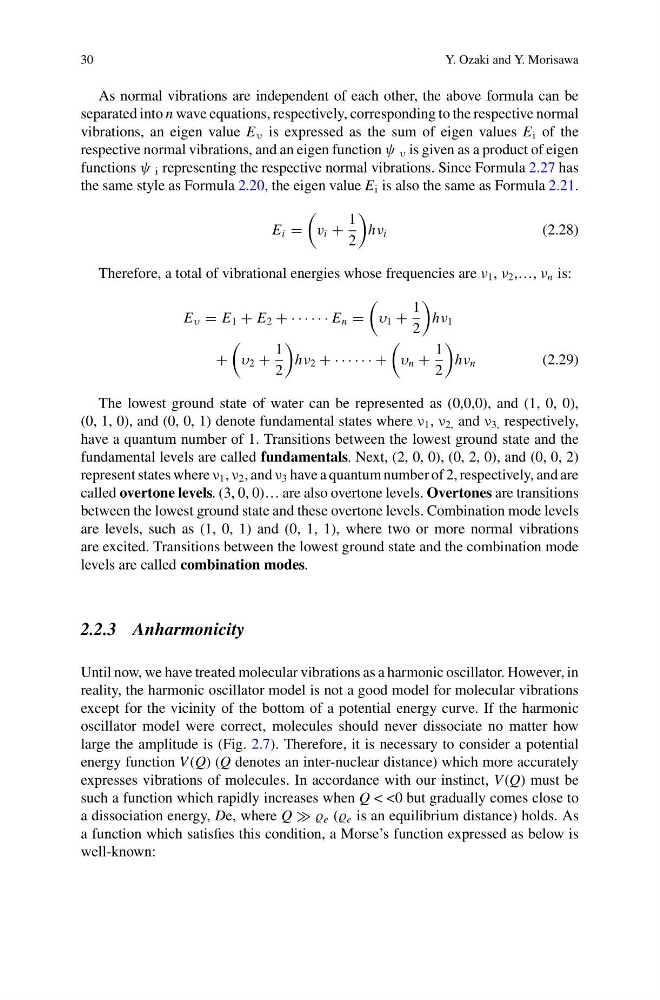
E i =
v i +
1
2
hν i
(2.28)
Therefore, a total of vibrational energies whose frequencies are ν 1 , ν 2 ,…, ν n is:
E υ = E 1 + E 2 + · · · · · · E n =
υ 1 +
1
2
hν 1
+
υ 2 +
1
2
hν 2 + · · · · · · +
υ n +
1
2
hν n
(2.29)
The lowest ground state of water can be represented as (0,0,0), and (1, 0, 0),
(0, 1, 0), and (0, 0, 1) denote fundamental states where ν 1 , ν 2, and ν 3, respectively,
have a quantum number of 1. Transitions between the lowest ground state and the
fundamental levels are called fundamentals. Next, (2, 0, 0), (0, 2, 0), and (0, 0, 2)
represent states where ν 1 , ν 2 , and ν 3 have a quantum number of 2, respectively, and are
called overtone levels. (3, 0, 0)… are also overtone levels. Overtones are transitions
between the lowest ground state and these overtone levels. Combination mode levels
are levels, such as (1, 0, 1) and (0, 1, 1), where two or more normal vibrations
are excited. Transitions between the lowest ground state and the combination mode
levels are called combination modes.
2.2.3 Anharmonicity
Until now, we have treated molecular vibrations as a harmonic oscillator. However, in
reality, the harmonic oscillator model is not a good model for molecular vibrations
except for the vicinity of the bottom of a potential energy curve. If the harmonic
oscillator model were correct, molecules should never dissociate no matter how
large the amplitude is (Fig. 2.7). Therefore, it is necessary to consider a potential
energy function V (Q) (Q denotes an inter-nuclear distance) which more accurately
expresses vibrations of molecules. In accordance with our instinct, V (Q) must be
such a function which rapidly increases when Q < <0 but gradually comes close to
a dissociation energy, De, where Q e ( e is an equilibrium distance) holds. As
a function which satisfies this condition, a Morse’s function expressed as below is
well-known:
Y. Ozaki and Y. Morisawa
As normal vibrations are independent of each other, the above formula can be
separated into n wave equations, respectively, corresponding to the respective normal
vibrations, an eigen value E υ is expressed as the sum of eigen values E i of the
respective normal vibrations, and an eigen function ψ υ is given as a product of eigen
functions ψ i representing the respective normal vibrations. Since Formula 2.27 has
the same style as Formula 2.20, the eigen value E i is also the same as Formula 2.21.
E i =
v i +
1
2
hν i
(2.28)
Therefore, a total of vibrational energies whose frequencies are ν 1 , ν 2 ,…, ν n is:
E υ = E 1 + E 2 + · · · · · · E n =
υ 1 +
1
2
hν 1
+
υ 2 +
1
2
hν 2 + · · · · · · +
υ n +
1
2
hν n
(2.29)
The lowest ground state of water can be represented as (0,0,0), and (1, 0, 0),
(0, 1, 0), and (0, 0, 1) denote fundamental states where ν 1 , ν 2, and ν 3, respectively,
have a quantum number of 1. Transitions between the lowest ground state and the
fundamental levels are called fundamentals. Next, (2, 0, 0), (0, 2, 0), and (0, 0, 2)
represent states where ν 1 , ν 2 , and ν 3 have a quantum number of 2, respectively, and are
called overtone levels. (3, 0, 0)… are also overtone levels. Overtones are transitions
between the lowest ground state and these overtone levels. Combination mode levels
are levels, such as (1, 0, 1) and (0, 1, 1), where two or more normal vibrations
are excited. Transitions between the lowest ground state and the combination mode
levels are called combination modes.
2.2.3 Anharmonicity
Until now, we have treated molecular vibrations as a harmonic oscillator. However, in
reality, the harmonic oscillator model is not a good model for molecular vibrations
except for the vicinity of the bottom of a potential energy curve. If the harmonic
oscillator model were correct, molecules should never dissociate no matter how
large the amplitude is (Fig. 2.7). Therefore, it is necessary to consider a potential
energy function V (Q) (Q denotes an inter-nuclear distance) which more accurately
expresses vibrations of molecules. In accordance with our instinct, V (Q) must be
such a function which rapidly increases when Q < <0 but gradually comes close to
a dissociation energy, De, where Q e ( e is an equilibrium distance) holds. As
a function which satisfies this condition, a Morse’s function expressed as below is
well-known: