

17 Information and Communication Technology in Agriculture
385
the sugar content decreased from 2012 to 2013, with red and blue indicating sugar
content of less than and more than 14%, respectively. However, the potassium content
in cane juice increased in all farmlands. This indicates that potassium and the sugar
content are negatively correlated, that is, reducing potassium in the soil or adding an
organic fertilizer can increase the sugar content [8]. This evaluation system has been
used not only for cane payment but also as a low-cost diagnostic system to improve
field management. The NIR database contains information on all cane farmers in
Japan and could be extended to other farm management applications.
17.4 On-Site Analysis for Agriculture
In sugarcane production, estimating the cane quality and quantity prior to harvest is
key for optimizing harvest scheduling and supply chain management. Doing so would
contribute to increasing profitability for growers and sugar production factories.
A previous study reported a calibration model for analyzing sugarcane stalks and
evaluating components such as sugar, moisture, and fiber contents [9–11]. It used a
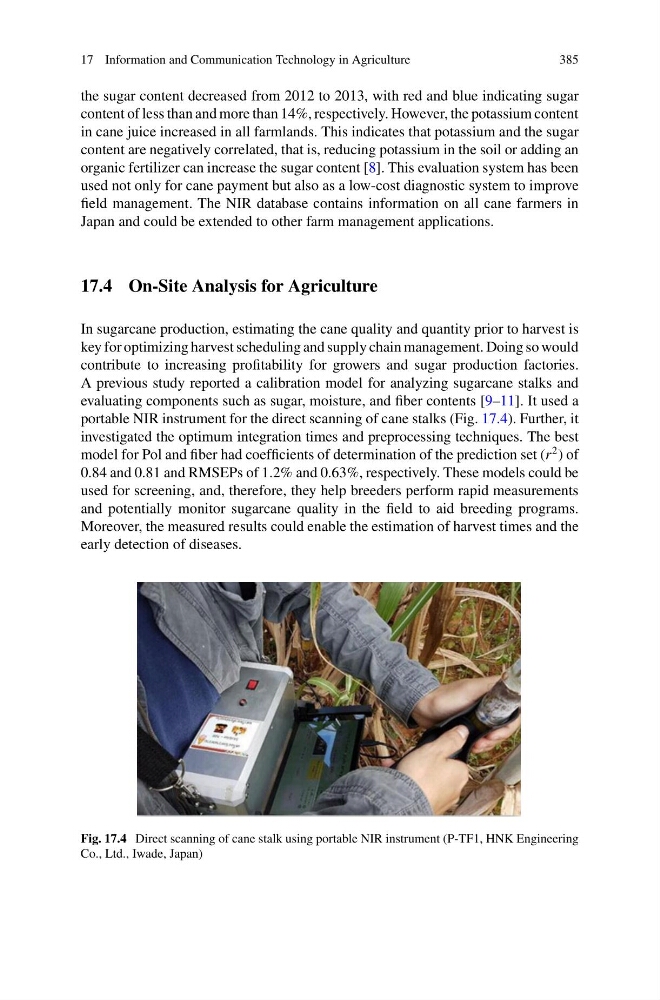
portable NIR instrument for the direct scanning of cane stalks (Fig. 17.4). Further, it
investigated the optimum integration times and preprocessing techniques. The best
model for Pol and fiber had coefficients of determination of the prediction set (r
2 ) of
0.84 and 0.81 and RMSEPs of 1.2% and 0.63%, respectively. These models could be
used for screening, and, therefore, they help breeders perform rapid measurements
and potentially monitor sugarcane quality in the field to aid breeding programs.
Moreover, the measured results could enable the estimation of harvest times and the
early detection of diseases.
Fig. 17.4 Direct scanning of cane stalk using portable NIR instrument (P-TF1, HNK Engineering
Co., Ltd., Iwade, Japan)
385
the sugar content decreased from 2012 to 2013, with red and blue indicating sugar
content of less than and more than 14%, respectively. However, the potassium content
in cane juice increased in all farmlands. This indicates that potassium and the sugar
content are negatively correlated, that is, reducing potassium in the soil or adding an
organic fertilizer can increase the sugar content [8]. This evaluation system has been
used not only for cane payment but also as a low-cost diagnostic system to improve
field management. The NIR database contains information on all cane farmers in
Japan and could be extended to other farm management applications.
17.4 On-Site Analysis for Agriculture
In sugarcane production, estimating the cane quality and quantity prior to harvest is
key for optimizing harvest scheduling and supply chain management. Doing so would
contribute to increasing profitability for growers and sugar production factories.
A previous study reported a calibration model for analyzing sugarcane stalks and
evaluating components such as sugar, moisture, and fiber contents [9–11]. It used a
portable NIR instrument for the direct scanning of cane stalks (Fig. 17.4). Further, it
investigated the optimum integration times and preprocessing techniques. The best
model for Pol and fiber had coefficients of determination of the prediction set (r
2 ) of
0.84 and 0.81 and RMSEPs of 1.2% and 0.63%, respectively. These models could be
used for screening, and, therefore, they help breeders perform rapid measurements
and potentially monitor sugarcane quality in the field to aid breeding programs.
Moreover, the measured results could enable the estimation of harvest times and the
early detection of diseases.
Fig. 17.4 Direct scanning of cane stalk using portable NIR instrument (P-TF1, HNK Engineering
Co., Ltd., Iwade, Japan)