

14 Application of NIR in Agriculture
337
Predicted leghaemoglobin content (mg/g)
Observed leghaemoglobin content (mg/g)
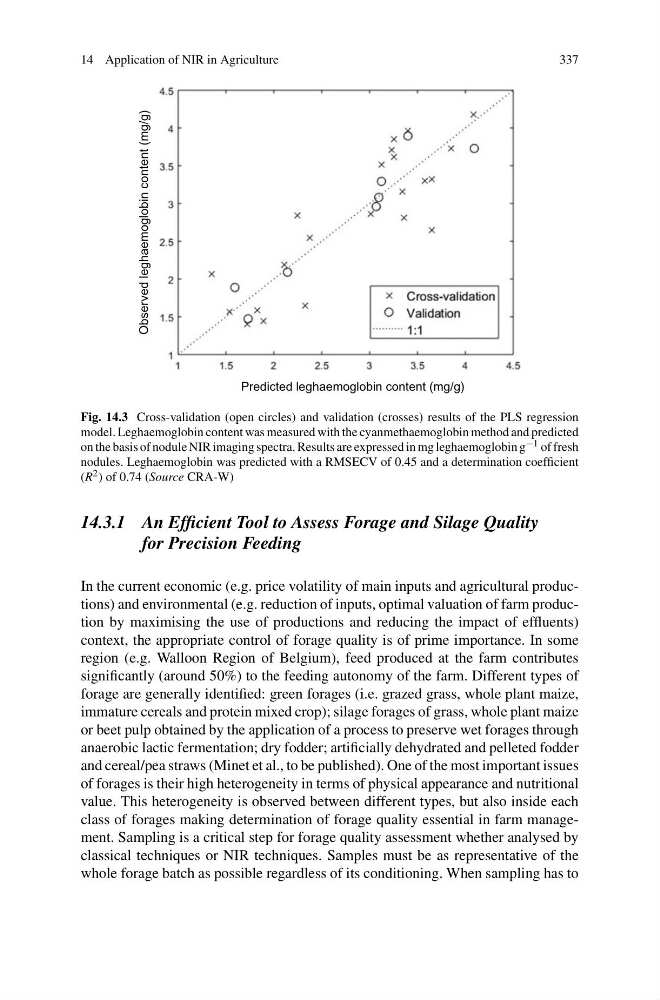
Fig. 14.3 Cross-validation (open circles) and validation (crosses) results of the PLS regression
model. Leghaemoglobin content was measured with the cyanmethaemoglobin method and predicted
on the basis of nodule NIR imaging spectra. Results are expressed in mg leghaemoglobin g −1 of fresh
nodules. Leghaemoglobin was predicted with a RMSECV of 0.45 and a determination coefficient
(R 2 ) of 0.74 (Source CRA-W)
14.3.1 An Efficient Tool to Assess Forage and Silage Quality
for Precision Feeding
In the current economic (e.g. price volatility of main inputs and agricultural productions) and environmental (e.g. reduction of inputs, optimal valuation of farm production by maximising the use of productions and reducing the impact of effluents)
context, the appropriate control of forage quality is of prime importance. In some
region (e.g. Walloon Region of Belgium), feed produced at the farm contributes
significantly (around 50%) to the feeding autonomy of the farm. Different types of
forage are generally identified: green forages (i.e. grazed grass, whole plant maize,
immature cereals and protein mixed crop); silage forages of grass, whole plant maize
or beet pulp obtained by the application of a process to preserve wet forages through
anaerobic lactic fermentation; dry fodder; artificially dehydrated and pelleted fodder
and cereal/pea straws (Minet et al., to be published). One of the most important issues
of forages is their high heterogeneity in terms of physical appearance and nutritional
value. This heterogeneity is observed between different types, but also inside each
class of forages making determination of forage quality essential in farm management. Sampling is a critical step for forage quality assessment whether analysed by
classical techniques or NIR techniques. Samples must be as representative of the
whole forage batch as possible regardless of its conditioning. When sampling has to
337
Predicted leghaemoglobin content (mg/g)
Observed leghaemoglobin content (mg/g)
Fig. 14.3 Cross-validation (open circles) and validation (crosses) results of the PLS regression
model. Leghaemoglobin content was measured with the cyanmethaemoglobin method and predicted
on the basis of nodule NIR imaging spectra. Results are expressed in mg leghaemoglobin g −1 of fresh
nodules. Leghaemoglobin was predicted with a RMSECV of 0.45 and a determination coefficient
(R 2 ) of 0.74 (Source CRA-W)
14.3.1 An Efficient Tool to Assess Forage and Silage Quality
for Precision Feeding
In the current economic (e.g. price volatility of main inputs and agricultural productions) and environmental (e.g. reduction of inputs, optimal valuation of farm production by maximising the use of productions and reducing the impact of effluents)
context, the appropriate control of forage quality is of prime importance. In some
region (e.g. Walloon Region of Belgium), feed produced at the farm contributes
significantly (around 50%) to the feeding autonomy of the farm. Different types of
forage are generally identified: green forages (i.e. grazed grass, whole plant maize,
immature cereals and protein mixed crop); silage forages of grass, whole plant maize
or beet pulp obtained by the application of a process to preserve wet forages through
anaerobic lactic fermentation; dry fodder; artificially dehydrated and pelleted fodder
and cereal/pea straws (Minet et al., to be published). One of the most important issues
of forages is their high heterogeneity in terms of physical appearance and nutritional
value. This heterogeneity is observed between different types, but also inside each
class of forages making determination of forage quality essential in farm management. Sampling is a critical step for forage quality assessment whether analysed by
classical techniques or NIR techniques. Samples must be as representative of the
whole forage batch as possible regardless of its conditioning. When sampling has to