

318
M. A. Czarnecki et al.
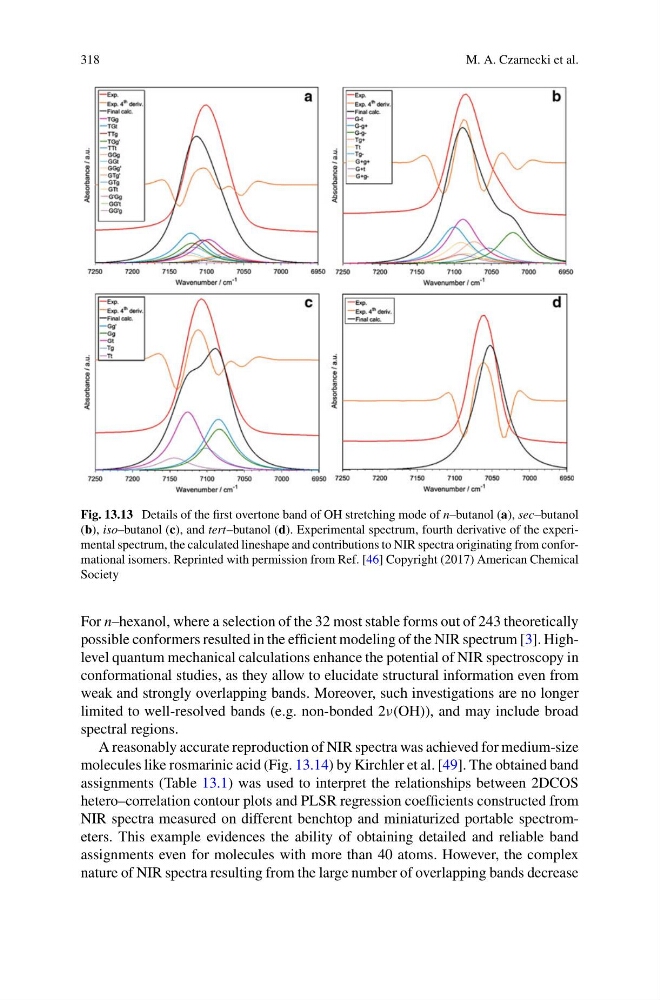
Fig. 13.13 Details of the first overtone band of OH stretching mode of n–butanol (a), sec–butanol
(b), iso–butanol (c), and tert–butanol (d). Experimental spectrum, fourth derivative of the experimental spectrum, the calculated lineshape and contributions to NIR spectra originating from conformational isomers. Reprinted with permission from Ref. [46] Copyright (2017) American Chemical
Society
For n–hexanol, where a selection of the 32 most stable forms out of 243 theoretically
possible conformers resulted in the efficient modeling of the NIR spectrum [3]. Highlevel quantum mechanical calculations enhance the potential of NIR spectroscopy in
conformational studies, as they allow to elucidate structural information even from
weak and strongly overlapping bands. Moreover, such investigations are no longer
limited to well-resolved bands (e.g. non-bonded 2ν(OH)), and may include broad
spectral regions.
A reasonably accurate reproduction of NIR spectra was achieved for medium-size
molecules like rosmarinic acid (Fig. 13.14) by Kirchler et al. [49]. The obtained band
assignments (Table 13.1) was used to interpret the relationships between 2DCOS
hetero–correlation contour plots and PLSR regression coefficients constructed from
NIR spectra measured on different benchtop and miniaturized portable spectrometers. This example evidences the ability of obtaining detailed and reliable band
assignments even for molecules with more than 40 atoms. However, the complex
nature of NIR spectra resulting from the large number of overlapping bands decrease
M. A. Czarnecki et al.
Fig. 13.13 Details of the first overtone band of OH stretching mode of n–butanol (a), sec–butanol
(b), iso–butanol (c), and tert–butanol (d). Experimental spectrum, fourth derivative of the experimental spectrum, the calculated lineshape and contributions to NIR spectra originating from conformational isomers. Reprinted with permission from Ref. [46] Copyright (2017) American Chemical
Society
For n–hexanol, where a selection of the 32 most stable forms out of 243 theoretically
possible conformers resulted in the efficient modeling of the NIR spectrum [3]. Highlevel quantum mechanical calculations enhance the potential of NIR spectroscopy in
conformational studies, as they allow to elucidate structural information even from
weak and strongly overlapping bands. Moreover, such investigations are no longer
limited to well-resolved bands (e.g. non-bonded 2ν(OH)), and may include broad
spectral regions.
A reasonably accurate reproduction of NIR spectra was achieved for medium-size
molecules like rosmarinic acid (Fig. 13.14) by Kirchler et al. [49]. The obtained band
assignments (Table 13.1) was used to interpret the relationships between 2DCOS
hetero–correlation contour plots and PLSR regression coefficients constructed from
NIR spectra measured on different benchtop and miniaturized portable spectrometers. This example evidences the ability of obtaining detailed and reliable band
assignments even for molecules with more than 40 atoms. However, the complex
nature of NIR spectra resulting from the large number of overlapping bands decrease