

2 Principles and Characteristics of NIR Spectroscopy
23
T =
1
2
m 1 ˙
χ
2
1 +
1
2
m 2 ˙
χ
2
2 , where
˙
χ i =
dχ i
dt
.
(2.6)
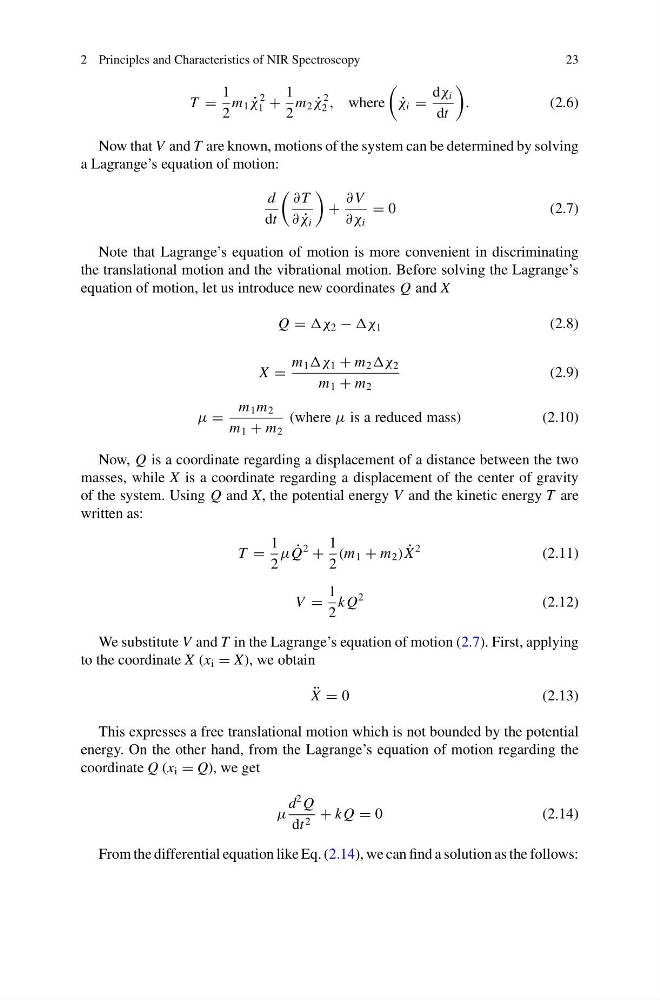
Now that V and T are known, motions of the system can be determined by solving
a Lagrange’s equation of motion:
d
dt
∂ T
∂ ˙
χ i
+
∂ V
∂χ i
= 0
(2.7)
Note that Lagrange’s equation of motion is more convenient in discriminating
the translational motion and the vibrational motion. Before solving the Lagrange’s
equation of motion, let us introduce new coordinates Q and X
Q = χ 2 − χ 1
(2.8)
X =
m 1 χ 1 + m 2 χ 2
m 1 + m 2
(2.9)
μ =
m 1 m 2
m 1 + m 2
(where μ is a reduced mass)
(2.10)
Now, Q is a coordinate regarding a displacement of a distance between the two
masses, while X is a coordinate regarding a displacement of the center of gravity
of the system. Using Q and X, the potential energy V and the kinetic energy T are
written as:
T =
1
2
μ ˙
Q
2
+
1
2
(m 1 + m 2 ) ˙
X
2
(2.11)
V =
1
2
k Q
2
(2.12)
We substitute V and T in the Lagrange’s equation of motion (2.7). First, applying
to the coordinate X (x i = X), we obtain
¨
X = 0
(2.13)
This expresses a free translational motion which is not bounded by the potential
energy. On the other hand, from the Lagrange’s equation of motion regarding the
coordinate Q (x i = Q), we get
μ
d
2 Q
dt 2 + k Q = 0
(2.14)
From the differential equation like Eq. (2.14), we can find a solution as the follows:
23
T =
1
2
m 1 ˙
χ
2
1 +
1
2
m 2 ˙
χ
2
2 , where
˙
χ i =
dχ i
dt
.
(2.6)
Now that V and T are known, motions of the system can be determined by solving
a Lagrange’s equation of motion:
d
dt
∂ T
∂ ˙
χ i
+
∂ V
∂χ i
= 0
(2.7)
Note that Lagrange’s equation of motion is more convenient in discriminating
the translational motion and the vibrational motion. Before solving the Lagrange’s
equation of motion, let us introduce new coordinates Q and X
Q = χ 2 − χ 1
(2.8)
X =
m 1 χ 1 + m 2 χ 2
m 1 + m 2
(2.9)
μ =
m 1 m 2
m 1 + m 2
(where μ is a reduced mass)
(2.10)
Now, Q is a coordinate regarding a displacement of a distance between the two
masses, while X is a coordinate regarding a displacement of the center of gravity
of the system. Using Q and X, the potential energy V and the kinetic energy T are
written as:
T =
1
2
μ ˙
Q
2
+
1
2
(m 1 + m 2 ) ˙
X
2
(2.11)
V =
1
2
k Q
2
(2.12)
We substitute V and T in the Lagrange’s equation of motion (2.7). First, applying
to the coordinate X (x i = X), we obtain
¨
X = 0
(2.13)
This expresses a free translational motion which is not bounded by the potential
energy. On the other hand, from the Lagrange’s equation of motion regarding the
coordinate Q (x i = Q), we get
μ
d
2 Q
dt 2 + k Q = 0
(2.14)
From the differential equation like Eq. (2.14), we can find a solution as the follows: