

24
Y. Ozaki and Y. Morisawa
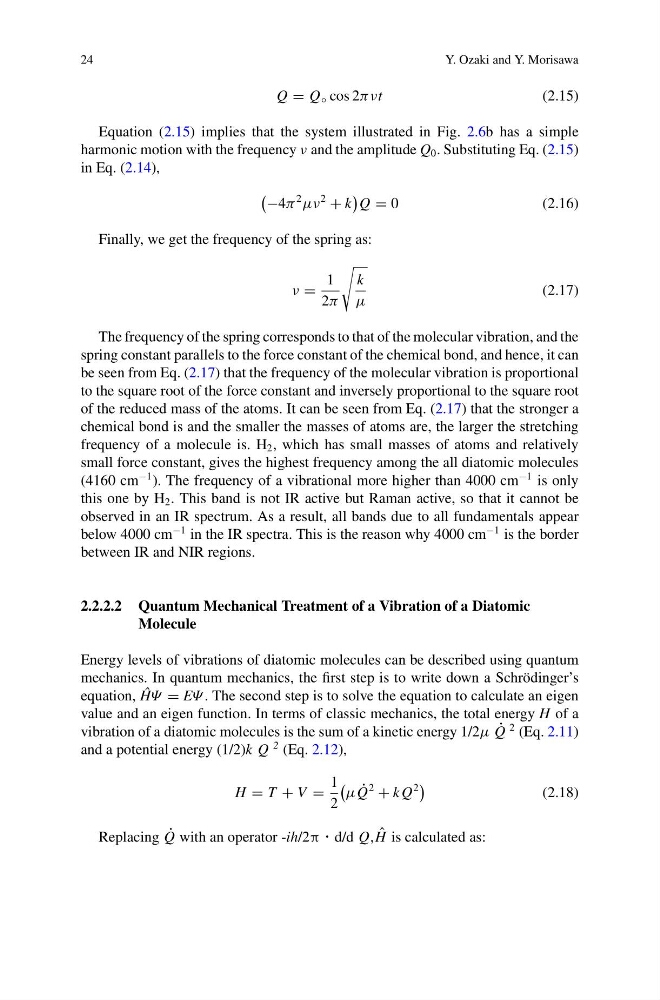
Q = Q ◦ cos 2πνt
(2.15)
Equation (2.15) implies that the system illustrated in Fig. 2.6b has a simple
harmonic motion with the frequency ν and the amplitude Q 0 . Substituting Eq. (2.15)
in Eq. (2.14),
−4π
2
μν
2
+ k
Q = 0
(2.16)
Finally, we get the frequency of the spring as:
ν =
1
2π
k
μ
(2.17)
The frequency of the spring corresponds to that of the molecular vibration, and the
spring constant parallels to the force constant of the chemical bond, and hence, it can
be seen from Eq. (2.17) that the frequency of the molecular vibration is proportional
to the square root of the force constant and inversely proportional to the square root
of the reduced mass of the atoms. It can be seen from Eq. (2.17) that the stronger a
chemical bond is and the smaller the masses of atoms are, the larger the stretching
frequency of a molecule is. H 2 , which has small masses of atoms and relatively
small force constant, gives the highest frequency among the all diatomic molecules
(4160 cm
−1 ). The frequency of a vibrational more higher than 4000 cm
−1 is only
this one by H 2 . This band is not IR active but Raman active, so that it cannot be
observed in an IR spectrum. As a result, all bands due to all fundamentals appear
below 4000 cm
−1 in the IR spectra. This is the reason why 4000 cm
−1 is the border
between IR and NIR regions.
2.2.2.2 Quantum Mechanical Treatment of a Vibration of a Diatomic
Molecule
Energy levels of vibrations of diatomic molecules can be described using quantum
mechanics. In quantum mechanics, the first step is to write down a Schrödinger’s
equation, ˆ
HΨ = EΨ . The second step is to solve the equation to calculate an eigen
value and an eigen function. In terms of classic mechanics, the total energy H of a
vibration of a diatomic molecules is the sum of a kinetic energy 1/2μ ˙
Q
2 (Eq. 2.11)
and a potential energy (1/2)k Q
2 (Eq. 2.12),
H = T + V =
1
2
μ ˙
Q
2
+ k Q
2
(2.18)
Replacing ˙
Q with an operator -ih/2π・d/d Q, ˆ
H is calculated as:
Y. Ozaki and Y. Morisawa
Q = Q ◦ cos 2πνt
(2.15)
Equation (2.15) implies that the system illustrated in Fig. 2.6b has a simple
harmonic motion with the frequency ν and the amplitude Q 0 . Substituting Eq. (2.15)
in Eq. (2.14),
−4π
2
μν
2
+ k
Q = 0
(2.16)
Finally, we get the frequency of the spring as:
ν =
1
2π
k
μ
(2.17)
The frequency of the spring corresponds to that of the molecular vibration, and the
spring constant parallels to the force constant of the chemical bond, and hence, it can
be seen from Eq. (2.17) that the frequency of the molecular vibration is proportional
to the square root of the force constant and inversely proportional to the square root
of the reduced mass of the atoms. It can be seen from Eq. (2.17) that the stronger a
chemical bond is and the smaller the masses of atoms are, the larger the stretching
frequency of a molecule is. H 2 , which has small masses of atoms and relatively
small force constant, gives the highest frequency among the all diatomic molecules
(4160 cm
−1 ). The frequency of a vibrational more higher than 4000 cm
−1 is only
this one by H 2 . This band is not IR active but Raman active, so that it cannot be
observed in an IR spectrum. As a result, all bands due to all fundamentals appear
below 4000 cm
−1 in the IR spectra. This is the reason why 4000 cm
−1 is the border
between IR and NIR regions.
2.2.2.2 Quantum Mechanical Treatment of a Vibration of a Diatomic
Molecule
Energy levels of vibrations of diatomic molecules can be described using quantum
mechanics. In quantum mechanics, the first step is to write down a Schrödinger’s
equation, ˆ
HΨ = EΨ . The second step is to solve the equation to calculate an eigen
value and an eigen function. In terms of classic mechanics, the total energy H of a
vibration of a diatomic molecules is the sum of a kinetic energy 1/2μ ˙
Q
2 (Eq. 2.11)
and a potential energy (1/2)k Q
2 (Eq. 2.12),
H = T + V =
1
2
μ ˙
Q
2
+ k Q
2
(2.18)
Replacing ˙
Q with an operator -ih/2π・d/d Q, ˆ
H is calculated as: