

22
Y. Ozaki and Y. Morisawa
which restores a displacement of a nucleus from its equilibrium position complies
with the Hooke’s law; vibrations in harmonic oscillator approximation are called
harmonic vibrations), any vibrations of the molecule are expressed as composition
of simple vibrations called normal vibrations. Normal vibrations are vibrations of
nuclei within a molecule, and in the normal vibrations, translational motions and
rotational motions of the molecule as a whole are excluded. In each normal vibration, all atoms vibrate with the same frequency (normal frequency), and they pass
through their equilibrium positions simultaneously. Generally, a molecule with N
atoms has 3N–6 normal vibrations (3N–5 normal vibrations if the molecule is a
linear molecule). Since normal vibrations are determined by the molecular structure,
the atomic weight and the force constant, when these three are known, it is possible
to calculate the normal frequencies and the normal modes.
2.2.2.1 A Vibration of a Diatomic Molecule
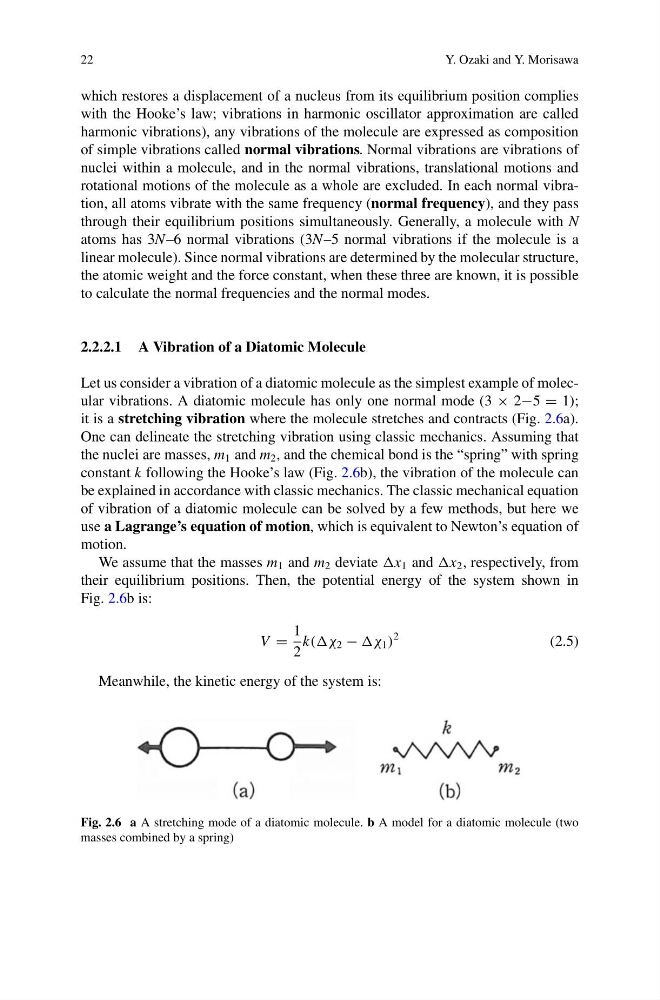
Let us consider a vibration of a diatomic molecule as the simplest example of molecular vibrations. A diatomic molecule has only one normal mode (3 × 2−5 = 1);
it is a stretching vibration where the molecule stretches and contracts (Fig. 2.6a).
One can delineate the stretching vibration using classic mechanics. Assuming that
the nuclei are masses, m 1 and m 2 , and the chemical bond is the “spring” with spring
constant k following the Hooke’s law (Fig. 2.6b), the vibration of the molecule can
be explained in accordance with classic mechanics. The classic mechanical equation
of vibration of a diatomic molecule can be solved by a few methods, but here we
use a Lagrange’s equation of motion, which is equivalent to Newton’s equation of
motion.
We assume that the masses m 1 and m 2 deviate x 1 and x 2 , respectively, from
their equilibrium positions. Then, the potential energy of the system shown in
Fig. 2.6b is:
V =
1
2
k((χ 2 − χ 1 )
2
(2.5)
Meanwhile, the kinetic energy of the system is:
Fig. 2.6 a A stretching mode of a diatomic molecule. b A model for a diatomic molecule (two
masses combined by a spring)
Y. Ozaki and Y. Morisawa
which restores a displacement of a nucleus from its equilibrium position complies
with the Hooke’s law; vibrations in harmonic oscillator approximation are called
harmonic vibrations), any vibrations of the molecule are expressed as composition
of simple vibrations called normal vibrations. Normal vibrations are vibrations of
nuclei within a molecule, and in the normal vibrations, translational motions and
rotational motions of the molecule as a whole are excluded. In each normal vibration, all atoms vibrate with the same frequency (normal frequency), and they pass
through their equilibrium positions simultaneously. Generally, a molecule with N
atoms has 3N–6 normal vibrations (3N–5 normal vibrations if the molecule is a
linear molecule). Since normal vibrations are determined by the molecular structure,
the atomic weight and the force constant, when these three are known, it is possible
to calculate the normal frequencies and the normal modes.
2.2.2.1 A Vibration of a Diatomic Molecule
Let us consider a vibration of a diatomic molecule as the simplest example of molecular vibrations. A diatomic molecule has only one normal mode (3 × 2−5 = 1);
it is a stretching vibration where the molecule stretches and contracts (Fig. 2.6a).
One can delineate the stretching vibration using classic mechanics. Assuming that
the nuclei are masses, m 1 and m 2 , and the chemical bond is the “spring” with spring
constant k following the Hooke’s law (Fig. 2.6b), the vibration of the molecule can
be explained in accordance with classic mechanics. The classic mechanical equation
of vibration of a diatomic molecule can be solved by a few methods, but here we
use a Lagrange’s equation of motion, which is equivalent to Newton’s equation of
motion.
We assume that the masses m 1 and m 2 deviate x 1 and x 2 , respectively, from
their equilibrium positions. Then, the potential energy of the system shown in
Fig. 2.6b is:
V =
1
2
k((χ 2 − χ 1 )
2
(2.5)
Meanwhile, the kinetic energy of the system is:
Fig. 2.6 a A stretching mode of a diatomic molecule. b A model for a diatomic molecule (two
masses combined by a spring)