

10 Hardware of Near-Infrared Spectroscopy
261
10.4.4 Considerations to Avoid Instrumental Differences
The following factors should be considered to minimize the instrumental difference
[15].
• The characteristics of the sample optics should be made approximately equal via
adjustments.
• The wavelength resolution of each spectrometer should be adjusted within 0.1 nm.
• The spectral sensitivity of the spectrometer should be as flat as possible.
• A wide wavelength resolution generates low noise levels; however, the instrumental difference increases.
• The sequence of calculations is important (see Sect. 10.2.4c). The reflectance
should be calculated first.
10.4.5 Standardization Methods for the Calibration
To compensate for the instrumental difference, the calibration or predicted results
should be modified. The modification process is called standardization. Several
standardization methods have been reported [16].
(a) The SBC Method
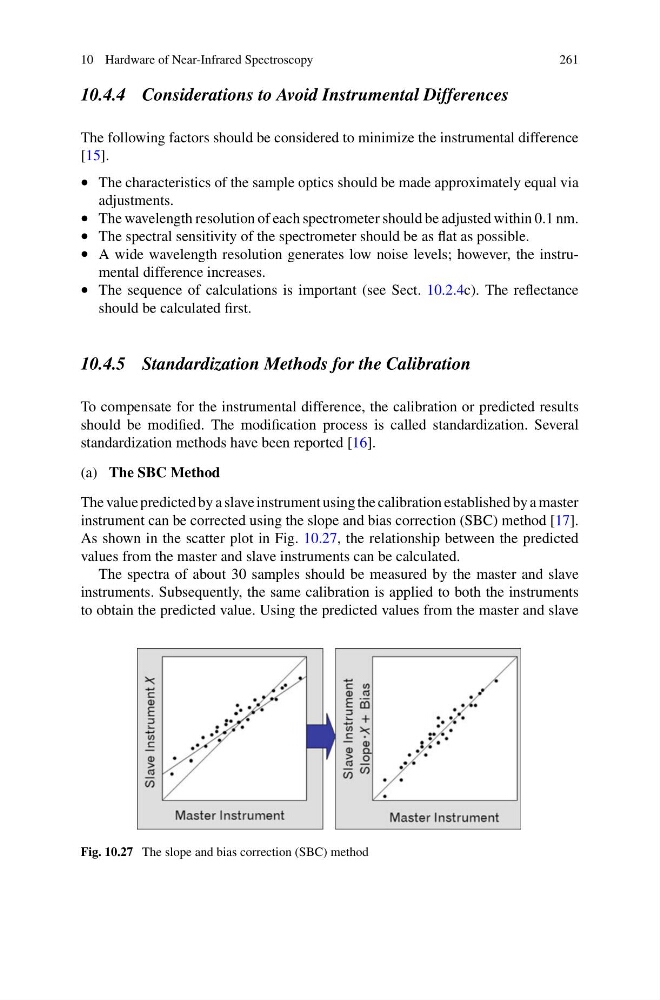
The value predicted by a slave instrument using the calibration established by a master
instrument can be corrected using the slope and bias correction (SBC) method [17].
As shown in the scatter plot in Fig. 10.27, the relationship between the predicted
values from the master and slave instruments can be calculated.
The spectra of about 30 samples should be measured by the master and slave
instruments. Subsequently, the same calibration is applied to both the instruments
to obtain the predicted value. Using the predicted values from the master and slave
Fig. 10.27 The slope and bias correction (SBC) method
261
10.4.4 Considerations to Avoid Instrumental Differences
The following factors should be considered to minimize the instrumental difference
[15].
• The characteristics of the sample optics should be made approximately equal via
adjustments.
• The wavelength resolution of each spectrometer should be adjusted within 0.1 nm.
• The spectral sensitivity of the spectrometer should be as flat as possible.
• A wide wavelength resolution generates low noise levels; however, the instrumental difference increases.
• The sequence of calculations is important (see Sect. 10.2.4c). The reflectance
should be calculated first.
10.4.5 Standardization Methods for the Calibration
To compensate for the instrumental difference, the calibration or predicted results
should be modified. The modification process is called standardization. Several
standardization methods have been reported [16].
(a) The SBC Method
The value predicted by a slave instrument using the calibration established by a master
instrument can be corrected using the slope and bias correction (SBC) method [17].
As shown in the scatter plot in Fig. 10.27, the relationship between the predicted
values from the master and slave instruments can be calculated.
The spectra of about 30 samples should be measured by the master and slave
instruments. Subsequently, the same calibration is applied to both the instruments
to obtain the predicted value. Using the predicted values from the master and slave
Fig. 10.27 The slope and bias correction (SBC) method