

260
T. Okura
w(λ 0 ) Reference signal intensity
λ 0
Wavelength of the spectrometer
X (λ 0 ) Sample spectrum
W (λ 0 ) Reference spectrum
a
Wavelength shift from λ 0
H (λ) Spectral sensitivity of the spectrometer
(a) Slit function of the spectrometer
D
Integral width of the slit function.
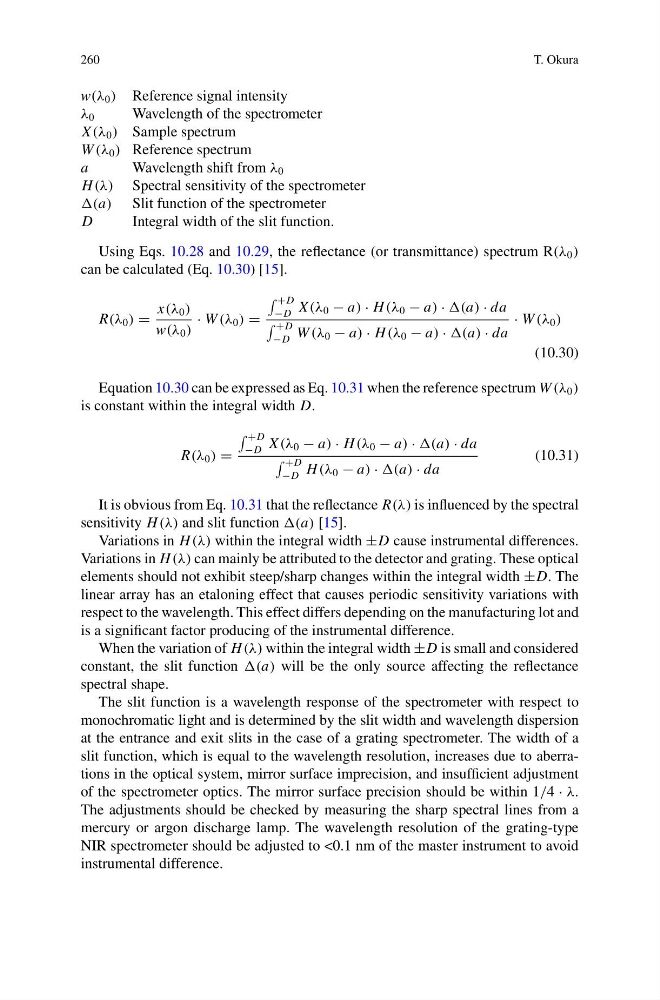
Using Eqs. 10.28 and 10.29, the reflectance (or transmittance) spectrum R(λ 0 )
can be calculated (Eq. 10.30) [15].
R(λ 0 ) =
x(λ 0 )
w(λ 0 )
· W (λ 0 ) =
+D
−D X (λ 0 − a) · H (λ 0 − a) · (a) · da
+D
−D W (λ 0 − a) · H (λ 0 − a) · (a) · da
· W (λ 0 )
(10.30)
Equation 10.30 can be expressed as Eq. 10.31 when the reference spectrum W (λ 0 )
is constant within the integral width D.
R(λ 0 ) =
+D
−D X (λ 0 − a) · H (λ 0 − a) · (a) · da
+D
−D H (λ 0 − a) · (a) · da
(10.31)
It is obvious from Eq. 10.31 that the reflectance R(λ) is influenced by the spectral
sensitivity H (λ) and slit function (a) [15].
Variations in H (λ) within the integral width ±D cause instrumental differences.
Variations in H (λ) can mainly be attributed to the detector and grating. These optical
elements should not exhibit steep/sharp changes within the integral width ±D. The
linear array has an etaloning effect that causes periodic sensitivity variations with
respect to the wavelength. This effect differs depending on the manufacturing lot and
is a significant factor producing of the instrumental difference.
When the variation of H (λ) within the integral width ±D is small and considered
constant, the slit function (a) will be the only source affecting the reflectance
spectral shape.
The slit function is a wavelength response of the spectrometer with respect to
monochromatic light and is determined by the slit width and wavelength dispersion
at the entrance and exit slits in the case of a grating spectrometer. The width of a
slit function, which is equal to the wavelength resolution, increases due to aberrations in the optical system, mirror surface imprecision, and insufficient adjustment
of the spectrometer optics. The mirror surface precision should be within 1/4 · λ.
The adjustments should be checked by measuring the sharp spectral lines from a
mercury or argon discharge lamp. The wavelength resolution of the grating-type
NIR spectrometer should be adjusted to <0.1 nm of the master instrument to avoid
instrumental difference.
T. Okura
w(λ 0 ) Reference signal intensity
λ 0
Wavelength of the spectrometer
X (λ 0 ) Sample spectrum
W (λ 0 ) Reference spectrum
a
Wavelength shift from λ 0
H (λ) Spectral sensitivity of the spectrometer
(a) Slit function of the spectrometer
D
Integral width of the slit function.
Using Eqs. 10.28 and 10.29, the reflectance (or transmittance) spectrum R(λ 0 )
can be calculated (Eq. 10.30) [15].
R(λ 0 ) =
x(λ 0 )
w(λ 0 )
· W (λ 0 ) =
+D
−D X (λ 0 − a) · H (λ 0 − a) · (a) · da
+D
−D W (λ 0 − a) · H (λ 0 − a) · (a) · da
· W (λ 0 )
(10.30)
Equation 10.30 can be expressed as Eq. 10.31 when the reference spectrum W (λ 0 )
is constant within the integral width D.
R(λ 0 ) =
+D
−D X (λ 0 − a) · H (λ 0 − a) · (a) · da
+D
−D H (λ 0 − a) · (a) · da
(10.31)
It is obvious from Eq. 10.31 that the reflectance R(λ) is influenced by the spectral
sensitivity H (λ) and slit function (a) [15].
Variations in H (λ) within the integral width ±D cause instrumental differences.
Variations in H (λ) can mainly be attributed to the detector and grating. These optical
elements should not exhibit steep/sharp changes within the integral width ±D. The
linear array has an etaloning effect that causes periodic sensitivity variations with
respect to the wavelength. This effect differs depending on the manufacturing lot and
is a significant factor producing of the instrumental difference.
When the variation of H (λ) within the integral width ±D is small and considered
constant, the slit function (a) will be the only source affecting the reflectance
spectral shape.
The slit function is a wavelength response of the spectrometer with respect to
monochromatic light and is determined by the slit width and wavelength dispersion
at the entrance and exit slits in the case of a grating spectrometer. The width of a
slit function, which is equal to the wavelength resolution, increases due to aberrations in the optical system, mirror surface imprecision, and insufficient adjustment
of the spectrometer optics. The mirror surface precision should be within 1/4 · λ.
The adjustments should be checked by measuring the sharp spectral lines from a
mercury or argon discharge lamp. The wavelength resolution of the grating-type
NIR spectrometer should be adjusted to <0.1 nm of the master instrument to avoid
instrumental difference.