

10 Hardware of Near-Infrared Spectroscopy
259
in the spectral shape results in large differences in the predicted ingredient values,
thus presenting a significant problem.
It is necessary to establish a calibration for each instrument when the instrumental
difference is large. However, generation of the calibration requires substantial cost
and time, which is a wasteful process. It is important to understand the factors causing
the instrumental differences to find an effective solution. Instruments with small
differences can be effectively designed by understanding the underlying causes.
10.4.2 Instrumental Differences Caused by the Sampling
Optics
The spectral shape of the light reflected or transmitted by the sample depends on the
physical configuration of the sample optics. During the manufacture of the sample
optics, the angle of the optical axis and position of the optical parts should be
precisely adjusted. The distance between the irradiated and observed areas should
be considered to generate the identical spectra when manufacturing the interactance
optics.
Furthermore, each lamp has light intensity angular characteristics due to the filament shape, and each spectrometer also has angular sensitivity dependence. Thus,
when the lamp or entrance slit is collimated onto the sample, the angular characteristics of the lamp and spectrometer influence the spectral shape. The non-collimated
optics and fiber optics are effective for eliminating the spectral shape difference,
although the light intensity reduces.
10.4.3 Instrumental Differences Caused by the Spectral
Sensitivity and Slit Function
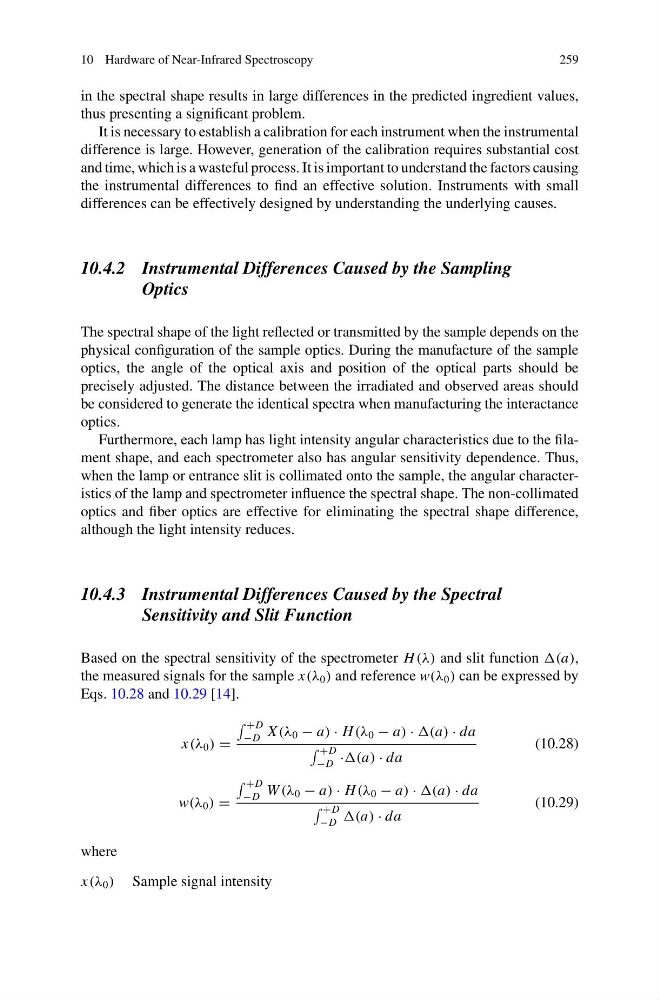
Based on the spectral sensitivity of the spectrometer H (λ) and slit function (a),
the measured signals for the sample x(λ 0 ) and reference w(λ 0 ) can be expressed by
Eqs. 10.28 and 10.29 [14].
x(λ 0 ) =
+D
−D X (λ 0 − a) · H (λ 0 − a) · (a) · da
+D
−D ·(a) · da
(10.28)
w(λ 0 ) =
+D
−D W (λ 0 − a) · H (λ 0 − a) · (a) · da
+D
−D (a) · da
(10.29)
where
x(λ 0 ) Sample signal intensity
259
in the spectral shape results in large differences in the predicted ingredient values,
thus presenting a significant problem.
It is necessary to establish a calibration for each instrument when the instrumental
difference is large. However, generation of the calibration requires substantial cost
and time, which is a wasteful process. It is important to understand the factors causing
the instrumental differences to find an effective solution. Instruments with small
differences can be effectively designed by understanding the underlying causes.
10.4.2 Instrumental Differences Caused by the Sampling
Optics
The spectral shape of the light reflected or transmitted by the sample depends on the
physical configuration of the sample optics. During the manufacture of the sample
optics, the angle of the optical axis and position of the optical parts should be
precisely adjusted. The distance between the irradiated and observed areas should
be considered to generate the identical spectra when manufacturing the interactance
optics.
Furthermore, each lamp has light intensity angular characteristics due to the filament shape, and each spectrometer also has angular sensitivity dependence. Thus,
when the lamp or entrance slit is collimated onto the sample, the angular characteristics of the lamp and spectrometer influence the spectral shape. The non-collimated
optics and fiber optics are effective for eliminating the spectral shape difference,
although the light intensity reduces.
10.4.3 Instrumental Differences Caused by the Spectral
Sensitivity and Slit Function
Based on the spectral sensitivity of the spectrometer H (λ) and slit function (a),
the measured signals for the sample x(λ 0 ) and reference w(λ 0 ) can be expressed by
Eqs. 10.28 and 10.29 [14].
x(λ 0 ) =
+D
−D X (λ 0 − a) · H (λ 0 − a) · (a) · da
+D
−D ·(a) · da
(10.28)
w(λ 0 ) =
+D
−D W (λ 0 − a) · H (λ 0 − a) · (a) · da
+D
−D (a) · da
(10.29)
where
x(λ 0 ) Sample signal intensity