

262
T. Okura
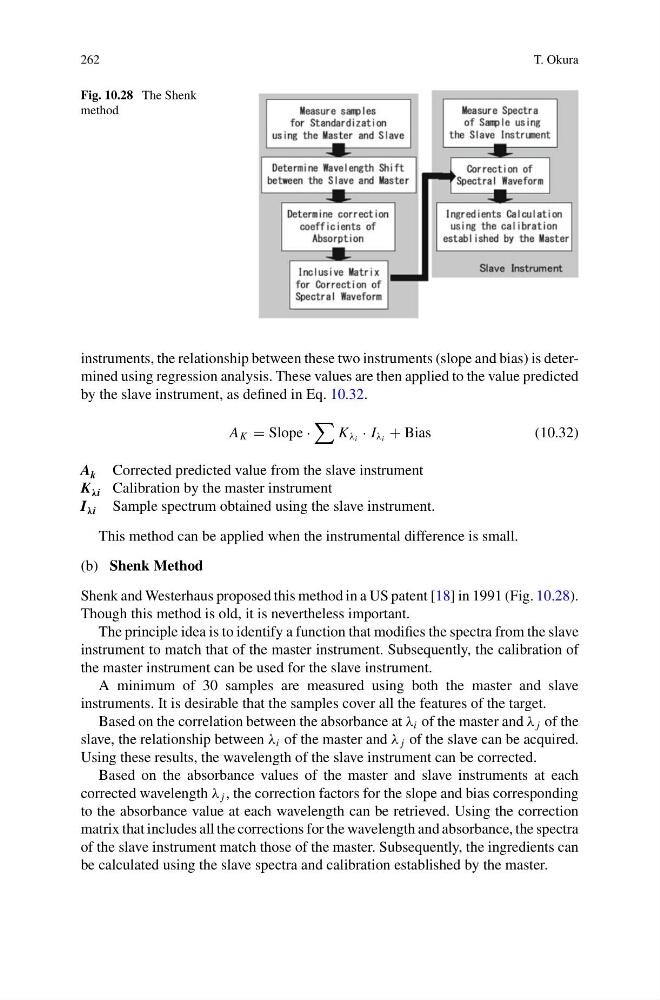
Fig. 10.28 The Shenk
method
instruments, the relationship between these two instruments (slope and bias) is determined using regression analysis. These values are then applied to the value predicted
by the slave instrument, as defined in Eq. 10.32.
A K = Slope ·
K λ i · I λ i + Bias
(10.32)
A k Corrected predicted value from the slave instrument
K λi Calibration by the master instrument
I λi Sample spectrum obtained using the slave instrument.
This method can be applied when the instrumental difference is small.
(b) Shenk Method
Shenk and Westerhaus proposed this method in a US patent [18] in 1991 (Fig. 10.28).
Though this method is old, it is nevertheless important.
The principle idea is to identify a function that modifies the spectra from the slave
instrument to match that of the master instrument. Subsequently, the calibration of
the master instrument can be used for the slave instrument.
A minimum of 30 samples are measured using both the master and slave
instruments. It is desirable that the samples cover all the features of the target.
Based on the correlation between the absorbance at λ i of the master and λ j of the
slave, the relationship between λ i of the master and λ j of the slave can be acquired.
Using these results, the wavelength of the slave instrument can be corrected.
Based on the absorbance values of the master and slave instruments at each
corrected wavelength λ j , the correction factors for the slope and bias corresponding
to the absorbance value at each wavelength can be retrieved. Using the correction
matrix that includes all the corrections for the wavelength and absorbance, the spectra
of the slave instrument match those of the master. Subsequently, the ingredients can
be calculated using the slave spectra and calibration established by the master.
T. Okura
Fig. 10.28 The Shenk
method
instruments, the relationship between these two instruments (slope and bias) is determined using regression analysis. These values are then applied to the value predicted
by the slave instrument, as defined in Eq. 10.32.
A K = Slope ·
K λ i · I λ i + Bias
(10.32)
A k Corrected predicted value from the slave instrument
K λi Calibration by the master instrument
I λi Sample spectrum obtained using the slave instrument.
This method can be applied when the instrumental difference is small.
(b) Shenk Method
Shenk and Westerhaus proposed this method in a US patent [18] in 1991 (Fig. 10.28).
Though this method is old, it is nevertheless important.
The principle idea is to identify a function that modifies the spectra from the slave
instrument to match that of the master instrument. Subsequently, the calibration of
the master instrument can be used for the slave instrument.
A minimum of 30 samples are measured using both the master and slave
instruments. It is desirable that the samples cover all the features of the target.
Based on the correlation between the absorbance at λ i of the master and λ j of the
slave, the relationship between λ i of the master and λ j of the slave can be acquired.
Using these results, the wavelength of the slave instrument can be corrected.
Based on the absorbance values of the master and slave instruments at each
corrected wavelength λ j , the correction factors for the slope and bias corresponding
to the absorbance value at each wavelength can be retrieved. Using the correction
matrix that includes all the corrections for the wavelength and absorbance, the spectra
of the slave instrument match those of the master. Subsequently, the ingredients can
be calculated using the slave spectra and calibration established by the master.