

10 Hardware of Near-Infrared Spectroscopy
245
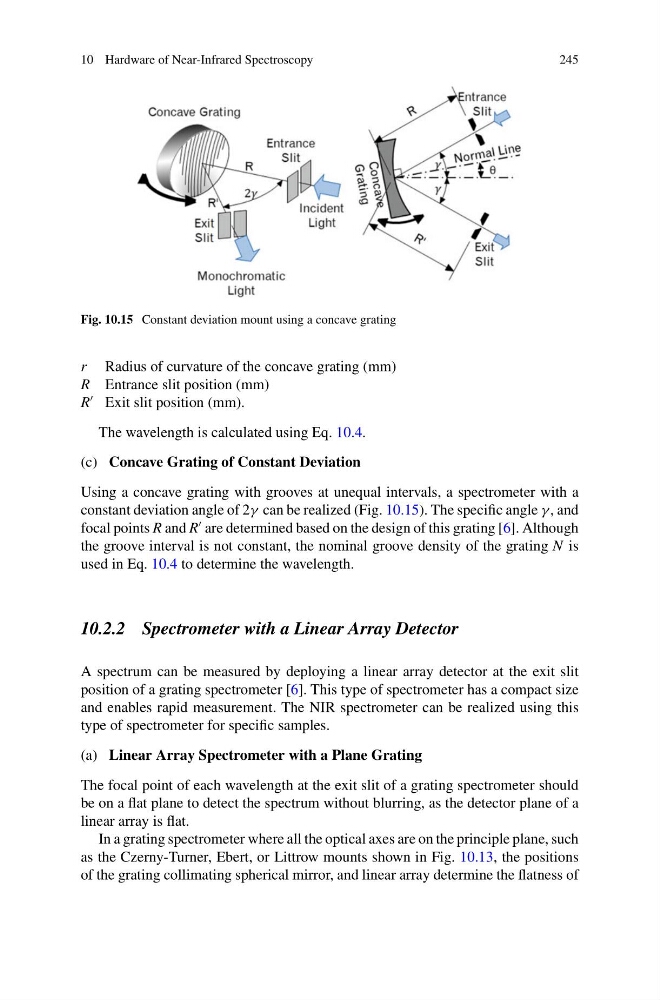
Fig. 10.15 Constant deviation mount using a concave grating
r Radius of curvature of the concave grating (mm)
R Entrance slit position (mm)
R
Exit slit position (mm).
The wavelength is calculated using Eq. 10.4.
(c) Concave Grating of Constant Deviation
Using a concave grating with grooves at unequal intervals, a spectrometer with a
constant deviation angle of 2γ can be realized (Fig. 10.15). The specific angle γ , and
focal points R and R
are determined based on the design of this grating [6]. Although
the groove interval is not constant, the nominal groove density of the grating N is
used in Eq. 10.4 to determine the wavelength.
10.2.2 Spectrometer with a Linear Array Detector
A spectrum can be measured by deploying a linear array detector at the exit slit
position of a grating spectrometer [6]. This type of spectrometer has a compact size
and enables rapid measurement. The NIR spectrometer can be realized using this
type of spectrometer for specific samples.
(a) Linear Array Spectrometer with a Plane Grating
The focal point of each wavelength at the exit slit of a grating spectrometer should
be on a flat plane to detect the spectrum without blurring, as the detector plane of a
linear array is flat.
In a grating spectrometer where all the optical axes are on the principle plane, such
as the Czerny-Turner, Ebert, or Littrow mounts shown in Fig. 10.13, the positions
of the grating collimating spherical mirror, and linear array determine the flatness of
245
Fig. 10.15 Constant deviation mount using a concave grating
r Radius of curvature of the concave grating (mm)
R Entrance slit position (mm)
R
Exit slit position (mm).
The wavelength is calculated using Eq. 10.4.
(c) Concave Grating of Constant Deviation
Using a concave grating with grooves at unequal intervals, a spectrometer with a
constant deviation angle of 2γ can be realized (Fig. 10.15). The specific angle γ , and
focal points R and R
are determined based on the design of this grating [6]. Although
the groove interval is not constant, the nominal groove density of the grating N is
used in Eq. 10.4 to determine the wavelength.
10.2.2 Spectrometer with a Linear Array Detector
A spectrum can be measured by deploying a linear array detector at the exit slit
position of a grating spectrometer [6]. This type of spectrometer has a compact size
and enables rapid measurement. The NIR spectrometer can be realized using this
type of spectrometer for specific samples.
(a) Linear Array Spectrometer with a Plane Grating
The focal point of each wavelength at the exit slit of a grating spectrometer should
be on a flat plane to detect the spectrum without blurring, as the detector plane of a
linear array is flat.
In a grating spectrometer where all the optical axes are on the principle plane, such
as the Czerny-Turner, Ebert, or Littrow mounts shown in Fig. 10.13, the positions
of the grating collimating spherical mirror, and linear array determine the flatness of