

226
A. Ikehata
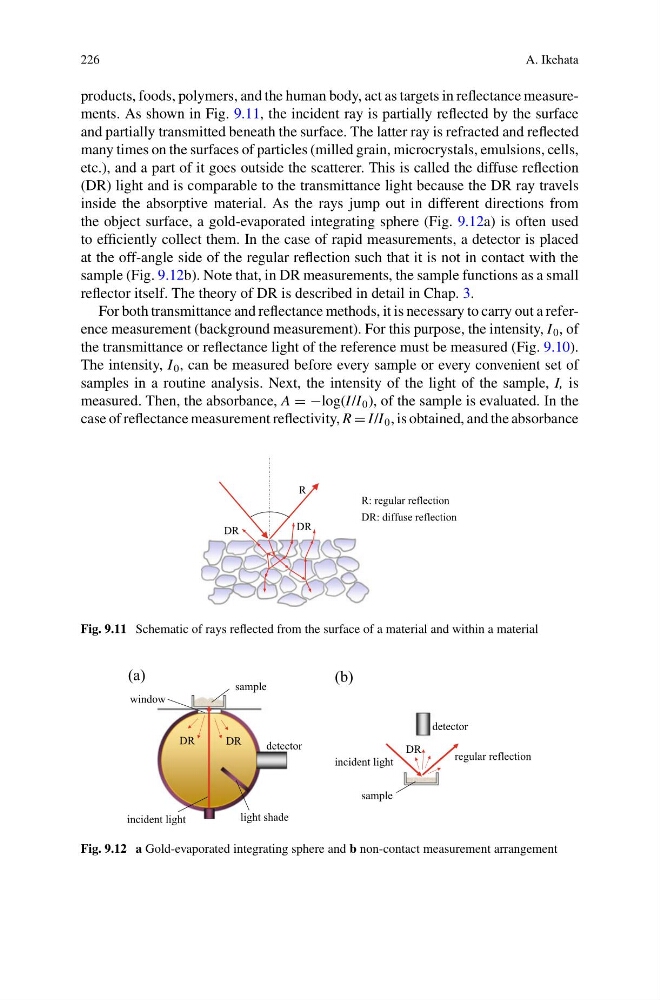
products, foods, polymers, and the human body, act as targets in reflectance measurements. As shown in Fig. 9.11, the incident ray is partially reflected by the surface
and partially transmitted beneath the surface. The latter ray is refracted and reflected
many times on the surfaces of particles (milled grain, microcrystals, emulsions, cells,
etc.), and a part of it goes outside the scatterer. This is called the diffuse reflection
(DR) light and is comparable to the transmittance light because the DR ray travels
inside the absorptive material. As the rays jump out in different directions from
the object surface, a gold-evaporated integrating sphere (Fig. 9.12a) is often used
to efficiently collect them. In the case of rapid measurements, a detector is placed
at the off-angle side of the regular reflection such that it is not in contact with the
sample (Fig. 9.12b). Note that, in DR measurements, the sample functions as a small
reflector itself. The theory of DR is described in detail in Chap. 3.
For both transmittance and reflectance methods, it is necessary to carry out a reference measurement (background measurement). For this purpose, the intensity, I 0 , of
the transmittance or reflectance light of the reference must be measured (Fig. 9.10).
The intensity, I 0 , can be measured before every sample or every convenient set of
samples in a routine analysis. Next, the intensity of the light of the sample, I, is
measured. Then, the absorbance, A = −log(I/I 0 ), of the sample is evaluated. In the
case of reflectance measurement reflectivity, R = I/I 0 , is obtained, and the absorbance
DR
R: regular reflection
DR: diffuse reflection
R
DR
Fig. 9.11 Schematic of rays reflected from the surface of a material and within a material
window
detector
sample
incident light
light shade
DR
DR
sample
detector
incident light
regular reflection
DR
(a)
(b)
Fig. 9.12 a Gold-evaporated integrating sphere and b non-contact measurement arrangement
A. Ikehata
products, foods, polymers, and the human body, act as targets in reflectance measurements. As shown in Fig. 9.11, the incident ray is partially reflected by the surface
and partially transmitted beneath the surface. The latter ray is refracted and reflected
many times on the surfaces of particles (milled grain, microcrystals, emulsions, cells,
etc.), and a part of it goes outside the scatterer. This is called the diffuse reflection
(DR) light and is comparable to the transmittance light because the DR ray travels
inside the absorptive material. As the rays jump out in different directions from
the object surface, a gold-evaporated integrating sphere (Fig. 9.12a) is often used
to efficiently collect them. In the case of rapid measurements, a detector is placed
at the off-angle side of the regular reflection such that it is not in contact with the
sample (Fig. 9.12b). Note that, in DR measurements, the sample functions as a small
reflector itself. The theory of DR is described in detail in Chap. 3.
For both transmittance and reflectance methods, it is necessary to carry out a reference measurement (background measurement). For this purpose, the intensity, I 0 , of
the transmittance or reflectance light of the reference must be measured (Fig. 9.10).
The intensity, I 0 , can be measured before every sample or every convenient set of
samples in a routine analysis. Next, the intensity of the light of the sample, I, is
measured. Then, the absorbance, A = −log(I/I 0 ), of the sample is evaluated. In the
case of reflectance measurement reflectivity, R = I/I 0 , is obtained, and the absorbance
DR
R: regular reflection
DR: diffuse reflection
R
DR
Fig. 9.11 Schematic of rays reflected from the surface of a material and within a material
window
detector
sample
incident light
light shade
DR
DR
sample
detector
incident light
regular reflection
DR
(a)
(b)
Fig. 9.12 a Gold-evaporated integrating sphere and b non-contact measurement arrangement