

9 NIR Optics and Measurement Methods
225
9.2 Measuring Methods of NIR Spectroscopy
NIR spectroscopy can be used to analyze various kinds of samples such as liquids,
solutions, suspensions, pastes, solids, fibers, powders, and gases. Moreover, it is
used to assess a variety of bulk and raw materials along with biomedical samples.
Therefore, different types of measuring methods are employed in NIR spectroscopy
[12–14]. Both the selection of the measuring method as well as that of the pretreatment method and measuring conditions are crucial. The most characteristic feature
of practical NIR spectroscopy is the measurement of a large number of samples in a
series to create a calibration model for a wide range of target objective variables such
as concentration. In this case, one must carefully choose the methods and conditions,
and operate it in the same manner each time to obtain good prediction results. Sample
selection is another important point for NIR measurements. Although this knowledge of experimental design is essential, it is not treated in this book. Reference [12]
provides an outline for sample selection. In this section, the measurement methods,
sample pretreatment methods, and measuring conditions in NIR spectroscopy are
described.
9.2.1 Outline of NIR Measuring Methods
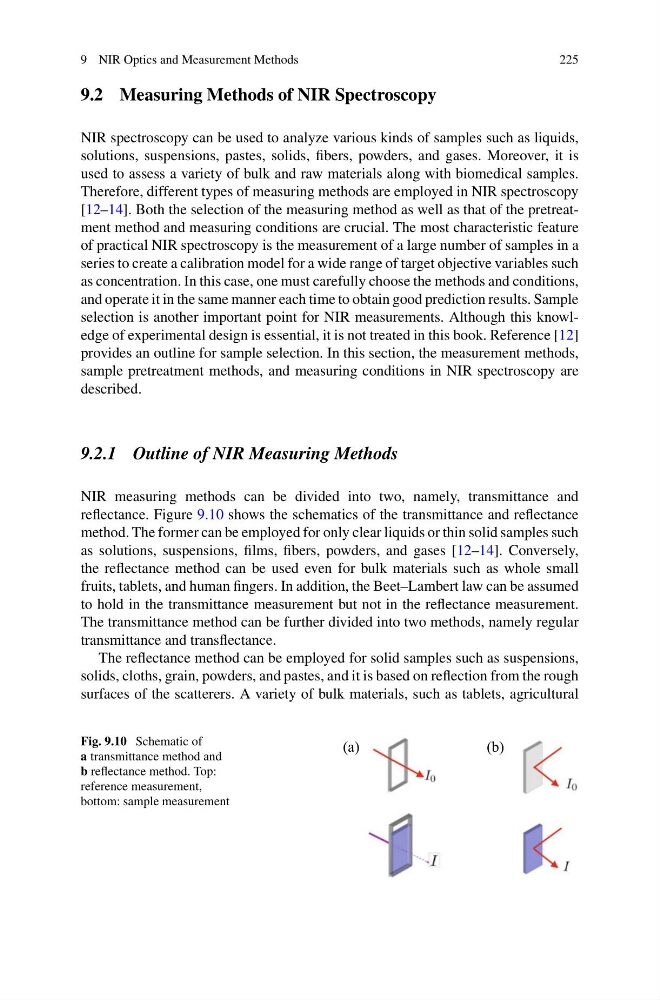
NIR measuring methods can be divided into two, namely, transmittance and
reflectance. Figure 9.10 shows the schematics of the transmittance and reflectance
method. The former can be employed for only clear liquids or thin solid samples such
as solutions, suspensions, films, fibers, powders, and gases [12–14]. Conversely,
the reflectance method can be used even for bulk materials such as whole small
fruits, tablets, and human fingers. In addition, the Beet–Lambert law can be assumed
to hold in the transmittance measurement but not in the reflectance measurement.
The transmittance method can be further divided into two methods, namely regular
transmittance and transflectance.
The reflectance method can be employed for solid samples such as suspensions,
solids, cloths, grain, powders, and pastes, and it is based on reflection from the rough
surfaces of the scatterers. A variety of bulk materials, such as tablets, agricultural
Fig. 9.10 Schematic of
a transmittance method and
b reflectance method. Top:
reference measurement,
bottom: sample measurement
(a)
(b)
225
9.2 Measuring Methods of NIR Spectroscopy
NIR spectroscopy can be used to analyze various kinds of samples such as liquids,
solutions, suspensions, pastes, solids, fibers, powders, and gases. Moreover, it is
used to assess a variety of bulk and raw materials along with biomedical samples.
Therefore, different types of measuring methods are employed in NIR spectroscopy
[12–14]. Both the selection of the measuring method as well as that of the pretreatment method and measuring conditions are crucial. The most characteristic feature
of practical NIR spectroscopy is the measurement of a large number of samples in a
series to create a calibration model for a wide range of target objective variables such
as concentration. In this case, one must carefully choose the methods and conditions,
and operate it in the same manner each time to obtain good prediction results. Sample
selection is another important point for NIR measurements. Although this knowledge of experimental design is essential, it is not treated in this book. Reference [12]
provides an outline for sample selection. In this section, the measurement methods,
sample pretreatment methods, and measuring conditions in NIR spectroscopy are
described.
9.2.1 Outline of NIR Measuring Methods
NIR measuring methods can be divided into two, namely, transmittance and
reflectance. Figure 9.10 shows the schematics of the transmittance and reflectance
method. The former can be employed for only clear liquids or thin solid samples such
as solutions, suspensions, films, fibers, powders, and gases [12–14]. Conversely,
the reflectance method can be used even for bulk materials such as whole small
fruits, tablets, and human fingers. In addition, the Beet–Lambert law can be assumed
to hold in the transmittance measurement but not in the reflectance measurement.
The transmittance method can be further divided into two methods, namely regular
transmittance and transflectance.
The reflectance method can be employed for solid samples such as suspensions,
solids, cloths, grain, powders, and pastes, and it is based on reflection from the rough
surfaces of the scatterers. A variety of bulk materials, such as tablets, agricultural
Fig. 9.10 Schematic of
a transmittance method and
b reflectance method. Top:
reference measurement,
bottom: sample measurement
(a)
(b)