

9 NIR Optics and Measurement Methods
227
of the reflectance is expressed as log(1/R). Although NIR spectrometers for practical use often output only a single absorbance spectrum, I 0 and I are independently
measured by single beam measurements in the apparatus. Note that the absorbance
in NIR spectroscopy is the ratio of two single beam measurements.
NIR spectroscopy rarely uses attenuated total reflection (ATR) optics. Such ATR
optics are used to suppress absorption that is too strong, for example, mid-IR. Thus,
ATR is normally useless in the NIR. However, it may be applied if one needs to
increase absorption. A method has been proposed in which a thin film of gold or
metal oxide is formed in the ATR configuration and the absorption signal is enhanced
by surface plasmon resonance [15]. This may be especially useful when only a small
amount of sample can be used for measurement.
9.2.1.1 Clear Liquids and Solution Samples
For clear liquids and solutions, the transmittance method is used, and for such cases,
the Beer–Lambert law can be applied except for dense solutions. It is the most
commonly employed method for a variety of spectroscopic techniques. When the
transmittance method is applied for a liquid sample, the selection of window materials
and optimum path length of a cell becomes imperative. In the selection of a window
material, its usable wavelength region, refractive index, and solubility in solvents
must be considered. Glass or quartz (fused silica) is most often employed as a window
material for the NIR region; however, they are not suitable for alkaline solutions. The
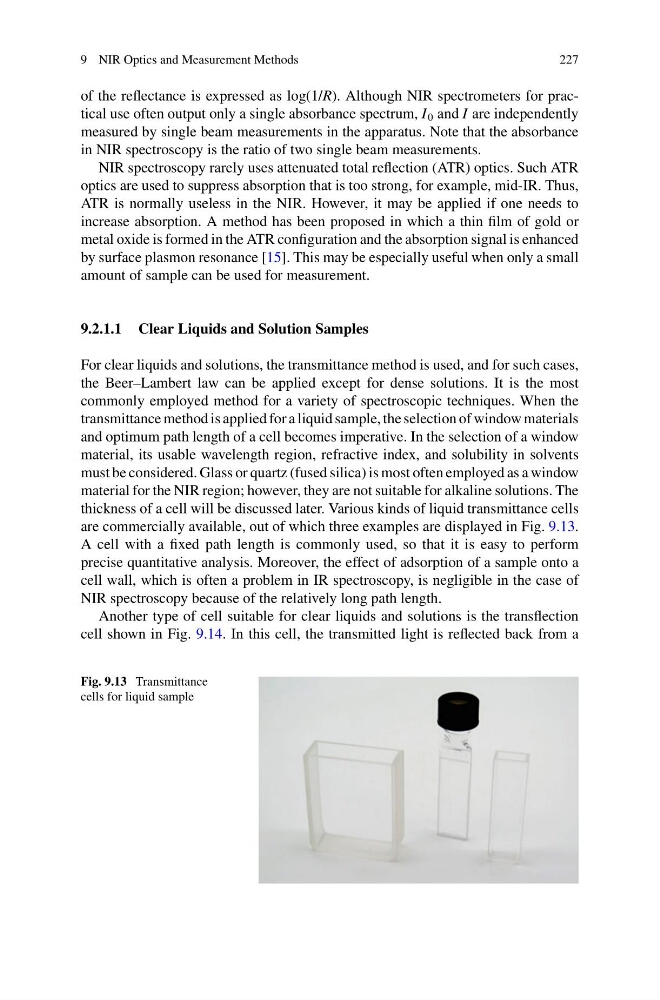
thickness of a cell will be discussed later. Various kinds of liquid transmittance cells
are commercially available, out of which three examples are displayed in Fig. 9.13.
A cell with a fixed path length is commonly used, so that it is easy to perform
precise quantitative analysis. Moreover, the effect of adsorption of a sample onto a
cell wall, which is often a problem in IR spectroscopy, is negligible in the case of
NIR spectroscopy because of the relatively long path length.
Another type of cell suitable for clear liquids and solutions is the transflection
cell shown in Fig. 9.14. In this cell, the transmitted light is reflected back from a
Fig. 9.13 Transmittance
cells for liquid sample
227
of the reflectance is expressed as log(1/R). Although NIR spectrometers for practical use often output only a single absorbance spectrum, I 0 and I are independently
measured by single beam measurements in the apparatus. Note that the absorbance
in NIR spectroscopy is the ratio of two single beam measurements.
NIR spectroscopy rarely uses attenuated total reflection (ATR) optics. Such ATR
optics are used to suppress absorption that is too strong, for example, mid-IR. Thus,
ATR is normally useless in the NIR. However, it may be applied if one needs to
increase absorption. A method has been proposed in which a thin film of gold or
metal oxide is formed in the ATR configuration and the absorption signal is enhanced
by surface plasmon resonance [15]. This may be especially useful when only a small
amount of sample can be used for measurement.
9.2.1.1 Clear Liquids and Solution Samples
For clear liquids and solutions, the transmittance method is used, and for such cases,
the Beer–Lambert law can be applied except for dense solutions. It is the most
commonly employed method for a variety of spectroscopic techniques. When the
transmittance method is applied for a liquid sample, the selection of window materials
and optimum path length of a cell becomes imperative. In the selection of a window
material, its usable wavelength region, refractive index, and solubility in solvents
must be considered. Glass or quartz (fused silica) is most often employed as a window
material for the NIR region; however, they are not suitable for alkaline solutions. The
thickness of a cell will be discussed later. Various kinds of liquid transmittance cells
are commercially available, out of which three examples are displayed in Fig. 9.13.
A cell with a fixed path length is commonly used, so that it is easy to perform
precise quantitative analysis. Moreover, the effect of adsorption of a sample onto a
cell wall, which is often a problem in IR spectroscopy, is negligible in the case of
NIR spectroscopy because of the relatively long path length.
Another type of cell suitable for clear liquids and solutions is the transflection
cell shown in Fig. 9.14. In this cell, the transmitted light is reflected back from a
Fig. 9.13 Transmittance
cells for liquid sample