

220
A. Ikehata
(b)
White light
Monochromatic light
2D sensor array
(a)
Single sensor
CVF
White light
Monochromatic light
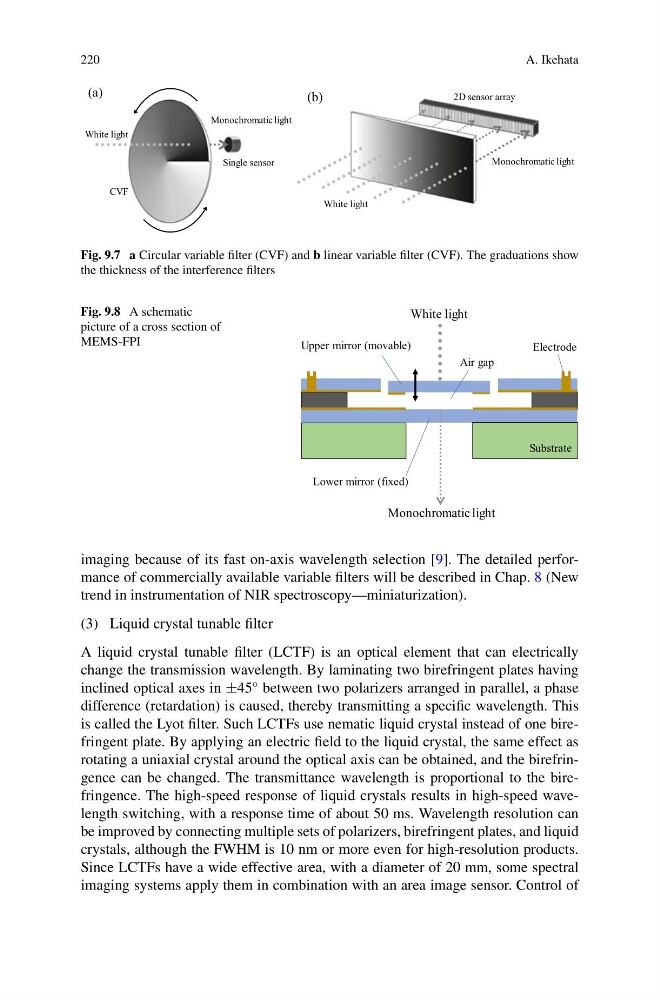
Fig. 9.7 a Circular variable filter (CVF) and b linear variable filter (CVF). The graduations show
the thickness of the interference filters
Fig. 9.8 A schematic
picture of a cross section of
MEMS-FPI
Electrode
Upper mirror (movable)
Lower mirror (fixed)
Air gap
Substrate
White light
Monochromatic light
imaging because of its fast on-axis wavelength selection [9]. The detailed performance of commercially available variable filters will be described in Chap. 8 (New
trend in instrumentation of NIR spectroscopy—miniaturization).
(3) Liquid crystal tunable filter
A liquid crystal tunable filter (LCTF) is an optical element that can electrically
change the transmission wavelength. By laminating two birefringent plates having
inclined optical axes in ±45° between two polarizers arranged in parallel, a phase
difference (retardation) is caused, thereby transmitting a specific wavelength. This
is called the Lyot filter. Such LCTFs use nematic liquid crystal instead of one birefringent plate. By applying an electric field to the liquid crystal, the same effect as
rotating a uniaxial crystal around the optical axis can be obtained, and the birefringence can be changed. The transmittance wavelength is proportional to the birefringence. The high-speed response of liquid crystals results in high-speed wavelength switching, with a response time of about 50 ms. Wavelength resolution can
be improved by connecting multiple sets of polarizers, birefringent plates, and liquid
crystals, although the FWHM is 10 nm or more even for high-resolution products.
Since LCTFs have a wide effective area, with a diameter of 20 mm, some spectral
imaging systems apply them in combination with an area image sensor. Control of
A. Ikehata
(b)
White light
Monochromatic light
2D sensor array
(a)
Single sensor
CVF
White light
Monochromatic light
Fig. 9.7 a Circular variable filter (CVF) and b linear variable filter (CVF). The graduations show
the thickness of the interference filters
Fig. 9.8 A schematic
picture of a cross section of
MEMS-FPI
Electrode
Upper mirror (movable)
Lower mirror (fixed)
Air gap
Substrate
White light
Monochromatic light
imaging because of its fast on-axis wavelength selection [9]. The detailed performance of commercially available variable filters will be described in Chap. 8 (New
trend in instrumentation of NIR spectroscopy—miniaturization).
(3) Liquid crystal tunable filter
A liquid crystal tunable filter (LCTF) is an optical element that can electrically
change the transmission wavelength. By laminating two birefringent plates having
inclined optical axes in ±45° between two polarizers arranged in parallel, a phase
difference (retardation) is caused, thereby transmitting a specific wavelength. This
is called the Lyot filter. Such LCTFs use nematic liquid crystal instead of one birefringent plate. By applying an electric field to the liquid crystal, the same effect as
rotating a uniaxial crystal around the optical axis can be obtained, and the birefringence can be changed. The transmittance wavelength is proportional to the birefringence. The high-speed response of liquid crystals results in high-speed wavelength switching, with a response time of about 50 ms. Wavelength resolution can
be improved by connecting multiple sets of polarizers, birefringent plates, and liquid
crystals, although the FWHM is 10 nm or more even for high-resolution products.
Since LCTFs have a wide effective area, with a diameter of 20 mm, some spectral
imaging systems apply them in combination with an area image sensor. Control of