

9 NIR Optics and Measurement Methods
221
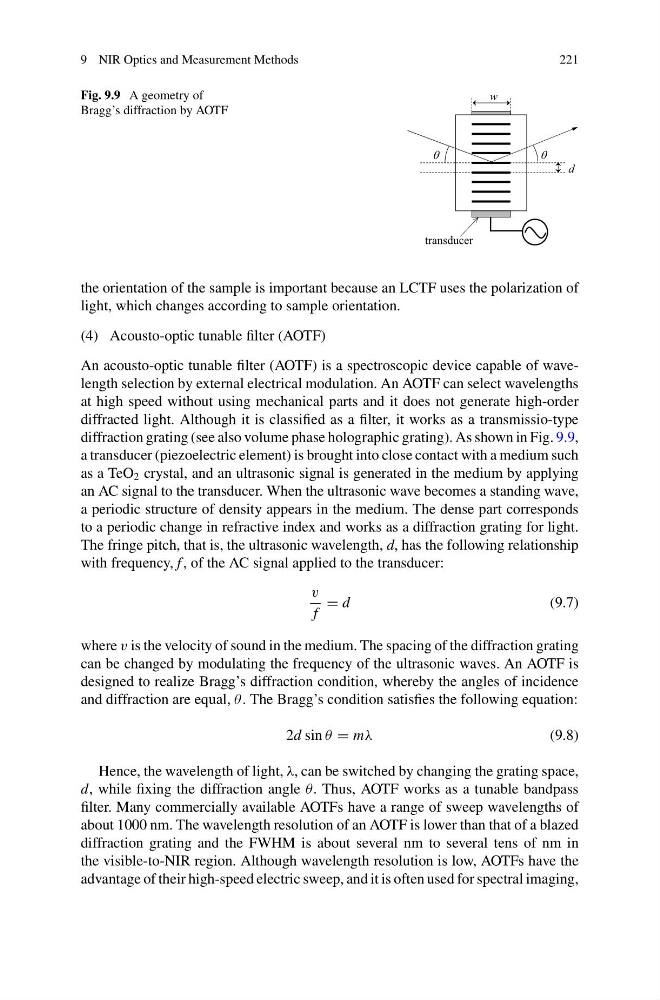
Fig. 9.9 A geometry of
Bragg’s diffraction by AOTF
d
transducer
w
the orientation of the sample is important because an LCTF uses the polarization of
light, which changes according to sample orientation.
(4) Acousto-optic tunable filter (AOTF)
An acousto-optic tunable filter (AOTF) is a spectroscopic device capable of wavelength selection by external electrical modulation. An AOTF can select wavelengths
at high speed without using mechanical parts and it does not generate high-order
diffracted light. Although it is classified as a filter, it works as a transmissio-type
diffraction grating (see also volume phase holographic grating). As shown in Fig. 9.9,
a transducer (piezoelectric element) is brought into close contact with a medium such
as a TeO 2 crystal, and an ultrasonic signal is generated in the medium by applying
an AC signal to the transducer. When the ultrasonic wave becomes a standing wave,
a periodic structure of density appears in the medium. The dense part corresponds
to a periodic change in refractive index and works as a diffraction grating for light.
The fringe pitch, that is, the ultrasonic wavelength, d, has the following relationship
with frequency, f , of the AC signal applied to the transducer:
v
f
= d
(9.7)
where v is the velocity of sound in the medium. The spacing of the diffraction grating
can be changed by modulating the frequency of the ultrasonic waves. An AOTF is
designed to realize Bragg’s diffraction condition, whereby the angles of incidence
and diffraction are equal, θ . The Bragg’s condition satisfies the following equation:
2d sin θ = mλ
(9.8)
Hence, the wavelength of light, λ, can be switched by changing the grating space,
d, while fixing the diffraction angle θ. Thus, AOTF works as a tunable bandpass
filter. Many commercially available AOTFs have a range of sweep wavelengths of
about 1000 nm. The wavelength resolution of an AOTF is lower than that of a blazed
diffraction grating and the FWHM is about several nm to several tens of nm in
the visible-to-NIR region. Although wavelength resolution is low, AOTFs have the
advantage of their high-speed electric sweep, and it is often used for spectral imaging,
221
Fig. 9.9 A geometry of
Bragg’s diffraction by AOTF
d
transducer
w
the orientation of the sample is important because an LCTF uses the polarization of
light, which changes according to sample orientation.
(4) Acousto-optic tunable filter (AOTF)
An acousto-optic tunable filter (AOTF) is a spectroscopic device capable of wavelength selection by external electrical modulation. An AOTF can select wavelengths
at high speed without using mechanical parts and it does not generate high-order
diffracted light. Although it is classified as a filter, it works as a transmissio-type
diffraction grating (see also volume phase holographic grating). As shown in Fig. 9.9,
a transducer (piezoelectric element) is brought into close contact with a medium such
as a TeO 2 crystal, and an ultrasonic signal is generated in the medium by applying
an AC signal to the transducer. When the ultrasonic wave becomes a standing wave,
a periodic structure of density appears in the medium. The dense part corresponds
to a periodic change in refractive index and works as a diffraction grating for light.
The fringe pitch, that is, the ultrasonic wavelength, d, has the following relationship
with frequency, f , of the AC signal applied to the transducer:
v
f
= d
(9.7)
where v is the velocity of sound in the medium. The spacing of the diffraction grating
can be changed by modulating the frequency of the ultrasonic waves. An AOTF is
designed to realize Bragg’s diffraction condition, whereby the angles of incidence
and diffraction are equal, θ . The Bragg’s condition satisfies the following equation:
2d sin θ = mλ
(9.8)
Hence, the wavelength of light, λ, can be switched by changing the grating space,
d, while fixing the diffraction angle θ. Thus, AOTF works as a tunable bandpass
filter. Many commercially available AOTFs have a range of sweep wavelengths of
about 1000 nm. The wavelength resolution of an AOTF is lower than that of a blazed
diffraction grating and the FWHM is about several nm to several tens of nm in
the visible-to-NIR region. Although wavelength resolution is low, AOTFs have the
advantage of their high-speed electric sweep, and it is often used for spectral imaging,