

218
A. Ikehata
Fourier transform spectrometers with excellent features were relatively large and
expensive in the early years of development. Consequently, they were often used
only in research laboratories. However, because the high wavenumber resolution is
not always necessary in the NIR region, the movable range of the movable mirror
can be reduced and miniaturization is now progressing. In recent years, devices with
a single-chip interferometer based on micro-electro-mechanical systems (MEMS)
technology have been released, and portable FT-NIR spectrometers using this device
are also commercially available [7, 8].
9.1.3.4 Bandpass Filters
The filters discussed here are bandpass filters that transmit only light of a specific
wavelength, such as interference filters and liquid crystal filters.
(1) Interference filter
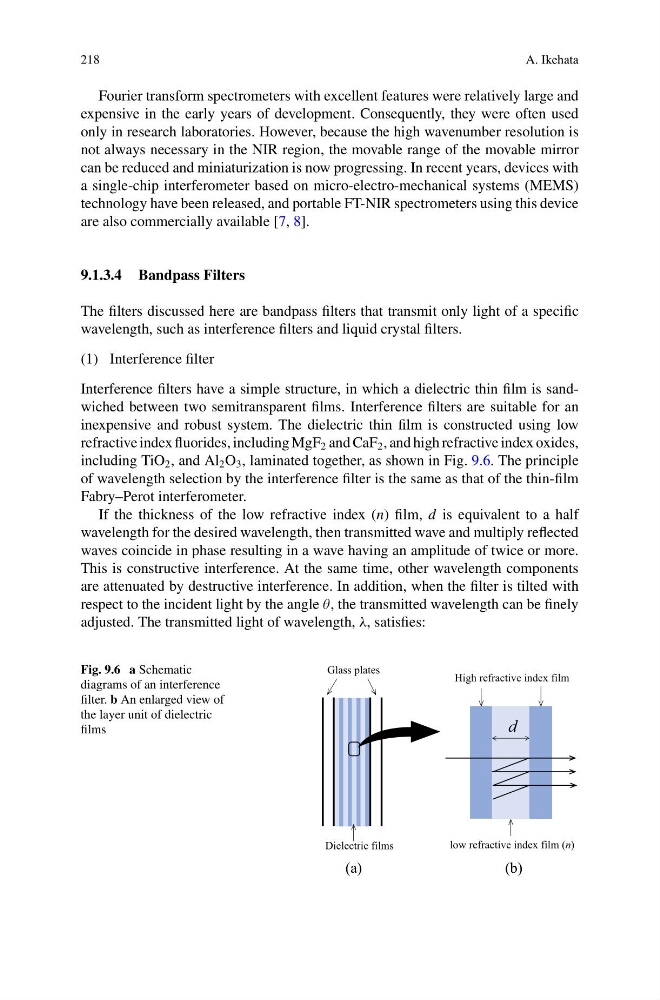
Interference filters have a simple structure, in which a dielectric thin film is sandwiched between two semitransparent films. Interference filters are suitable for an
inexpensive and robust system. The dielectric thin film is constructed using low
refractive index fluorides, including MgF 2 and CaF 2 , and high refractive index oxides,
including TiO 2 , and Al 2 O 3 , laminated together, as shown in Fig. 9.6. The principle
of wavelength selection by the interference filter is the same as that of the thin-film
Fabry–Perot interferometer.
If the thickness of the low refractive index (n) film, d is equivalent to a half
wavelength for the desired wavelength, then transmitted wave and multiply reflected
waves coincide in phase resulting in a wave having an amplitude of twice or more.
This is constructive interference. At the same time, other wavelength components
are attenuated by destructive interference. In addition, when the filter is tilted with
respect to the incident light by the angle θ, the transmitted wavelength can be finely
adjusted. The transmitted light of wavelength, λ, satisfies:
Fig. 9.6 a Schematic
diagrams of an interference
filter. b An enlarged view of
the layer unit of dielectric
films
d
High refractive index film
Dielectric films
Glass plates
low refractive index film (n)
(a)
(b)
A. Ikehata
Fourier transform spectrometers with excellent features were relatively large and
expensive in the early years of development. Consequently, they were often used
only in research laboratories. However, because the high wavenumber resolution is
not always necessary in the NIR region, the movable range of the movable mirror
can be reduced and miniaturization is now progressing. In recent years, devices with
a single-chip interferometer based on micro-electro-mechanical systems (MEMS)
technology have been released, and portable FT-NIR spectrometers using this device
are also commercially available [7, 8].
9.1.3.4 Bandpass Filters
The filters discussed here are bandpass filters that transmit only light of a specific
wavelength, such as interference filters and liquid crystal filters.
(1) Interference filter
Interference filters have a simple structure, in which a dielectric thin film is sandwiched between two semitransparent films. Interference filters are suitable for an
inexpensive and robust system. The dielectric thin film is constructed using low
refractive index fluorides, including MgF 2 and CaF 2 , and high refractive index oxides,
including TiO 2 , and Al 2 O 3 , laminated together, as shown in Fig. 9.6. The principle
of wavelength selection by the interference filter is the same as that of the thin-film
Fabry–Perot interferometer.
If the thickness of the low refractive index (n) film, d is equivalent to a half
wavelength for the desired wavelength, then transmitted wave and multiply reflected
waves coincide in phase resulting in a wave having an amplitude of twice or more.
This is constructive interference. At the same time, other wavelength components
are attenuated by destructive interference. In addition, when the filter is tilted with
respect to the incident light by the angle θ, the transmitted wavelength can be finely
adjusted. The transmitted light of wavelength, λ, satisfies:
Fig. 9.6 a Schematic
diagrams of an interference
filter. b An enlarged view of
the layer unit of dielectric
films
d
High refractive index film
Dielectric films
Glass plates
low refractive index film (n)
(a)
(b)