

9 NIR Optics and Measurement Methods
217
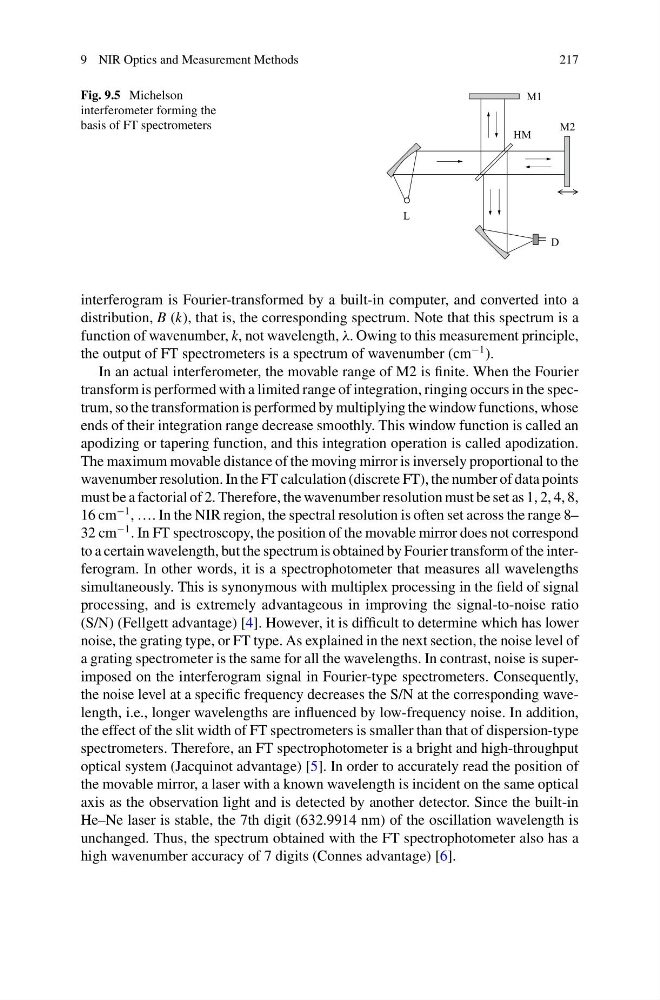
Fig. 9.5 Michelson
interferometer forming the
basis of FT spectrometers
L
HM
M1
M2
D
interferogram is Fourier-transformed by a built-in computer, and converted into a
distribution, B (k), that is, the corresponding spectrum. Note that this spectrum is a
function of wavenumber, k, not wavelength, λ. Owing to this measurement principle,
the output of FT spectrometers is a spectrum of wavenumber (cm
−1 ).
In an actual interferometer, the movable range of M2 is finite. When the Fourier
transform is performed with a limited range of integration, ringing occurs in the spectrum, so the transformation is performed by multiplying the window functions, whose
ends of their integration range decrease smoothly. This window function is called an
apodizing or tapering function, and this integration operation is called apodization.
The maximum movable distance of the moving mirror is inversely proportional to the
wavenumber resolution. In the FT calculation (discrete FT), the number of data points
must be a factorial of 2. Therefore, the wavenumber resolution must be set as 1, 2, 4, 8,
16 cm
−1 , …. In the NIR region, the spectral resolution is often set across the range 8–
32 cm
−1 . In FT spectroscopy, the position of the movable mirror does not correspond
to a certain wavelength, but the spectrum is obtained by Fourier transform of the interferogram. In other words, it is a spectrophotometer that measures all wavelengths
simultaneously. This is synonymous with multiplex processing in the field of signal
processing, and is extremely advantageous in improving the signal-to-noise ratio
(S/N) (Fellgett advantage) [4]. However, it is difficult to determine which has lower
noise, the grating type, or FT type. As explained in the next section, the noise level of
a grating spectrometer is the same for all the wavelengths. In contrast, noise is superimposed on the interferogram signal in Fourier-type spectrometers. Consequently,
the noise level at a specific frequency decreases the S/N at the corresponding wavelength, i.e., longer wavelengths are influenced by low-frequency noise. In addition,
the effect of the slit width of FT spectrometers is smaller than that of dispersion-type
spectrometers. Therefore, an FT spectrophotometer is a bright and high-throughput
optical system (Jacquinot advantage) [5]. In order to accurately read the position of
the movable mirror, a laser with a known wavelength is incident on the same optical
axis as the observation light and is detected by another detector. Since the built-in
He–Ne laser is stable, the 7th digit (632.9914 nm) of the oscillation wavelength is
unchanged. Thus, the spectrum obtained with the FT spectrophotometer also has a
high wavenumber accuracy of 7 digits (Connes advantage) [6].
217
Fig. 9.5 Michelson
interferometer forming the
basis of FT spectrometers
L
HM
M1
M2
D
interferogram is Fourier-transformed by a built-in computer, and converted into a
distribution, B (k), that is, the corresponding spectrum. Note that this spectrum is a
function of wavenumber, k, not wavelength, λ. Owing to this measurement principle,
the output of FT spectrometers is a spectrum of wavenumber (cm
−1 ).
In an actual interferometer, the movable range of M2 is finite. When the Fourier
transform is performed with a limited range of integration, ringing occurs in the spectrum, so the transformation is performed by multiplying the window functions, whose
ends of their integration range decrease smoothly. This window function is called an
apodizing or tapering function, and this integration operation is called apodization.
The maximum movable distance of the moving mirror is inversely proportional to the
wavenumber resolution. In the FT calculation (discrete FT), the number of data points
must be a factorial of 2. Therefore, the wavenumber resolution must be set as 1, 2, 4, 8,
16 cm
−1 , …. In the NIR region, the spectral resolution is often set across the range 8–
32 cm
−1 . In FT spectroscopy, the position of the movable mirror does not correspond
to a certain wavelength, but the spectrum is obtained by Fourier transform of the interferogram. In other words, it is a spectrophotometer that measures all wavelengths
simultaneously. This is synonymous with multiplex processing in the field of signal
processing, and is extremely advantageous in improving the signal-to-noise ratio
(S/N) (Fellgett advantage) [4]. However, it is difficult to determine which has lower
noise, the grating type, or FT type. As explained in the next section, the noise level of
a grating spectrometer is the same for all the wavelengths. In contrast, noise is superimposed on the interferogram signal in Fourier-type spectrometers. Consequently,
the noise level at a specific frequency decreases the S/N at the corresponding wavelength, i.e., longer wavelengths are influenced by low-frequency noise. In addition,
the effect of the slit width of FT spectrometers is smaller than that of dispersion-type
spectrometers. Therefore, an FT spectrophotometer is a bright and high-throughput
optical system (Jacquinot advantage) [5]. In order to accurately read the position of
the movable mirror, a laser with a known wavelength is incident on the same optical
axis as the observation light and is detected by another detector. Since the built-in
He–Ne laser is stable, the 7th digit (632.9914 nm) of the oscillation wavelength is
unchanged. Thus, the spectrum obtained with the FT spectrophotometer also has a
high wavenumber accuracy of 7 digits (Connes advantage) [6].